
Guides · Lawn care · Published November 15, 2026
Lawn Grubs: Signs of Damage and the Only Treatment Windows That Work
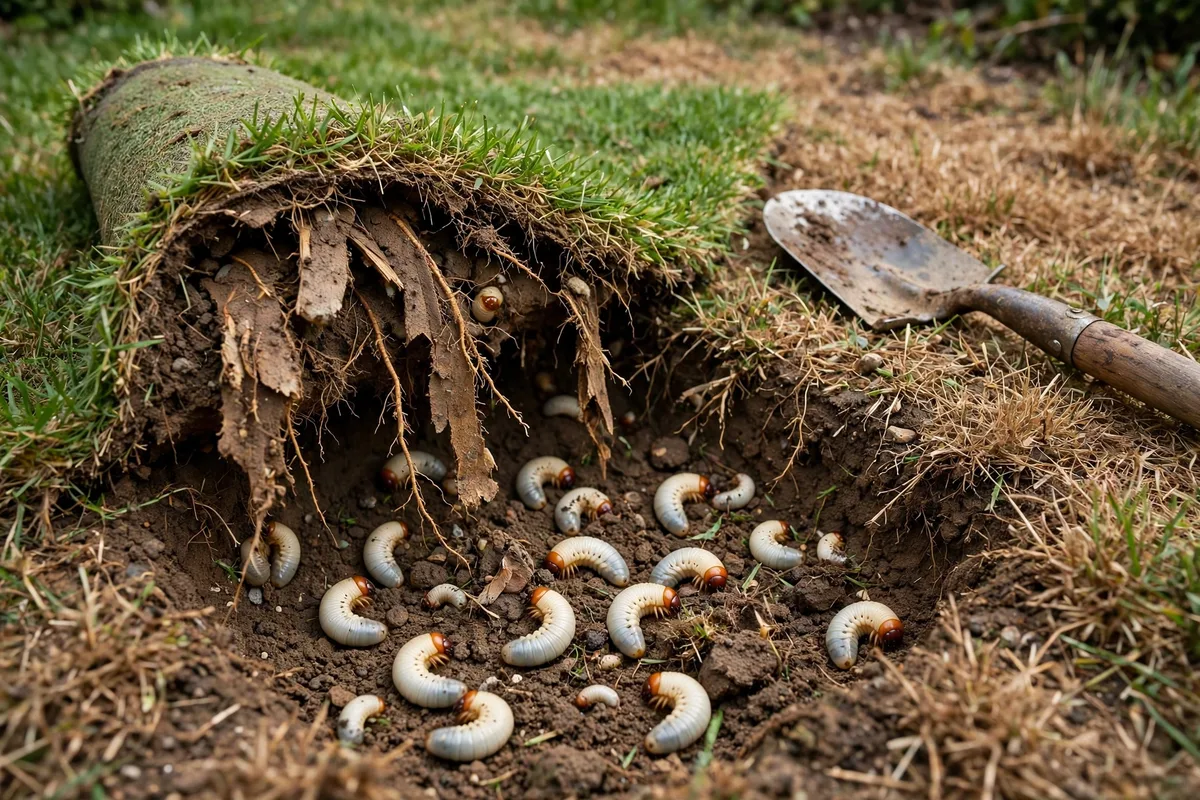
Grubs in lawn grass are the white, C-shaped larvae of scarab beetles — June beetles, Japanese beetles, chafers — feeding on grass roots a couple of inches under the surface. A few grubs are a normal part of a living lawn and do no visible harm. A crowd of them severs the roots until the turf starves in the middle of plenty, and then skunks and birds arrive to tear up the buffet. Most grub treatments fail for one boring reason: they are applied when the grubs are too big, too deep, or not there at all. This page gives you the signs, the count that separates "leave it" from "treat it," and the only two windows in the year when treatment actually works.
Step 1 — Confirm it is grubs: spongy turf and the peel-back test
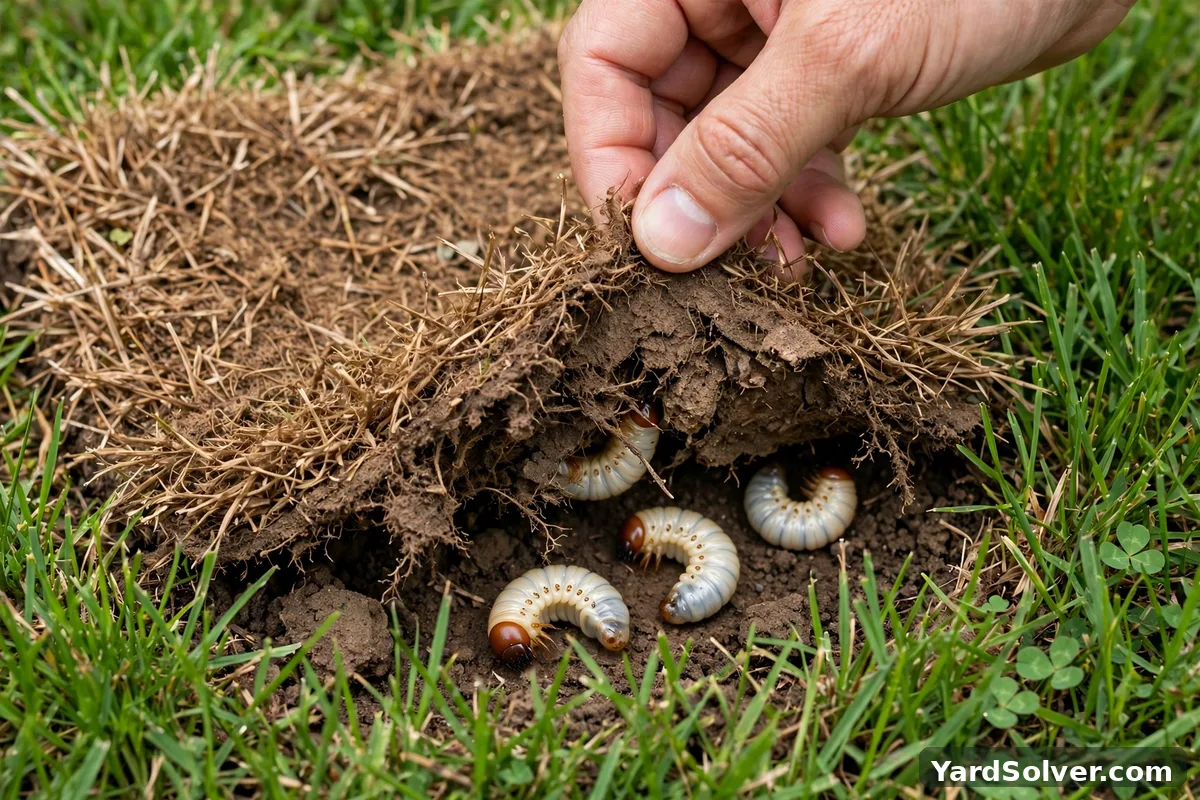
The classic sign is a patch of lawn that browns in late summer or fall despite adequate water, feels spongy underfoot, and — the giveaway — peels back like a carpet when you tug it, because there are no roots left holding it down. Cut three sides of a square foot of turf at the edge of a damaged patch and fold it back. Grubs sit right in the root zone, fat, white and curled in a C. Count them. Under about five per square foot, a healthy lawn usually tolerates them — water and wait. Around ten or more per square foot, or fewer with visible damage on a stressed lawn, treatment is worth it. Secondary evidence: birds pecking methodically at one area, and skunk or raccoon digging overnight — the animals are better grub detectors than we are, and their digging often does more visible damage than the grubs.
Rule out the lookalikes first: the diagnosis walk in Brown Spots in Your Lawn separates grub damage from drought, fungus and urine burn with the same tug test, and it is worth five minutes before you spend anything.
Step 2 — Learn the life cycle, because timing is everything
Adult beetles lay eggs in the lawn in early to mid-summer. The eggs hatch in a few weeks into tiny grubs that feed near the surface through late summer and fall — this is when they do most of their damage, and when they are smallest and most vulnerable. As soil cools, they burrow deep and overwinter. In spring they come up, feed briefly, then pupate and stop feeding — big, fat, and largely indifferent to treatments. That cycle creates exactly two useful windows. The preventive window runs from late spring into early summer, when products based on chlorantraniliprole (and similar season-long preventives) are applied before or just as eggs hatch, so the young grubs meet the treatment as they start feeding. The curative window runs from late summer into fall, when grubs are small, near the surface and feeding hard — fast-acting curative products and biological controls work now. Outside those windows — spring, against big pre-pupation grubs — most products disappoint, and the honest treatment is water, patience and a fall plan.
Step 3 — Treat in the window: products in the US, nematodes in Canada
In the US, choose by window: a preventive product in late spring or early summer if grubs have been a proven, recurring problem, or a curative product in late summer/fall when your square-foot count says treat. Read the label for the active ingredient and the target pest, apply at the label rate, and water it in — grub products must reach the root zone, not sit on the blades.

Canada changes the menu. Most cosmetic grub insecticides are banned for home lawn use in Ontario and restricted in many other provinces and municipalities, which is why the standard Canadian route is biological: beneficial nematodes (microscopic worms, usually Heterorhabditis bacteriophora for grubs) applied in the late-summer curative window. Nematodes are living creatures and the method is fussy in specific ways: buy them fresh and refrigerated, apply in the evening or on a cloudy day because UV kills them, keep the lawn moist for a week or two afterwards so they can move through the soil, and make sure the soil is warm — they work best above about 15°C (60°F). Milky spore, often recommended in older US books, is specific to Japanese beetle grubs and unreliable in cold Canadian soils, so it is not the northern answer. Whichever route you take, treat the whole affected area plus a margin — grubs do not respect the visible edge of the patch.
Step 4 — Repair the damage and make the lawn grub-resistant
Dead, rootless turf does not come back. Rake it out, and reseed or re-sod the patch: small areas take seed well in the fall window (the same weeks as curative treatment, conveniently), and the Seed Calculator sizes seed for the patch while the Sod Calculator does the same for sod if the area is large or you need it closed fast. Keep repairs moist until established.
Long term, the lawns that shrug off grubs share three traits: they are watered deeply and infrequently so roots run deep (a deep root system feeds more grubs without showing it), they are mowed high — 3 inches or more — which also shades the soil against egg-laying beetles, and they are fed at measured rates rather than pushed soft. It is also worth knowing that grubs are a garden-wide fact, not just a lawn one: the same beetle family sends adults to feed on roses and fruit, and larvae turn up in vegetable beds — gardeners digging zucchini beds in spring meet the same white C, and in beds the answer is simply to pick them out for the birds.
Keep going
Not sure the brown patch is grubs at all? The sorting guide is Brown Spots in Your Lawn: 7 Causes and How to Tell Them Apart — five minutes with the tug and screwdriver tests before any purchase.
Grub windows, seeding windows and feeding dates all live on the same calendar — the Garden Planner builds yours from your frost dates so the fall curative window does not sneak past.
Questions people ask
What month is best to treat lawn grubs?
It depends on the approach. Preventive products go down in late spring to early summer, around egg-laying and hatch. Curative treatments — including beneficial nematodes in Canada — work best from late summer into fall, when grubs are small, feeding near the surface and vulnerable. The worst time is spring, when the big overwintered grubs are about to pupate and barely feed; most products fail then no matter what the bag promises.
How many grubs per square foot is a problem?
As a working threshold: under about five grubs per square foot, a healthy, well-watered lawn usually shows no damage and needs no treatment. Around ten or more per square foot — or fewer on a lawn already stressed by drought or heat — damage is likely and treatment in the right window is worth it. Always count in a square foot cut at the edge of a damaged patch, where the grubs are actively feeding.
Do beneficial nematodes really work on grubs?
Yes, when the method is followed — they are the standard route in Canada, where most cosmetic grub insecticides are restricted. The failures usually trace to handling: nematodes that sat warm on a shelf, application in bright sun (UV kills them), dry soil afterwards, or soil too cold for them to hunt. Applied fresh on a cloudy evening to moist soil above about 15°C, and kept moist for a week or two, they parasitize grubs in the root zone effectively.
Comments & ratings
No comments yet.
Be the first to share your experience.