
Guides · Seed starting · Published November 10, 2026
Chitting Potatoes: Sprout Seed Potatoes Before Planting
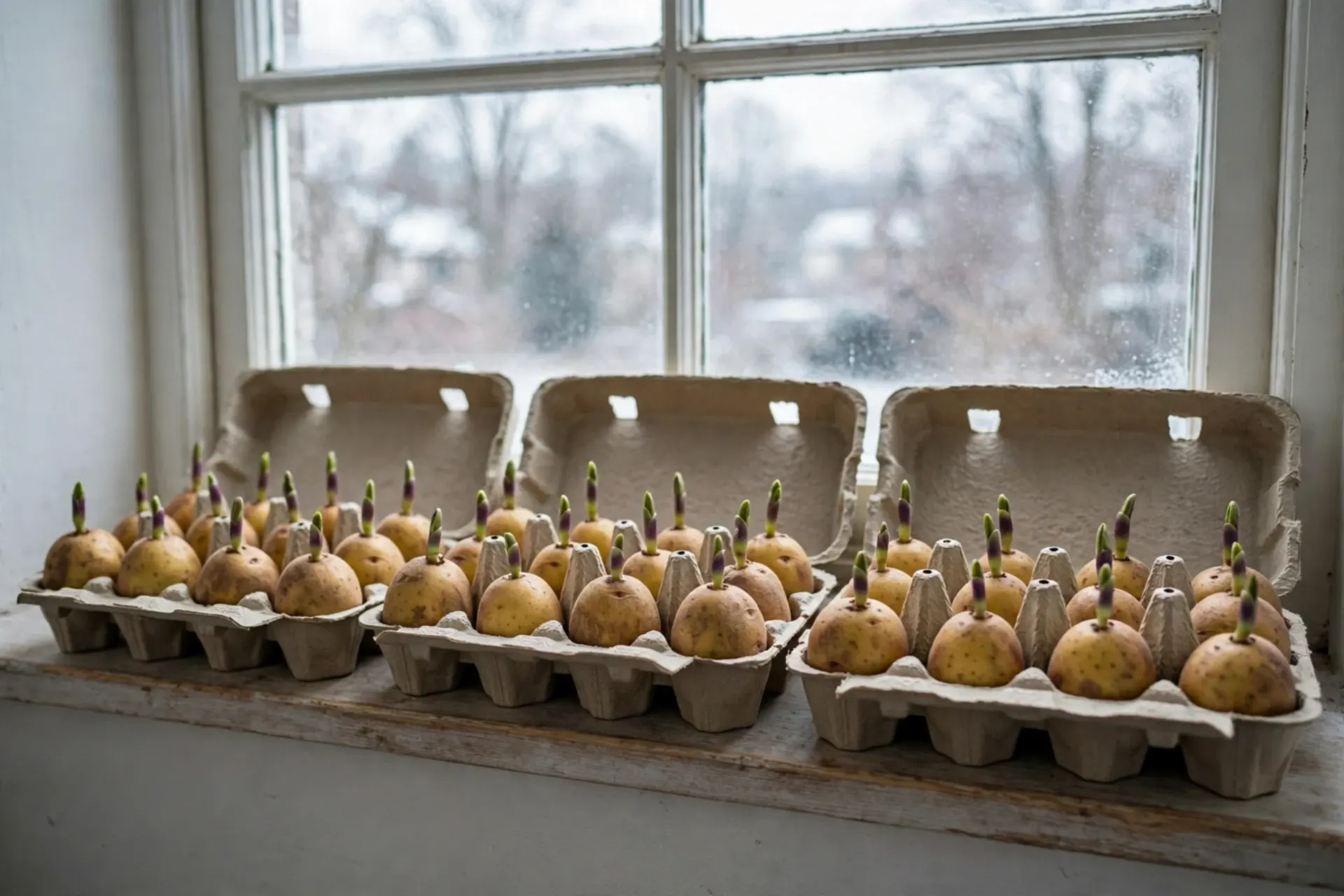
Potatoes planted cold and dark spend their first weeks doing underground what they could have done on your windowsill. Chitting is simply giving them that time indoors first: stand the seed potatoes in egg cartons in a cool, bright place, and they wake up and grow short, sturdy sprouts before they ever touch soil. Sprouted seed goes in ready to run — it emerges days sooner, grows evenly, and gives short-season gardens back a week or more at the harvest end. It costs nothing but a few egg cartons and some patience. Here is the whole process.
Good sprouts vs bad sprouts
| What you want | What to avoid | |
|---|---|---|
| Length | ½ to 1 inch | Long shoots over an inch — they snap at planting |
| Colour | Dark green or purple | Pale white — the sign of darkness |
| Build | Short, thick, knobbly | Thin and stringy |
| Cause | Bright light, cool room at 50–60°F | A warm dark cupboard |
Light is the whole secret. The same potato that grows weak white ropes in a dark drawer grows tough little stubs on a bright sill — and stubs survive planting, ropes often do not.
Step 1 — Start 4 to 6 weeks before planting day
Count backwards. Most gardeners plant potatoes two to three weeks before the last spring frost, once the soil has warmed to about 45°F and dried enough to work — your own dates are in the Planting Calendar. Start chitting four to six weeks before that planting day: for an early-April planting, the cartons come out in late February. Earlies need nearer four weeks, maincrop varieties the full six. There is no rush and no penalty for being a week early — if planting day slips, moving the trays somewhere cooler, near 45°F, politely pauses the sprouts.
Step 2 — Buy certified seed potatoes
Start with proper seed potatoes, not the eating kind from a store shelf. Certified seed is grown and inspected to be disease-free, and potato diseases are the lasting kind — some stay in your soil for years once they arrive. Supermarket potatoes are also often treated to hold back sprouting, so they chit slowly and unevenly even when they are healthy. Pick varieties for your season and your kitchen from the Potato plant page, and order early: the popular varieties sell out by mid-winter, which is exactly when you want them on the sill.
Step 3 — Stand them rose-end up in egg cartons
Look at a seed potato closely and you will see the eyes are not spread evenly: most of them cluster at one end, the rose end, while the other end carries one small scar where the potato hung from the plant. Stand each potato in an egg-carton cup with the rose end up and the scar end down, one per cup, not touching its neighbours. The carton holds them upright, keeps them apart, and lets light and air reach all sides. Shallow trays or seed trays do the same job if the egg cartons ran out.
Step 4 — Keep them cool, bright and frost-free
Set the cartons where they get plenty of bright, indirect daylight and the temperature sits around 50 to 60°F — a windowsill in an unheated room, a porch, a cool spare bedroom. Bright light keeps the sprouts short and turns them green or purple, which toughens them for planting. Warmth is the enemy: a cosy room pushes soft, fast growth, and a dark one gives you the long white ropes in the table above. Never let the trays freeze — if a hard night threatens an unheated porch, throw a blanket over the cartons or bring them in for the night. Do not water them. A seed potato carries all the moisture it needs inside itself. Turn each tray around every few days so the sprouts grow straight instead of leaning to the glass.
Step 5 — Plant them sprouts-up, gently
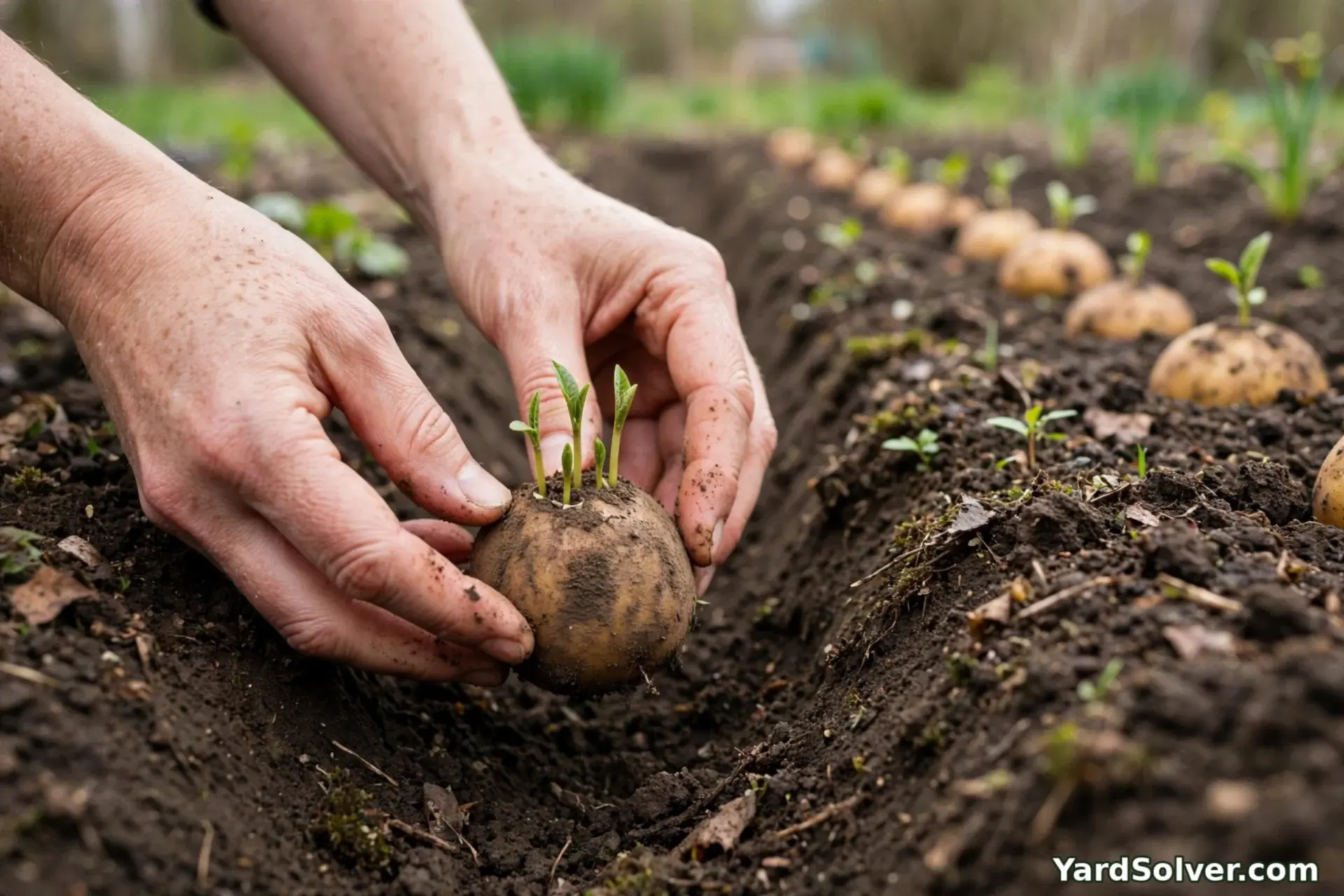
When the sprouts are short, thick and dark — ½ to 1 inch — and the soil is workable, plant. Dig a trench about 4 to 6 inches deep, set the potatoes sprouts-up along it about 12 inches apart with rows 2 to 3 feet apart, and cover them with care: those sprouts are the whole point of the last six weeks, and they snap if you are rough. The Plant Spacing Calculator lays out exactly how many seed potatoes a bed or row of any size needs. From here the crop follows the normal rhythm — earth up as the stems grow, water in dry spells, dig when the tops die back. If bags are your method instead of trenches, How to Grow Potatoes in Bags picks the story up from planting day — chitted seed goes into bags exactly the same way.
Keep going
Planting day, the bag way: How to Grow Potatoes in Bags — filling, earthing up in a bag, and the harvest tip-out.
Varieties, timing and care for the whole crop: the Potato plant page.
Questions people ask
Do I have to chit potatoes, or can I plant them straight away?
You can plant them straight from the bag and they will grow — potatoes are forgiving. Chitting earns its keep in short seasons and cold soil: sprouted seed emerges days sooner and more evenly, which can mean a week or more of extra growing at the harvest end. For early varieties especially, it is the cheapest head start in gardening.
My sprouts grew long and white. Are the potatoes ruined?
Not ruined, but handle them like glass — long white sprouts come from warmth and darkness, and they snap at a touch. Move the trays somewhere cooler and brighter today to stop them stretching further. At planting, lay them in the trench with great care, or rub a long sprout off and let the eye grow a fresh, sturdier one if there is still time. Next year, more light and less heat is the whole cure.
Can I chit supermarket potatoes?
They will sprout, but it is a false saving. Eating potatoes can carry diseases that stay in your soil for years, and many are treated to delay sprouting, so results are patchy. Certified seed potatoes cost little, are grown to be disease-free, and are named varieties you chose on purpose. Buy seed.
How do I know which end of the potato goes up?
Look at both ends. One end — the rose end — carries a cluster of most of the eyes, and those eyes are where the sprouts grow. The other end has a single small scar where the potato hung from the plant. Stand the potato scar-end down in its egg cup and the rose end up, and the sprouts rise straight toward the light.
Comments & ratings
No comments yet.
Be the first to share your experience.