
Guides · Edging & Borders · Published November 12, 2026
How Many Bricks Do I Need for Garden Edging? It Depends How the Brick Sits
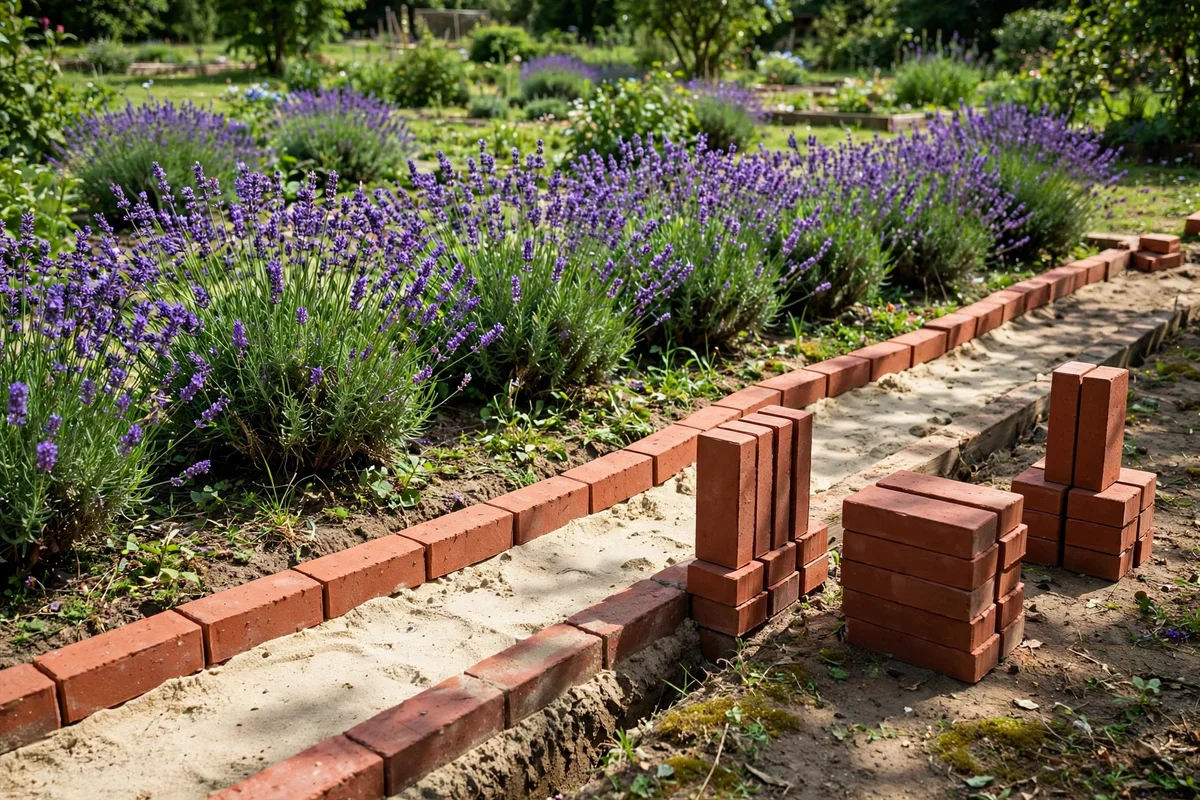
Search this question and the answers fight each other: one page says a brick covers a foot and a half of border per brick laid flat, another says 3 bricks per foot, a third claims 8 to 12 per foot. They cannot all be right — and yet each is the honest count for somebody's edging, because the answer is decided by one thing most guides never state: which way the brick sits. A standard brick is 7⅝ inches long, 3⅝ wide and 2¼ thick, and each orientation spends a different one of those dimensions along your border. The same 24-foot run around a 4×8 bed needs 36 bricks laid flat — or 110 standing upright. Here are all four common styles, verified, with the counts per foot and for real borders.
The short answers
- Laid flat: 1.5 bricks per foot — a 24 ft bed border needs 36 (buy 40)
- On edge: also 1.5 per foot — same count, taller edge
- Sawtooth at 45°: about 2.1 per foot — 24 ft needs 51 (buy 57)
- Standing upright: about 4.6 per foot — 24 ft needs 110 (buy 121)
- Always add 10% for cuts, breakage and the corner bricks
Run your own border through the calculators
For walls, paths and patios the Brick Calculator counts bricks by area and size, and the Paver Calculator handles 4×8 paving bricks and full patio layouts. The Sand Calculator sizes the bedding layer under any of it. Edging is simpler than all of those — it is a one-dimensional problem: length of border × bricks per foot, from the table below.
Step 1 — Measure the run, curves included
Edging is bought by the brick but consumed by the foot, so measure the full run first. For straight borders, a tape or a string line does it: the border around a rectangular bed is just its perimeter — a 4×8 bed is 2 × (4 + 8) = 24 feet. For curves, lay a garden hose along the intended line, adjust it until the curve looks right, then measure the hose. Add corners honestly: every corner in flat or upright styles costs a cut or a fanned joint, which is what the 10% allowance in the tables is for. Sketch the border into the Garden Designer before you dig and you can test the curve against the beds and paths around it.
Step 2 — Pick how the brick sits (this is the whole decision)
Each style below uses a standard modular brick, dry-laid tight with a thin sand joint. "Pitch" is the border length one brick consumes; bricks per foot is 12 divided by the pitch:
| Style | How it sits | Pitch per brick | Bricks per foot | Edge height above soil |
|---|---|---|---|---|
| Flat (stretcher) | Lying flat, long side along the border | 8 in | 1.5 | About 2¼ in |
| On edge | On its long edge, sunk into the trench | 8 in | 1.5 | About 3⅝ in |
| Sawtooth | Tilted at 45°, corners alternating up | About 5⅝ in | About 2.1 | About 5 in at the points |
| Upright (soldier style) | Standing tall, thin end along the border, like books on a shelf | About 2⅝ in | About 4.6 | About 7⅝ in if fully exposed — usually sunk deeper |
Two of these surprise people. On edge uses exactly the same count as flat — you are spending the brick's length along the border either way; the edge style only buys height, which is often what you actually want for holding back mulch. And sawtooth, the Victorian zigzag, is the value pick of the decorative styles: tilting the brick at 45° shortens its footprint along the run to about 5⅝ inches, so it needs fewer than half the bricks of the upright style while showing almost as much height. The upright style is the hungry one — over three times the flat count — because each brick contributes only its 2¼-inch thickness to the run.
Step 3 — Worked borders, with the buy count
| Border | Flat or on edge | Sawtooth | Upright |
|---|---|---|---|
| Around a 4×8 bed (24 ft) | 36 → buy 40 | 51 → buy 57 | 110 → buy 121 |
| One side of a 20 ft path | 30 → buy 33 | 43 → buy 47 | 91 → buy 101 |
| Both sides of a 20 ft path (40 ft) | 60 → buy 66 | 85 → buy 94 | 183 → buy 202 |
Buy counts include the 10% allowance. If you are working with 4×8 paving bricks instead of modular bricks, the flat and on-edge numbers barely move (the pitch is a true 8 inches), and the Paver Calculator will confirm your count. Reclaimed bricks vary in size, so measure a sample of ten, average the length, and if the average is far from 7⅝ inches, scale the counts in proportion — the method matters more than the exact brick.
Step 4 — The trench and the sand bed underneath
Edging fails by tipping and creeping, and both are prevented by burial: dig the trench deep enough to sink at least half of every brick, on a 1-inch bed of coarse sand about 6 inches wide. That sand bed takes roughly 0.42 cubic feet per 10 feet — one 0.5 cu ft bag per 12 feet of border; the Sand Calculator will size a longer run exactly. Screed the sand level, set each brick against a taut string line, and tap it level with its neighbours — the sand is there so you can correct each brick individually, which is what makes a home-laid edge look professional. Backfill and firm both sides as you go. Where the border meets lawn, finish the top of the brick at or a hair below grass level so the mower passes cleanly over it; where it holds back a mulched bed, leave an inch or two showing and check How Deep Should Mulch Be? so the mulch sits below the brick top rather than washing over it. Edge a bed you are about to plant and choose plants that soften the line without swallowing it — lavender and marigolds are the classic pair, one for scent and structure, one for a season of colour.
Keep going
Designing the whole border layout first pays off — lay beds, paths and edging out in the Garden Designer or the Garden Planner before the first trench is dug.
Bigger brick projects use the same bricks by area instead of by the foot: the Brick Calculator for walls and the Paver Calculator for paths and patios.
Questions people ask
How many bricks do I need for 20 feet of edging?
It depends on the style. Laid flat or on edge, a standard brick covers 8 inches of run, so 20 feet needs 30 bricks — buy 33 with the usual 10% extra. In a 45-degree sawtooth pattern it needs about 43, so buy 47. Standing upright like books on a shelf, each brick covers only about 2.6 inches, so the same 20 feet needs about 91 bricks — buy 101.
Does standing bricks on edge use fewer bricks?
No. A brick laid flat and a brick stood on its long edge both advance the border by the brick's length — 8 inches — so both use 1.5 bricks per foot. Standing on edge buys you a taller edge (about 3.6 inches showing instead of 2.25) for the same count, not a saving. The style that changes the count dramatically is standing bricks fully upright, which uses the brick's thin end as the pitch.
How much sand do I need under brick edging?
A 1-inch sand bed in a trench about 6 inches wide uses roughly 0.42 cubic feet of sand per 10 feet of edging — one standard 0.5 cu ft bag covers about 12 feet. The sand is a levelling bed, not a foundation: its job is to let you tap each brick level with its neighbours and correct the line as you go.
Can I edge a garden with old house bricks?
In mild climates, usually yes, and reclaimed brick looks wonderful. In freeze-thaw climates be careful: soft, underfired house bricks absorb water and can crack and flake apart after a few winters in the ground. Bricks and pavers rated for ground contact and freezing weather survive; if your reclaimed bricks ring when tapped and feel dense and hard, they are the likeliest survivors. Keep a few spares either way — individual bricks are easy to swap.
How deep should the trench be for brick edging?
Deep enough to bury at least half the brick plus the 1-inch sand bed — buried depth is what stops edging from tipping and creeping. For flat edging that means a trench about 2.5 to 3 inches deep; for upright bricks, about 5 inches. Set the finished height so the top of the brick sits at or just below lawn level where a mower needs to pass over it.
Comments & ratings
No comments yet.
Be the first to share your experience.