
Guides · Soil & feeding · Published November 6, 2026
How Deep Should Mulch Be?
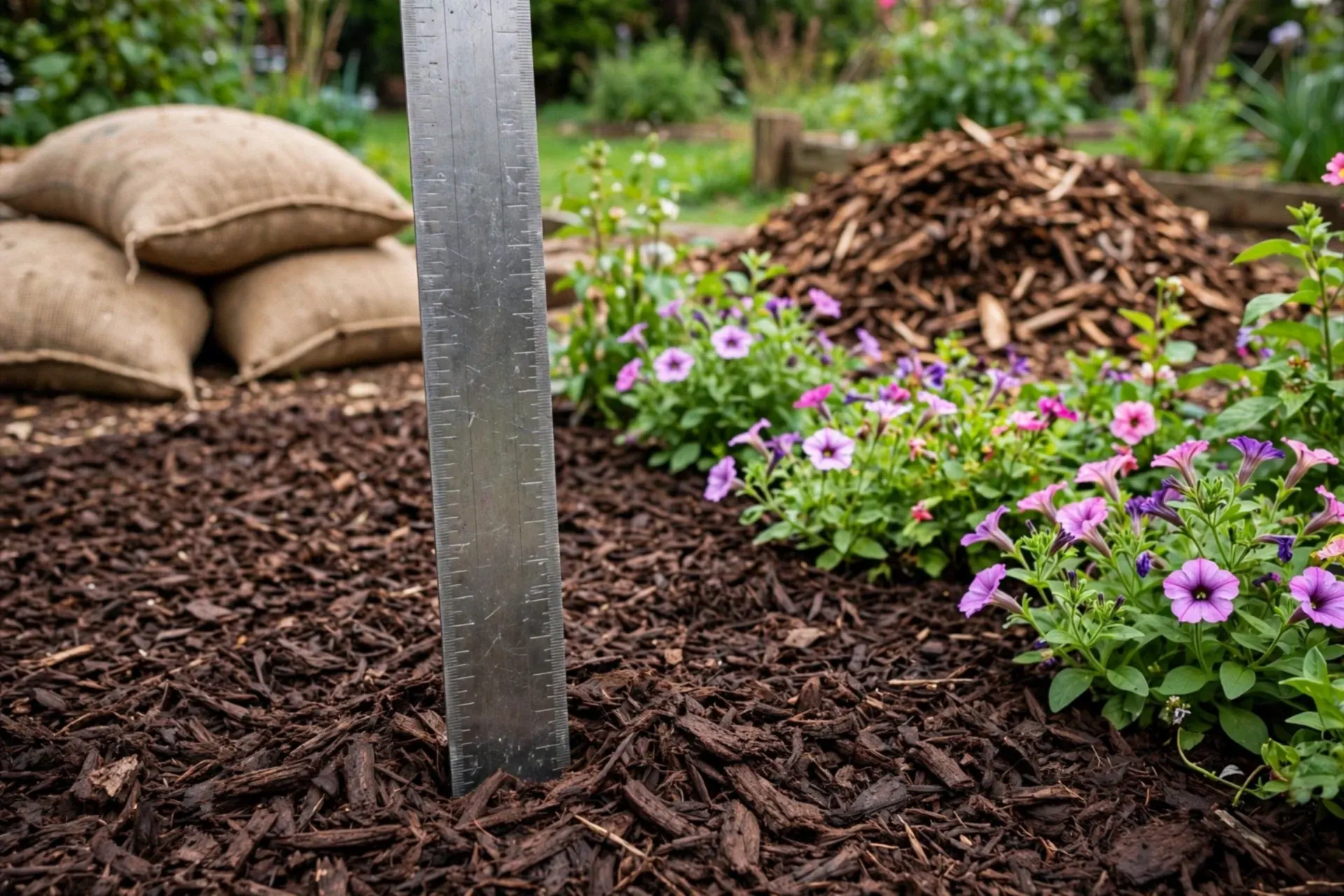
Mulch depth is a Goldilocks number with real consequences on both sides. Too thin and it does none of its jobs — no moisture held, no weed seeds shaded, no soil protected. Too thick and it starts doing damage: rain intercepted before it reaches roots, a soggy airless mat, roots lured up into the mulch where the next drought kills them. The good news is that the right depth is a small, knowable set of numbers — Clemson Cooperative Extension's home garden fact sheet (HGIC 1604) is the reference most North American extension services agree with — and once you have your depth, the "how much do I buy" maths is one multiplication. This guide gives both, plus the one spreading mistake that slowly kills more garden trees than any pest.
The depth rules, on one card
- Most beds: 5–7.5 cm (2–3 inches) of mulch, finished depth after settling
- Fine mulches go thinner: shredded leaves, grass clippings and compost cap at about 5 cm (2 inches) — they pack tight
- Coarse bark nuggets can go to 10 cm (4 inches) — the chunky pieces still let air and water through
- Refreshing old mulch: usually just 2.5 cm (1 inch) — measure what is left before you buy anything
- Around trees, the 3-3-3 rule: 7.5 cm (3 in) deep, kept 7.5 cm (3 in) back from the trunk, in a ring about 90 cm (3 ft) out
- Never against stems or trunks: mulch touching bark holds moisture against it and invites rot
Step 1 — Pick your depth by material, not by habit
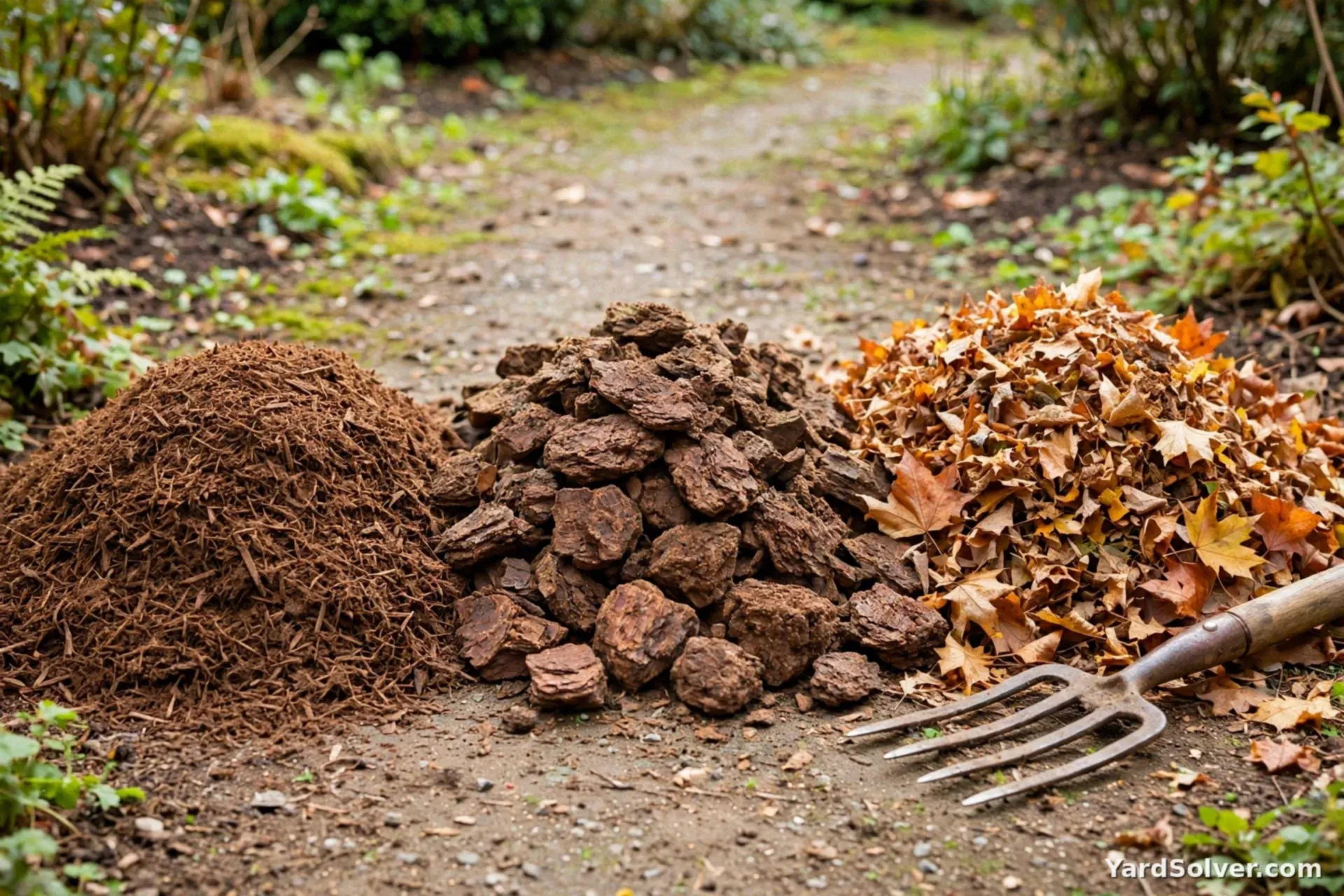
Depth depends on how tightly the material packs. Per Clemson Cooperative Extension's mulch fact sheet: shredded wood, bark mulch and wood chips — no more than 5–7.5 cm (2–3 inches), because fine pieces pack down and can keep air and water from reaching roots if piled thicker. Large bark nuggets — up to 10 cm (4 inches): the big pieces leave channels for air and rain. Pine needles and leaves — 5–7.5 cm (2–3 inches); grass clippings and shredded leaves — never more than 5 cm (2 inches), because thick layers of clippings mat into a waterproof felt. Vegetable beds sit at the thinner end too: 5–7.5 cm of straw or shredded leaves around strawberries and other crops keeps fruit clean without sealing the soil. And all of these numbers are finished depth — fluffy mulch settles by roughly a quarter in the first weeks, so spread slightly proud and judge the job a month later.
Step 2 — Adjust for the plant: beds, trees and paths
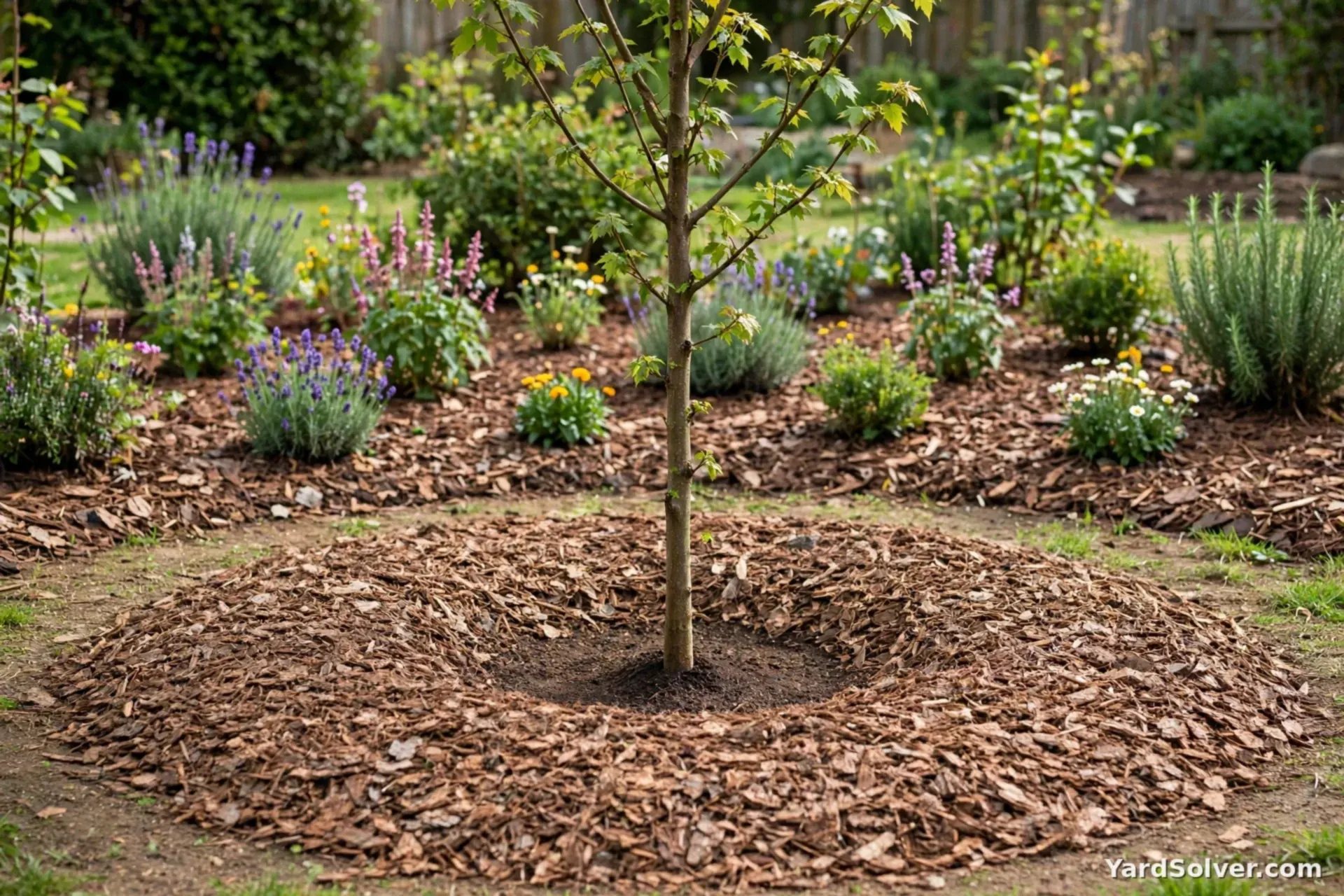
Flower beds and shrubs take the standard 5–7.5 cm. Trees take the same depth but a different shape: a wide, flat ring — the 3-3-3 shorthand is 7.5 cm deep, 7.5 cm back from the trunk, extending about 90 cm (3 ft) out, wider as the tree grows. What a tree must never get is the "mulch volcano": a cone piled against the trunk. Mulch against bark keeps the trunk wet, invites rot and pests, and can coax roots into circling inside the cone instead of spreading. If your trees already wear volcanoes, the fix is a rake, not a purchase: pull the mulch back until the trunk flare — the widening at the base — is visible again, and redistribute the excess out into the ring. Paths and play areas are the exception that goes deeper, 7.5–10 cm (3–4 inches), because foot traffic compacts the layer continuously.
Step 3 — Do the buy maths: area × depth, once
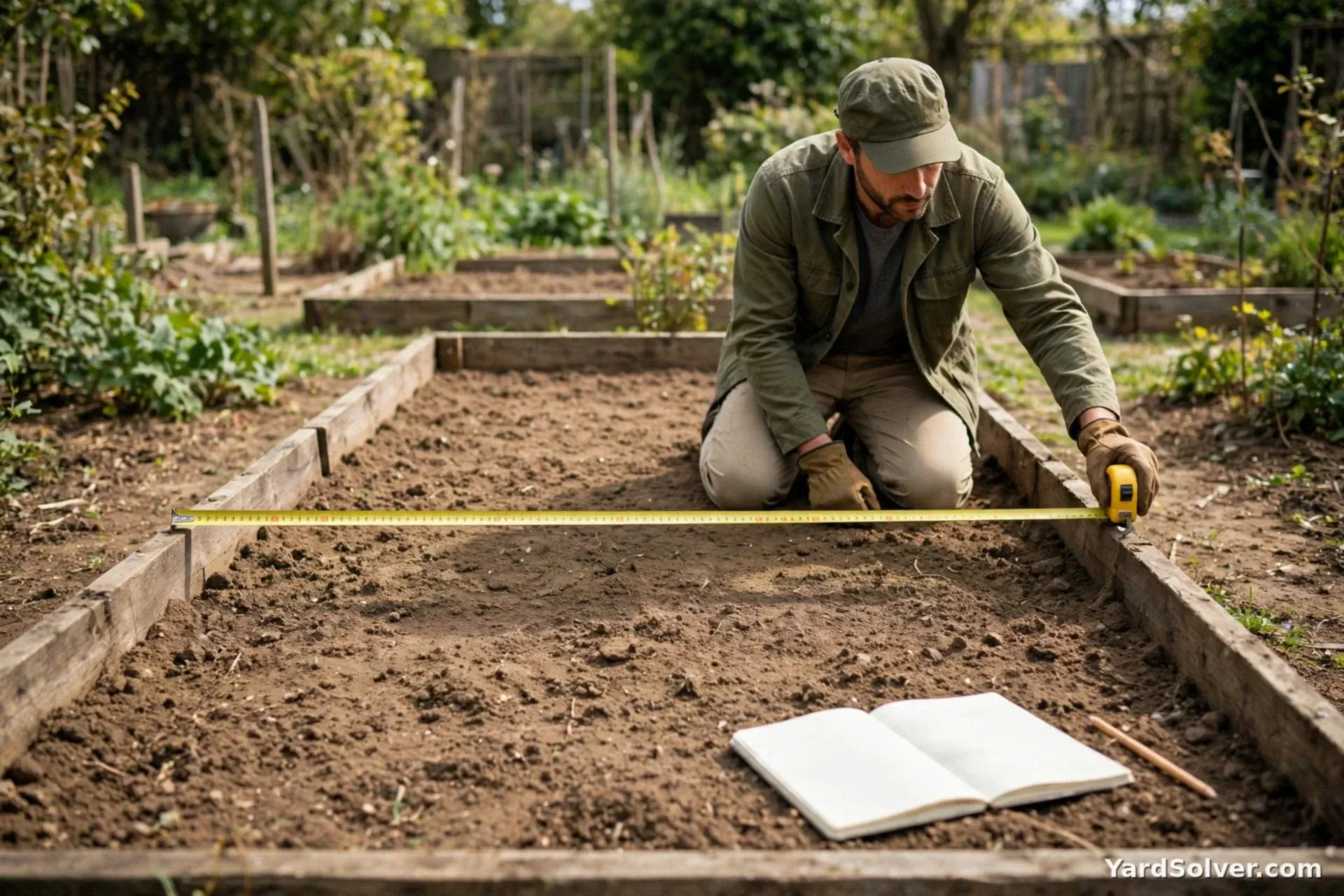
The whole calculation is: area (sq ft) × depth (inches) ÷ 12 = cubic feet. Divide cubic feet by 27 for cubic yards (bulk), or by the bag size for bags. Worked example, the one to sanity-check any store advice against: a 100 sq ft bed at 7.5 cm (3 inches) needs 100 × 3 ÷ 12 = 25 cubic feet — about 0.93 cubic yards, or 13 bags of the standard 2-cubic-foot size. Reference points worth memorising: one cubic yard covers about 10 sq m (108 sq ft) at 3 inches, 15 sq m (162 sq ft) at 2 inches, and 7.5 sq m (81 sq ft) at 4 inches; one 2-cubic-foot bag covers about 8 sq ft at 3 inches. Add roughly 10% for settling and uneven ground. Rather do it once with your real bed sizes? The Mulch Calculator runs exactly this maths, including circles and odd shapes, and the break-even rule from Step 4 tells you which way to buy it.
Step 4 — Bags or bulk? The one-yard rule
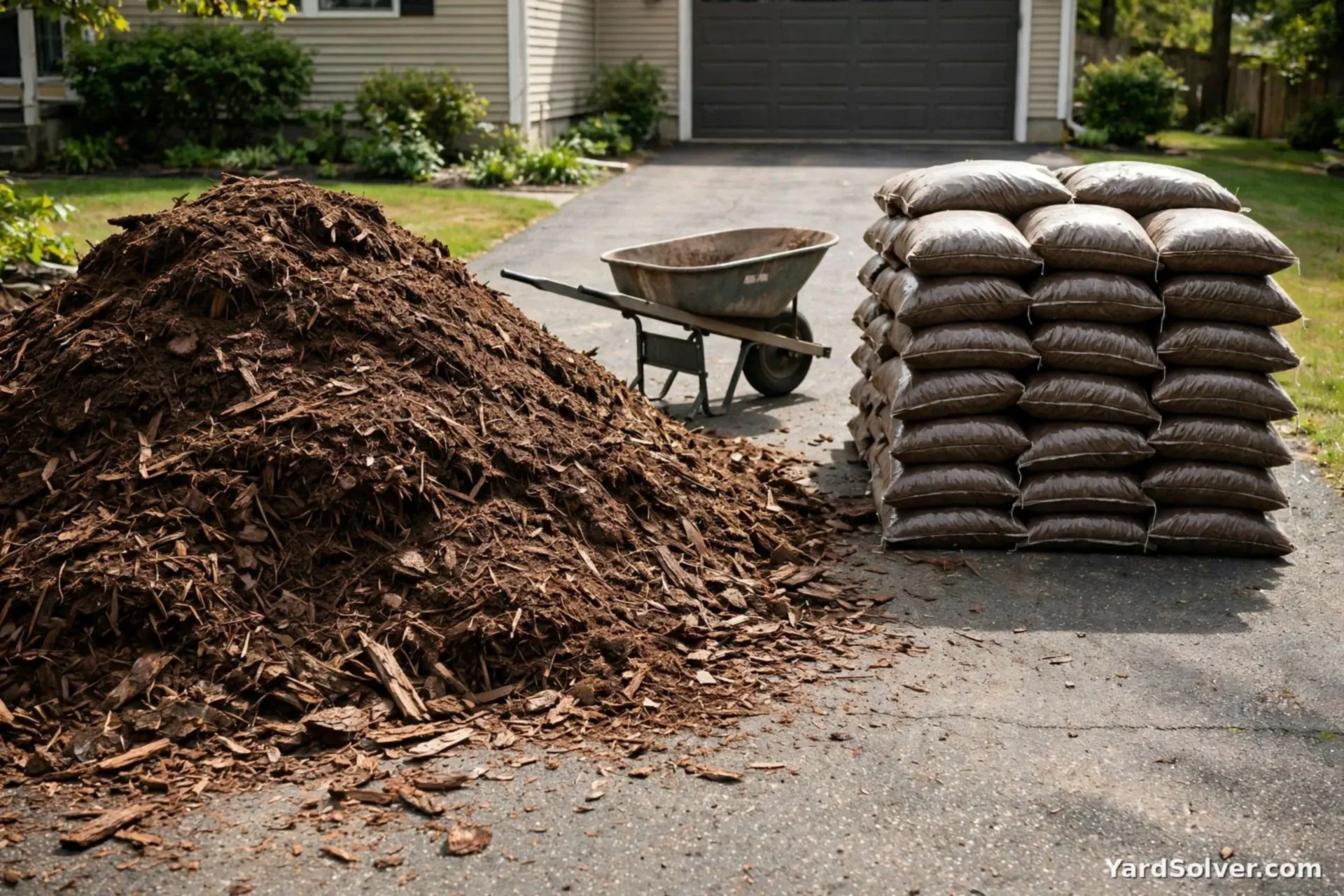
A cubic yard is 27 cubic feet — about 14 standard 2-cubic-foot bags. That volume is the practical break-even: below roughly half a yard, bags win on convenience and zero waste; at a yard or more, a bulk delivery usually costs less than the equivalent bags even after the delivery fee, and spares you a small mountain of plastic. Two honest caveats. A bulk yard is a bigger pile than most people picture — about a full pickup bed — so have the tarp spot chosen before the truck arrives. And bulk mulch quality varies more than bagged: you want shredded bark or wood, not sour-smelling, steaming, weed-seed-laden loads; a pile that smells like vinegar or ammonia is not finished and should not go on beds until it has aired. Plan the mulching day in the Garden Planner next to the bed work it follows, because mulch spread on weedy soil is a weed blanket, not a weed cure — clear the bed first, ideally after rain when weeds pull easily.
Step 5 — Spread it like you mean it: edges, gaps and timing
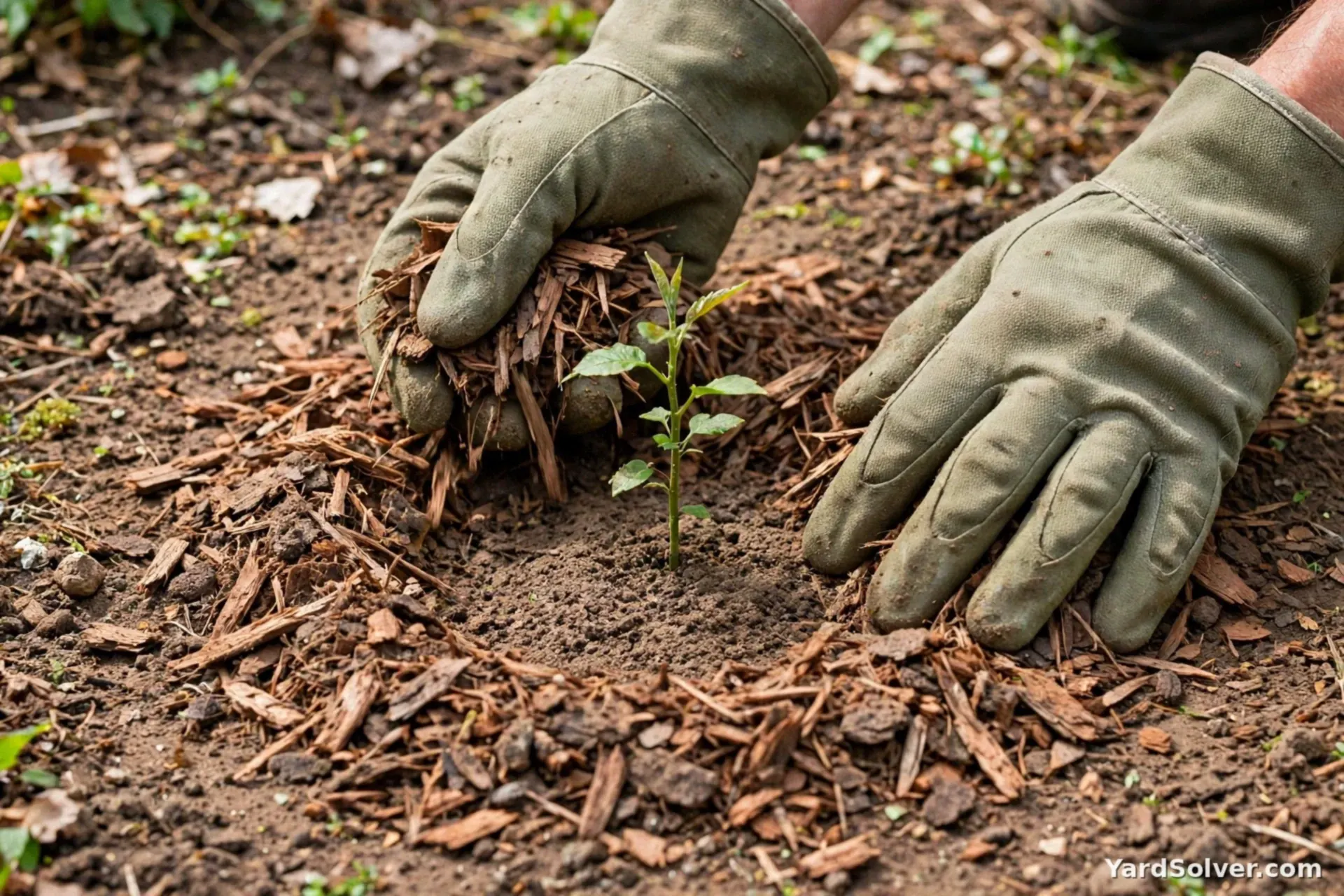
Technique decides whether the right depth does its job. Water the bed first if the soil is dry — mulch locks in whatever moisture state it finds. Tip piles along the bed and level with the back of a rake, then finish around plants by hand: keep mulch a few centimetres back from every stem and crown, because mulch mounded against soft growth rots it the same way it rots trunks. Leave a bare circle of about 15 cm (6 inches) across for a young tree and up to 30 cm (12 inches) for a mature one. Timing: spring mulch goes on after the soil has warmed (mulch is insulation — it keeps cold soil cold as happily as it keeps warm soil warm), and a fall refresh protects soil structure through winter, which is why mulching pairs naturally with putting the garden to bed. Top up little and often: an annual 2.5 cm refresh beats a heroic 10 cm dump every fourth year, and the old mulch you bury under each new layer is quietly becoming soil — the same organic-matter engine that fixes clay soil from the top down.
Keep going
Run your beds through the Mulch Calculator, then read How to Get Rid of Weeds Naturally and Putting Your Garden to Bed for Winter. Mulch is also Step 4's surface strategy in How to Fix Clay Soil.
Mulch you do not have to buy: What to Do With Fallen Leaves turns the fall leaf pile into shredded bed mulch, leaf mold and compost.
Questions people ask
How many bags of mulch are in a cubic yard?
A cubic yard is 27 cubic feet, so it equals about 14 bags of the standard 2-cubic-foot size (13.5 exactly — you cannot buy half a bag), 18 bags of 1.5 cubic feet, or 9 bags of 3 cubic feet. That is also the rough break-even point: once a job needs more than about a cubic yard, a bulk delivery usually costs less than the same volume in bags.
How much area does one bag of mulch cover?
One standard 2-cubic-foot bag covers about 1.1 square metres (12 sq ft) at 5 cm (2 inches) deep, about 0.74 square metres (8 sq ft) at 7.5 cm (3 inches), and about 0.56 square metres (6 sq ft) at 10 cm (4 inches). Depth is the whole ballgame: the same bag covers half the area if you spread it twice as deep.
Can mulch be too deep?
Yes — past about 10 cm (4 inches), a mulch layer starts working against the plants: it can keep rain from reaching the soil, hold the surface soggy while roots below stay dry, starve roots of oxygen and push roots up into the mulch itself. Fine mulches such as shredded leaves or compost pack tighter and cause trouble sooner, which is why extension guidance caps them thinner than coarse bark. When in doubt, rake some off rather than adding more.
Comments & ratings
No comments yet.
Be the first to share your experience.