
Guides · DIY build · Published November 10, 2026
Soggy Yard? How to Fix Drainage With a French Drain
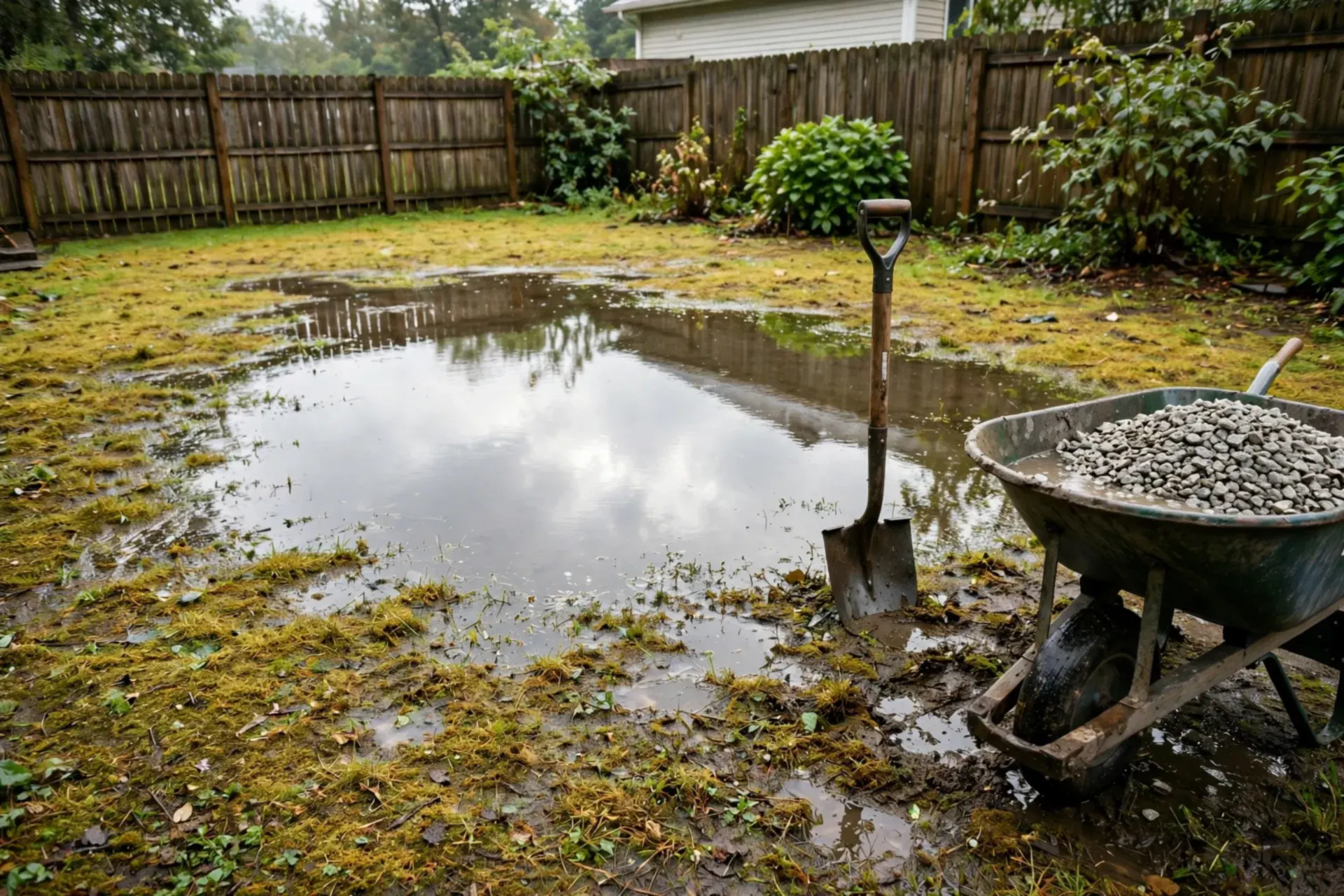
Every yard has one: the low spot that stays a pond for days after rain, kills its grass a little more each year, and squelches under your shoes in a dry week. Water sitting on a yard is not a mystery — it just has nowhere to go. A French drain gives it somewhere: a gravel-filled trench with a perforated pipe at the bottom, sloping gently to an outlet, that collects the water underground and carries it away. It is a weekend or two of honest digging, no special skills, and it is the fix that keeps working for a decade. One rule before anything else: a drain does not make water disappear, it moves it — so the outlet is planned first.
The materials list
- Pipe: 4-inch perforated drain pipe — rigid PVC holds a slope best; corrugated bends around obstacles
- Fabric: nonwoven geotextile (drainage fabric), enough to line the trench and fold over the top — not thin weed barrier
- Stone: washed, angular 3/4-inch drain rock (#57 stone) — never pea gravel, never dusty unwashed stone
- Outlet: a length of solid pipe for the last run, plus a pop-up emitter or a daylight exit fitting
- Tools: spade, string line and stakes, a line level or long spirit level, a tarp for the dug soil
- Before digging: call 811 (US) or your local utility-locate service a few days ahead — the marking is free
Step 1 — Trace the water, then plan the outlet
Start where the water ends up, not where it bothers you. The trench runs through or just uphill of the soggy area and then to an outlet: a lower spot where the pipe can daylight on a slope, a pop-up emitter in a lower corner, a dry well, or a storm drain where your municipality allows it (many need a permit — check before you assume). The trench must fall the whole way, so walk the line and be honest about your ground: if there is no lower place to send the water and no room for a dry well, a French drain cannot help you, and the money is better spent regrading. If the soggy patch sits under a downspout or below a neighbour's slope, note that too — catching the water at its source with the trench is half the win. If your soil is heavy clay, read How to Fix Clay Soil alongside this plan: the drain handles the water, the soil work handles the surface, and clay yards usually need a bit of both.
Step 2 — Dig the trench and hold the slope
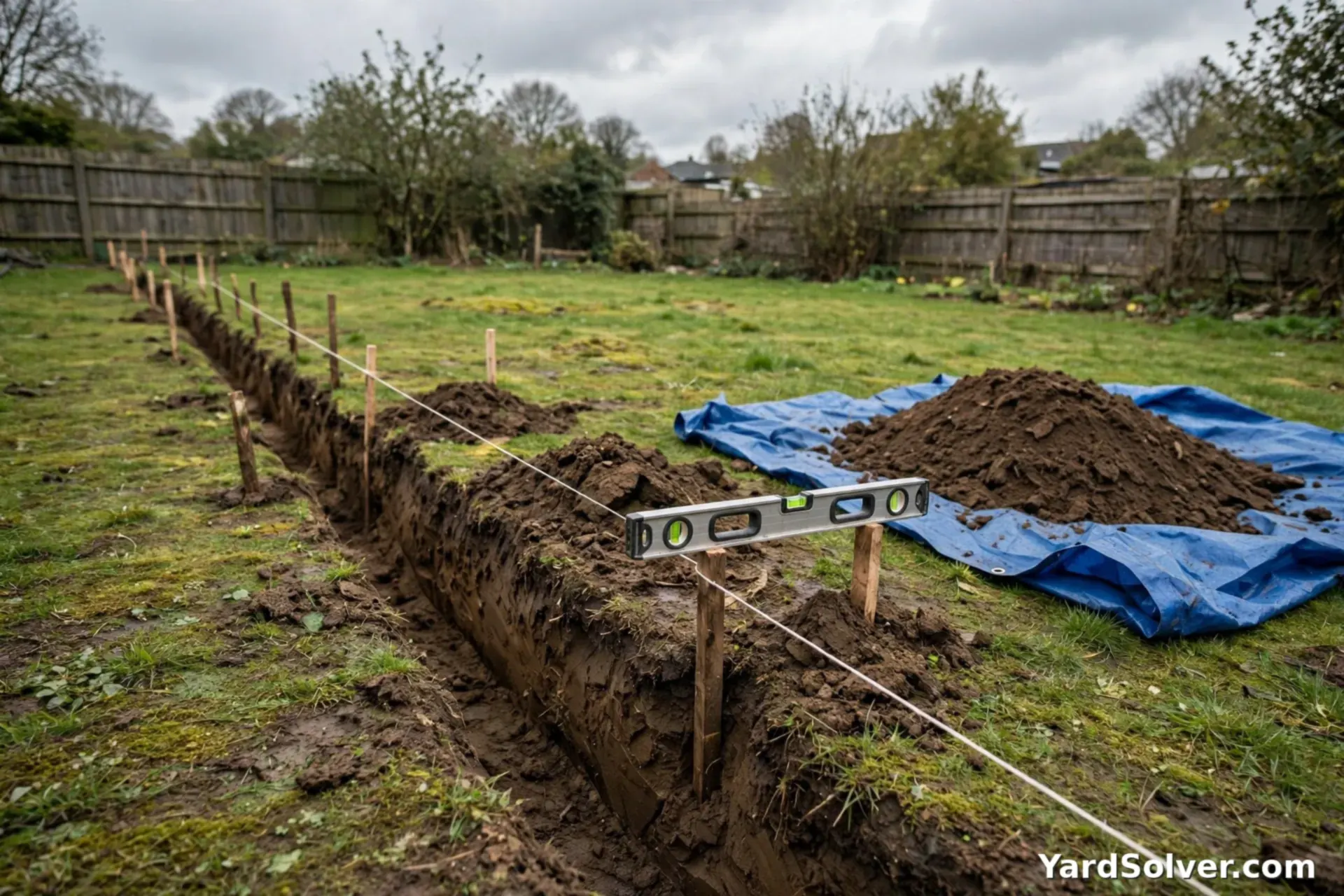
Dig 18–24 inches deep and about 12 inches wide — deep enough to catch the water where it gathers, wide enough for fabric, stone and pipe. The slope is the detail the whole drain stands or falls on: a minimum 1 percent fall, which is 1 inch of drop for every 8 feet of run. Set a string line along the trench at a level height above the bottom, and measure down from it every few feet as you dig — the bottom should get steadily deeper below the string (or the string itself slopes, if you set it that way). Check every few feet, not at the end: a flat or uphill pocket anywhere in the run is a permanent puddle inside your pipe. Pile the soil on a tarp beside the trench and the lawn forgives you afterwards.
Step 3 — Line it with fabric and a bed of stone
Drape the nonwoven fabric down the trench, along the bottom and up both sides, leaving generous extra lying on the ground on both edges — you will fold it over the top at the end, like closing a burrito. This fabric is the difference between a drain that lasts fifteen years and one that chokes in three: it lets water in and keeps soil out, and soil in the stone is what clogging is. Then shovel in 2–3 inches of washed stone along the bottom as the pipe's bed. Do not put the pipe straight on soil or fabric: it needs to sit level on stone, holding the exact slope you dug.
Step 4 — Lay the pipe holes-down, and bury it in stone
Lay the perforated pipe on its stone bed with the holes facing down. That seems backwards until you picture it working: water rises up through the stone into the pipe from below, and sediment is far less likely to drop into downward-facing holes. Check the slope on the pipe itself with your level before a single stone covers it — this is the last free chance to fix a flat spot. Connect the solid outlet pipe at the low end. Then fill around and over the pipe with washed stone to within about 3–4 inches of the surface, and fold the extra fabric over the top with a good overlap. Stone quantities surprise everyone, so do the sum before the delivery is booked: a 50-foot trench at these dimensions holds about 75 cubic feet of stone gross — roughly 2.8 cubic yards, around 4 tons. The Gravel Calculator gives you the exact yardage and tonnage for your own trench length and depth in seconds.
Step 5 — Backfill, then test it with a hose
Cover the wrapped stone with the dug soil, firm it, and reseed or lay the sod back over the trench line. Then test before you celebrate: run a hose into the wet end of the drain (or into its highest catch point) and walk to the outlet. Water should arrive there in a steady flow — that is the whole system proving itself in a minute. What to expect afterwards is honest and unspectacular: after the next real rain, the old pond spot drains within hours instead of days, and it gets a little better over the first season as the soil around the trench dries and firms. If a rain barrel overflow feeds the same low corner, send it into the drain line instead — plan its size with the Rain Barrel Calculator. Note the outlet's location in your Garden Planner: the one maintenance job, years from now, is checking that the outlet is clear.
Keep going
Wet because the soil itself holds water like a sponge that never wrings out? How to Fix Clay Soil is the companion job.
Roof water is part of the problem? Rainwater Harvesting for Beginners turns the downspouts from a cause into a supply.
Questions people ask
How long does a French drain last?
A well-built one — nonwoven fabric around washed angular stone, correct slope — typically works for 10 to 15 years or more before the gravel may need attention. The drains that fail in three years almost always skipped the fabric or used dirty, dusty stone: soil migrates in, the voids fill, and the trench becomes a buried mud pie.
Can I use pea gravel in a French drain?
No. Pea gravel is rounded, so the stones roll and shift and pack together with smaller voids for water. Use washed, angular 3/4-inch stone (sold as drain rock or #57 stone): the sharp edges lock together, hold their gaps open, and let water move fast. And it must be washed — stone dust is the first clog.
Will a French drain fix a swampy clay yard on its own?
It fixes the water it can reach: a drain through the wet area gives groundwater and pooled runoff somewhere to go. If the whole yard is flat clay that sheds water off its surface, pair the drain with surface work — regrading shallow swales and improving the soil itself — or water will keep sheeting across the top and only slowly find the trench.
Comments & ratings
No comments yet.
Be the first to share your experience.