
Guides · Water · Published November 3, 2026
Rainwater Harvesting for Beginners
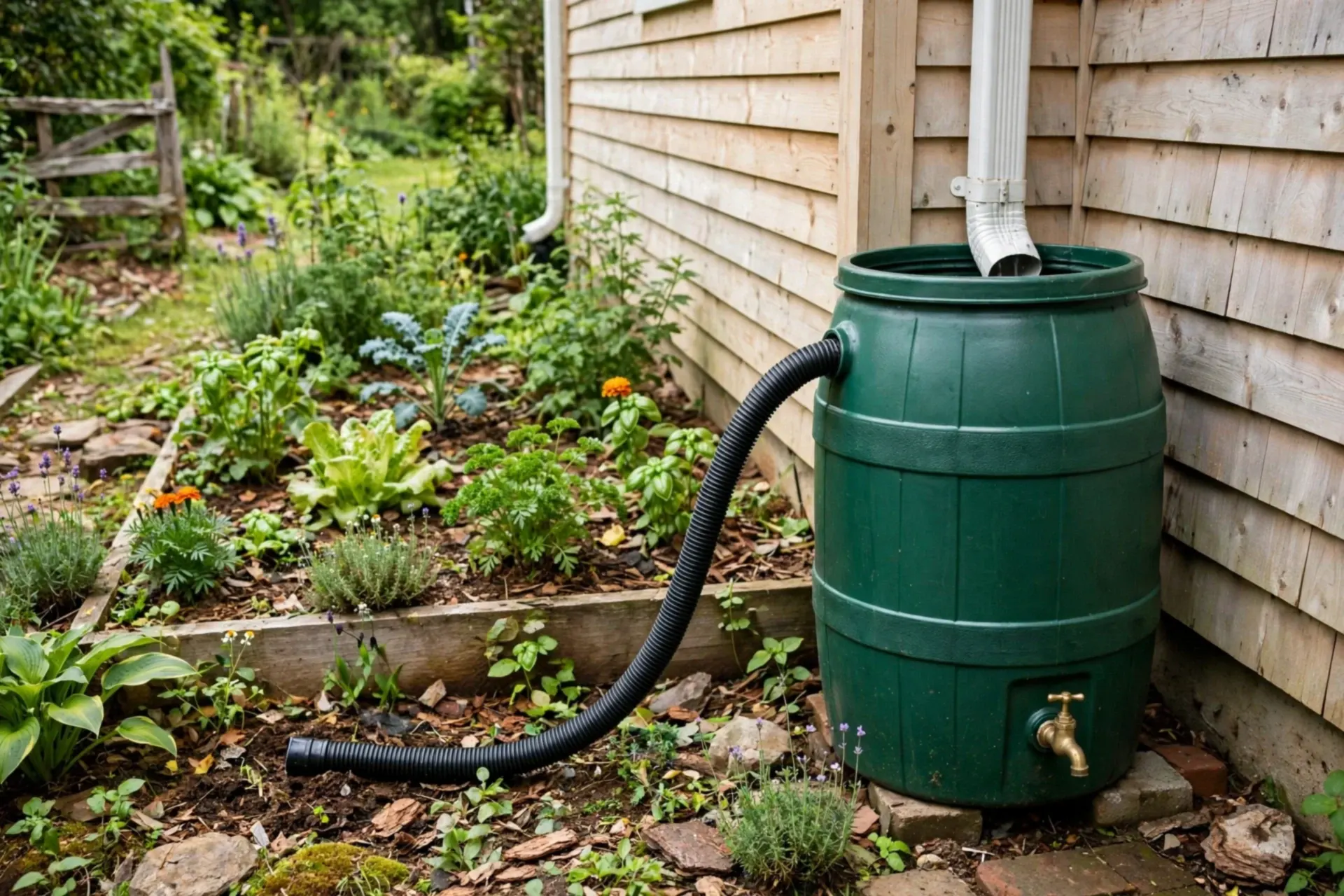
Every rain, your roof collects far more water than your garden hose delivers — and sends all of it down the drain. Beginner rainwater harvesting means intercepting one downspout with one barrel: free water, at roof temperature, stored beside the beds that need it. The setup takes an afternoon. What makes it work is the right order: math first, then the barrel, then the details — screen, overflow, first flush — that separate a system from a mosquito pond. Before anything else, size the idea with the Rain Barrel Calculator — it turns your roof area and rainfall into gallons.
What a simple system looks like
- One barrel: typically 50–60 gallons, food-grade plastic, dark or opaque so algae cannot grow in the light
- One downspout: ideally the one draining the largest roof section nearest the garden
- A screen on every opening: inlet and overflow — this is the entire mosquito strategy
- An overflow hose: when (not if) the barrel fills mid-storm, the extra water goes where you chose, not against the house
- A tap near the bottom: fitted while the barrel is empty and the job is easy
Step 1 — Do the roof math first
The math is simple enough to do honestly: every inch of rain on every square foot of roof gives about 0.62 gallons of runoff. Multiply your roof area by 0.62 for each inch of rain. A downspout draining 500 square feet therefore delivers roughly 310 gallons in a 1-inch rain — which also tells you a single 55-gallon barrel fills from only about 90 square feet of roof in that same rain. The conclusion surprises most beginners: the barrel is not the limit, the roof is generous — what matters is using the water between rains so there is room for the next storm. The Rain Barrel Calculator does this arithmetic for your own roof, rainfall and barrel size.
Step 2 — Choose the spot and raise the barrel
Pick the downspout nearest the garden, on level, firm ground. The barrel stands raised a foot or two on blocks or a stand: barrel water moves by gravity alone, and height is pressure — a raised barrel fills a can quickly and pushes water down a hose instead of dribbling. Level matters: a full barrel weighs as much as a large adult, and a leaning one strains its fittings all season. Keep the tap high enough for a can to slide under.
Step 3 — Connect the downspout (and think about the first flush)
Two honest ways in: a diverter kit fitted into the downspout sends water to the barrel until it is full, then sends the rest down the original drain — the tidy, reversible option. Or the downspout is shortened and aimed into the barrel's screened inlet directly — simpler and cheaper, but then the overflow has to handle every big storm. Then the first flush: the first minutes of runoff wash dust, pollen and droppings off the roof. A first-flush diverter — a short vertical pipe that traps the first few gallons and drains them slowly — keeps that wash out of your barrel. Many systems skip it and simply keep barrel water off salad leaves near harvest.
Step 4 — Screen it, and give it an overflow
Mosquitoes need only one thing: still water they can land on. A sealed lid and fine mesh over the inlet and the overflow opening deny them that, and that is the whole strategy — no chemicals, no gadgets. Check the screens each spring; one torn corner undoes the system. The overflow is the other half: when the barrel fills in a downpour, the surplus must go somewhere deliberate. Fit an overflow hose at the top of the barrel, at least as wide as the inlet, and run it away from the foundations — to a bed, a soakaway or the original drain. A barrel without an overflow overflows anyway — just over its rim, beside your wall.
Step 5 — Check your local rules before you install
Rain rules genuinely vary. In many places a garden barrel needs no permission at all and is actively encouraged; some regions have rules about collection, and some homeowner associations restrict visible barrels or equipment. The only safe general advice is: check your local municipal rules and any association rules before you buy, because this guide cannot know your jurisdiction. Two points apply everywhere: barrel water is garden-only, not drinking water without proper treatment; and where winters freeze, drain and disconnect the barrel before freeze-up, or ice will split it.
Step 6 — Use the water where it works best
Barrel pressure is gentle, so match the tool to it: watering cans for pots and seedlings, a hose run downhill for beds, or a soaker hose laid level. Short drip runs can work from a raised barrel — the design principles in How to Set Up Drip Irrigation apply, with patience standing in for pressure. Water the soil, not the leaves; use stored water within a week or so of a storm, which conveniently empties the barrel in time for the next rain; and save tap water for the week the barrel honestly runs dry.
Keep going
Size your system first: the Rain Barrel Calculator turns roof area and rainfall into gallons and barrels.
Put the water to work at the roots: How to Set Up Drip Irrigation. Away while the garden drinks? How to Water Plants While on Vacation.
When the season ends, winterize the rain barrel before the first hard freeze so it survives to catch spring rain.
Questions people ask
How much water runs off my roof in one rain?
About 0.62 gallons for every square foot of roof, for every inch of rain. So a downspout draining 500 square feet of roof delivers roughly 310 gallons in a 1-inch rain — far more than one barrel holds. Run your own roof area through the rain barrel calculator to see what your roof sends down in a typical storm.
Will a rain barrel breed mosquitoes?
Only if mosquitoes can reach the water. A sealed lid and fine mesh over the inlet and overflow openings are the whole strategy — females cannot lay eggs on water they cannot touch. Keep screens intact, and use stored water regularly so it never sits stagnant for weeks.
Is collecting rainwater legal?
In many places a garden rain barrel is completely fine, but the rules genuinely vary — some regions encourage barrels, a few regulate collection, and homeowner associations sometimes have their own restrictions. Check your local municipal rules before installing, and treat barrel water as garden-only: it is not drinking water without proper treatment.
Comments & ratings
No comments yet.
Be the first to share your experience.