
Guides · Lawn care · Published November 15, 2026
How to Level a Bumpy Lawn: Topdressing, Lift-and-Relay, and How Much Soil You Actually Need
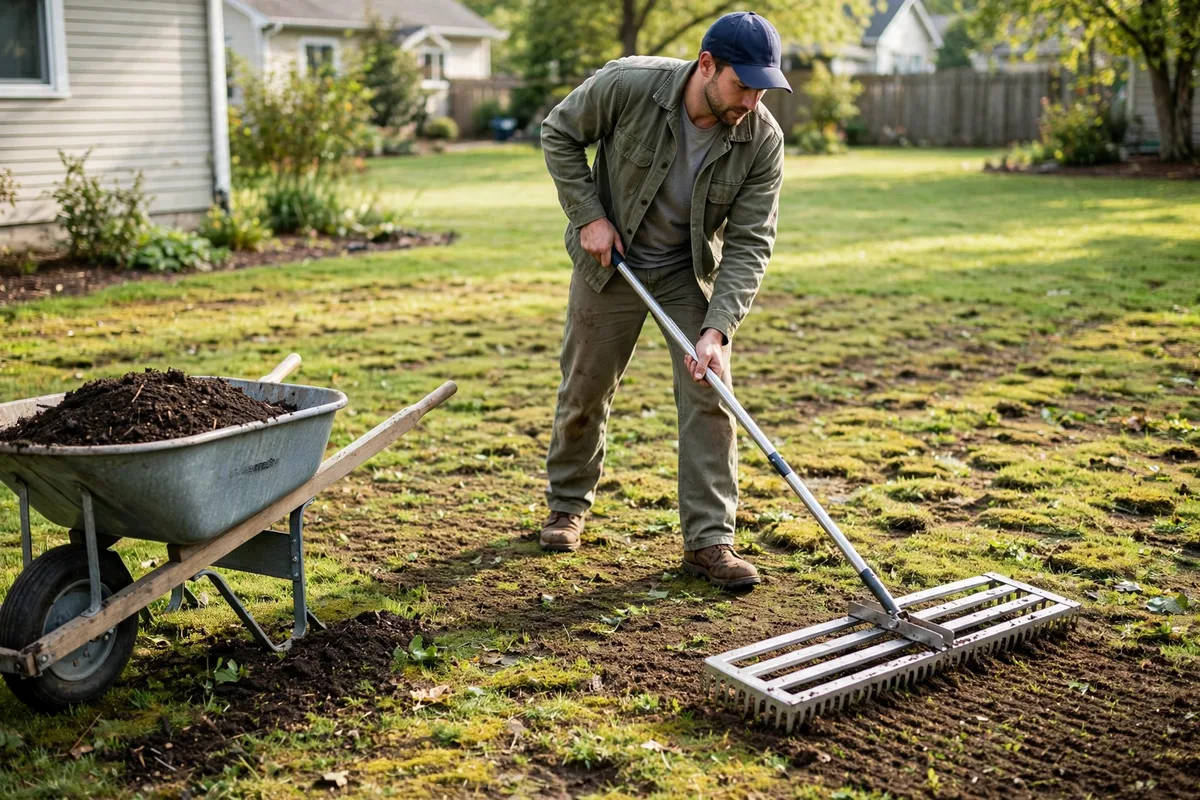
A bumpy lawn is rarely a grass problem — it is a soil-level problem wearing a grass disguise. Frost heave, settling trenches, old tree roots, worm casts and years of uneven wear leave hollows that hold water and humps that the mower scalps. The fix is methodical, not heroic: measure where the ground actually sits, add or move soil in controlled passes, and let the grass grow through. This guide walks through how to level a lawn both ways — topdressing for shallow unevenness, and lift-and-relay for deep hollows — and finishes with the material maths, because ordering the right amount of soil is where most people either waste money or run short mid-job.
Step 1 — Find the real low spots before you order anything
Your eye lies to you on a lawn; a string line does not. Stretch a taut string between two stakes across the area at grass height and measure down from the string every foot or so. Anywhere the gap is more than about an inch (2.5 cm) deeper than the surrounding level is a hollow worth filling; anything under half an inch the grass will forgive. Mark the hollows with landscape paint or flour, and note the deepest point of each — that depth decides your method. Shallow, broad unevenness of an inch or less is a topdressing job. A distinct dip deeper than about 2 inches (5 cm) is a lift-and-relay job: filling it in one go with loose soil buries the grass crowns and leaves a soft spot that settles right back down.
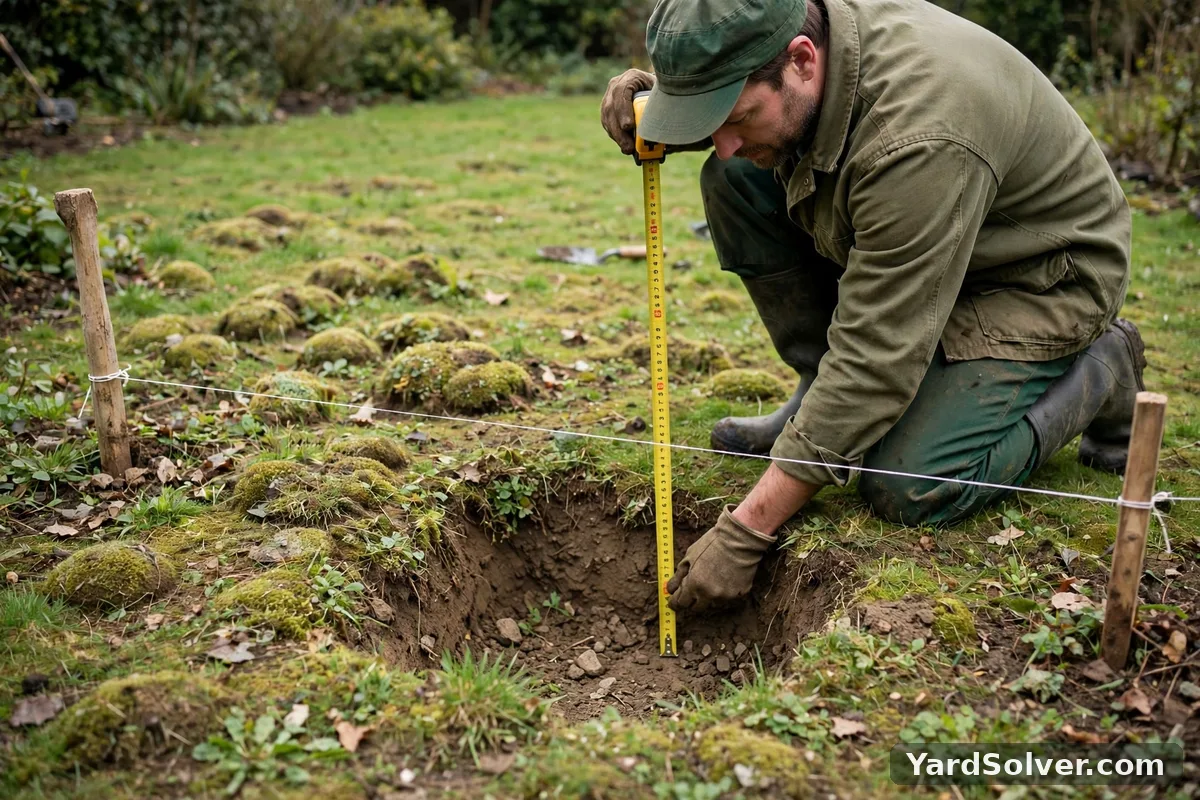
Do this check after rain if you can. Hollows announce themselves honestly when they hold puddles an hour after the rest of the lawn has drained, and a puddle map is the fastest survey you will ever do.
Step 2 — Choose the mix: soil and compost, sand with caution
For topdressing a lawn, the reliable mix is roughly 70% topsoil or sandy loam to 30% compost — the soil gives the level, the compost feeds the grass that has to grow up through it and keeps the layer from crusting. Screened, weed-free material matters more than any brand name: cheap unscreened fill full of weed seed and rubble will cost you a season of weeding. Straight sand is the professional's tool on sand-based sports turf, but on a typical clay or loam home lawn a heavy sand layer can set into a hard, separate stratum the roots dislike crossing; if you use sand at all, blend it into the mix rather than laying it pure. Work out your blend volumes with the Compost Calculator so the ratio you planned is the ratio that actually arrives.
Timing matters as much as material. Level when the grass is growing actively and can push up through the new layer: spring and early autumn for cool-season lawns, late spring into summer for warm-season lawns like bermuda, buffalo and couch. Never topdress a dormant or drought-stressed lawn — the grass cannot grow through, and the soil just sits there as a weed bed.
Step 3 — Topdress in thin passes, never one thick blanket
Mow short first, and rake or scarify lightly so the mix can reach the soil instead of sitting on the thatch. Shovel the mix out in small piles across the marked area, then work it in with the back of a rake or — far better — a levelling rake (lawn lute), dragging it back and forth so soil falls into the hollows and brushes off the humps. The rule every extension service repeats is the one to obey: no more than about ¼ to ½ inch (6–12 mm) of material in a single pass, with the grass tips still showing through everywhere. Bury the grass deeper than that and you have not levelled the lawn, you have smothered it.

Water lightly to settle the mix into the hollows, wait two to three weeks for the grass to grow through, then repeat on the spots that are still low. Two or three thin passes over a season produce a genuinely flat lawn; one heroic thick pass produces a lumpy one with dead patches. If compaction is half the reason your lawn went uneven — and on walked-on, played-on lawns it usually is — pair the job with aeration first: our guide to How to Aerate Your Lawn covers the wedge test that tells compaction and thatch apart.
Step 4 — Deep hollows: lift the turf, fix the soil, relay it
For a dip deeper than about 2 inches, cut the turf over the hollow into manageable squares or a single H-cut, slide a spade flat underneath, and lift the turf off in one piece, roots and all. Now you can see the real problem — a settled trench, a rotted root, a void. Fill the hole with topsoil in layers, firming each layer with your heel or a tamper so it cannot settle again, and finish with the soil level a fraction high, because some settling always happens. Relay the turf piece like a puzzle tile, firm it down, water it well, and keep it moist for two weeks while the roots knit back in. Done carefully, the patch disappears within a month; done with loose, uncompacted fill, you will be lifting the same square again next year.
Step 5 — How much soil to order (the maths that saves the second trip)
The standard extension figure is simple: a ½-inch layer over 1,000 sq ft takes about 1.5 cubic yards of material — roughly 40 cubic feet. Scale it honestly: a ¼-inch pass over the same area is about 0.75 yd³. But nobody levels a whole lawn evenly; you level the hollows. Estimate the total area of your marked low spots, multiply by your planned depth, and add 10% for settling. Run the numbers through the Topsoil Calculator with your area and depth and it returns cubic yards, cubic feet and bag counts in one pass — far safer than guessing at the merchant's yard. In metric terms for UK and Australian readers: 1 cm of topdressing over 10 m² is 0.1 m³, so a typical 100 m² lawn at 1 cm needs about 1 m³ — one bulk bag, which is exactly why the thin-pass rule is also the cheap rule.
The tool that makes passes fast and genuinely flat is a proper levelling rake rather than the back of a garden rake; our comparison of widths, weights and materials is in Best Lawn Levelling Rakes. And if the bumps turn out to be mole hills rather than soil movement, stop and read the mole guide first — levelling over active tunnels is work you will do twice.
Keep going
Levelling works best as one step in a full lawn renovation rather than a lone rescue. If you are opening the surface anyway, the same week is the cheapest time to overseed thin areas — the soil contact is already there. Our walkthrough of rates and timing is in How to Overseed Your Lawn.
Planning the whole season — levelling, seeding, feeding and the dates that bound them? The Garden Planner turns your frost dates into a dated plan with quantities and a shopping list, so the spring work lands in the right weeks without guesswork.
Questions people ask
How long does it take to level a lawn?
The spreading itself is a few hours for an average lawn, but the honest answer is one season: thin passes every two to three weeks, letting the grass grow through each one. A single deep hollow fixed by lift-and-relay is a one-afternoon job and knits back in about a month.
Can I level a lawn with sand alone?
On sand-based sports turf, yes; on a typical home lawn with clay or loam soil, a thick pure-sand layer can crust into a separate hard stratum. Blend sand into a topsoil-compost mix instead, and keep every pass at or under half an inch.
When is the best time to level a lawn?
When the grass is actively growing: spring and early autumn for cool-season lawns, late spring and summer for warm-season grasses. Australian readers can level warm-season lawns right through late spring and summer. Avoid dormant, frozen or drought-stressed grass.
Comments & ratings
No comments yet.
Be the first to share your experience.