
Guides · Lawn care · Published November 15, 2026
Robot Lawn Mowers: How They Work, What They Cost, and Who They’re Worth It For
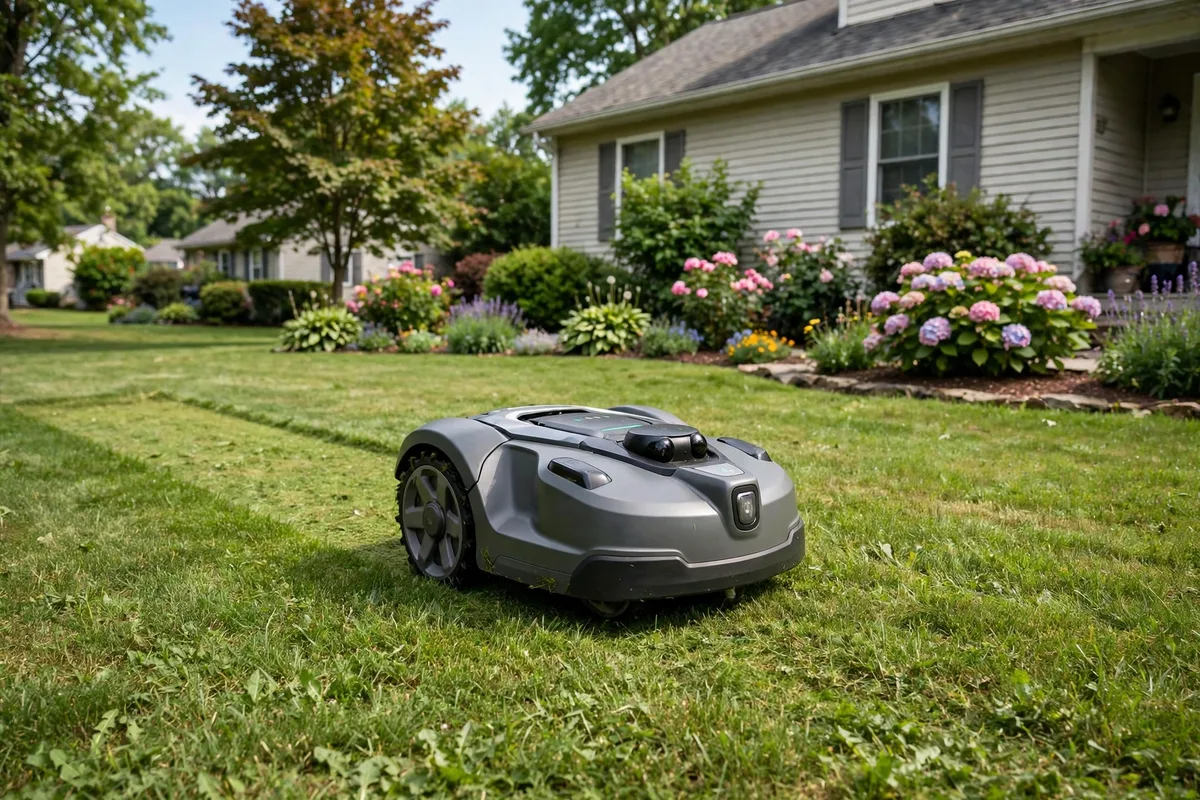
A robot lawn mower is not a small version of your mower with a remote control. It is a different mowing philosophy: instead of letting the lawn grow all week and cutting it down in one Saturday pass, the robot goes out daily or every other day and clips a few millimetres, leaving the clippings where they fall as mulch. The lawn is never long, never scalped, and never waiting for you. That promise is real — for the right lawn. For the wrong lawn it is an expensive ornament stuck under the trampoline. This explainer covers how the machines actually navigate, what ownership really involves and costs in ongoing terms, and the honest checklist of who should buy one and who should not.
Step 1 — How they work: boundaries, navigation and the daily clip
Most models navigate inside a boundary: traditionally a low-voltage wire pegged around the lawn’s edge and around beds and trees, which the robot detects and turns at; a growing number of newer models navigate by GPS/RTK positioning or cameras instead and need no wire, at a higher purchase price and with their own demands (a clear view of the sky, a base station position). Inside the boundary the robot mows in a pattern — older and cheaper models bounce at random angles, which sounds inefficient and works anyway over a full day; better models mow in systematic lanes. When the battery runs low the robot follows its guide wire or its map home to the charging dock, recharges, and goes out again. The cutting itself is done by small pivoting razor blades on a spinning disc — quiet enough to run in the evening, and safe in the sense that the blades stop when the machine is lifted, though the standard advice stands: supervise around small children and pets, and never treat it as a toy.
Before anything else, the machine’s capacity rating decides whether it can cope at all, and capacity is about area. Measure your actual lawn — not your lot, the grass — with the Square-Footage Calculator, then choose a model rated comfortably above that number: ratings assume ideal flat rectangles, and complex, sloped or narrow lawns eat capacity fast.
Step 2 — What ownership costs beyond the purchase
The purchase price is the loud number, so let us talk about the quiet ones — in relative terms, because models and markets shift constantly and any exact figure printed here would age badly. Blades are a consumable: the small razor blades dull and are swapped every one to three months of the season, cheaply, in minutes. Batteries last years, not forever, and a replacement battery is a real mid-life expense. Installation is either a weekend of your own labour pegging wire (kits include the wire and pegs) or a paid dealer install. Repairs exist in this category’s life — a cut boundary wire after garden digging is the classic, found with a wire-break detector and fixed with a waterproof connector. Against those costs, owners stop buying mower fuel, stop most mower servicing, and — the line item nobody prices — stop spending the weekly hour. The honest summary: a robot mower is not the cheap way to mow a lawn; it is paying to convert a weekly chore into occasional light maintenance, and for the right household that trade is worth it.
Step 3 — Set it up right: dock, wire and schedule
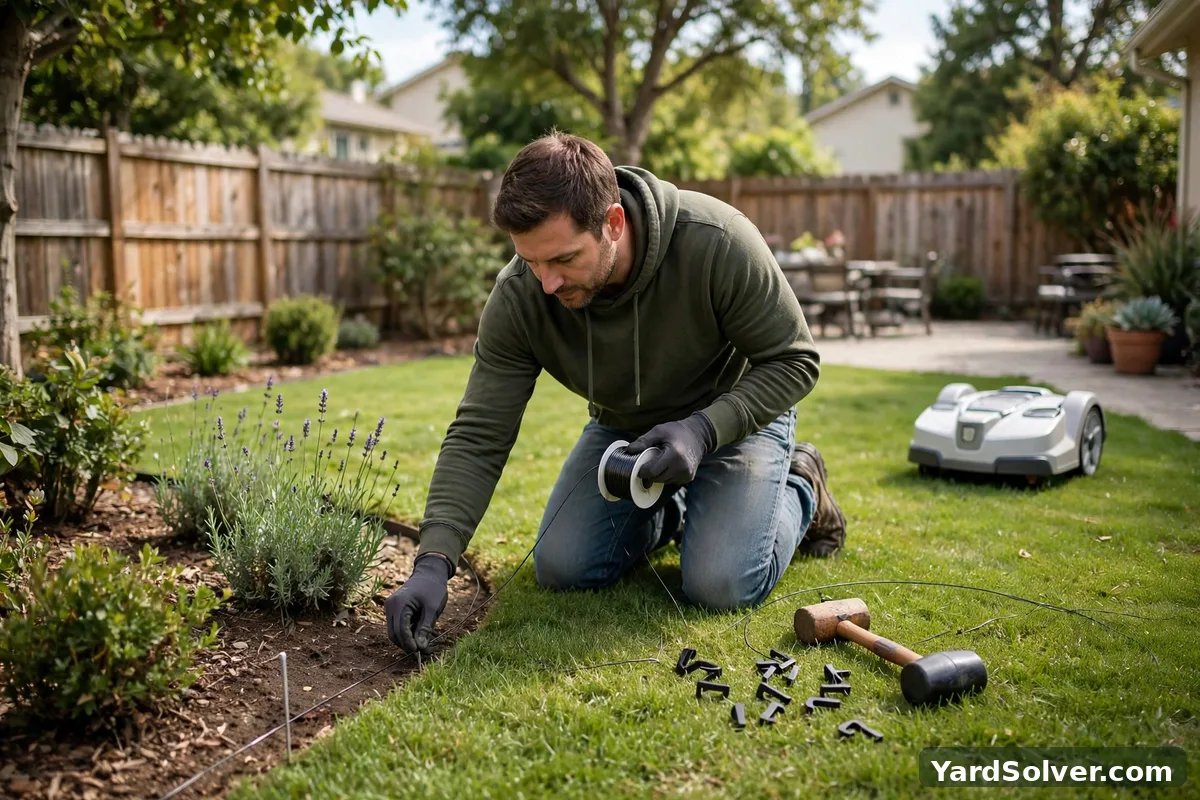
The dock wants a flat spot at the lawn’s edge with power, some shade if possible (batteries dislike baking), and a straight approach so the robot can dock cleanly. The boundary wire goes a hand’s width in from edges — the exact offsets for walls, beds and paths are in every manual, and they matter, because the robot’s body overhangs its wire line. Peg the wire down and let the grass grow over it in a few weeks, or bury it shallowly from the start if dogs or aerators are in your life. Then set a schedule that matches growth: daily clipping in the spring flush, easing back in a dry summer, and never a rigid timetable the lawn does not need. Most owners settle on daytime or early-evening runs and keep nights free — nocturnal wildlife, hedgehogs especially, are a genuine reason to keep the robot parked after dark.
Who it is worth it for — and who should skip it
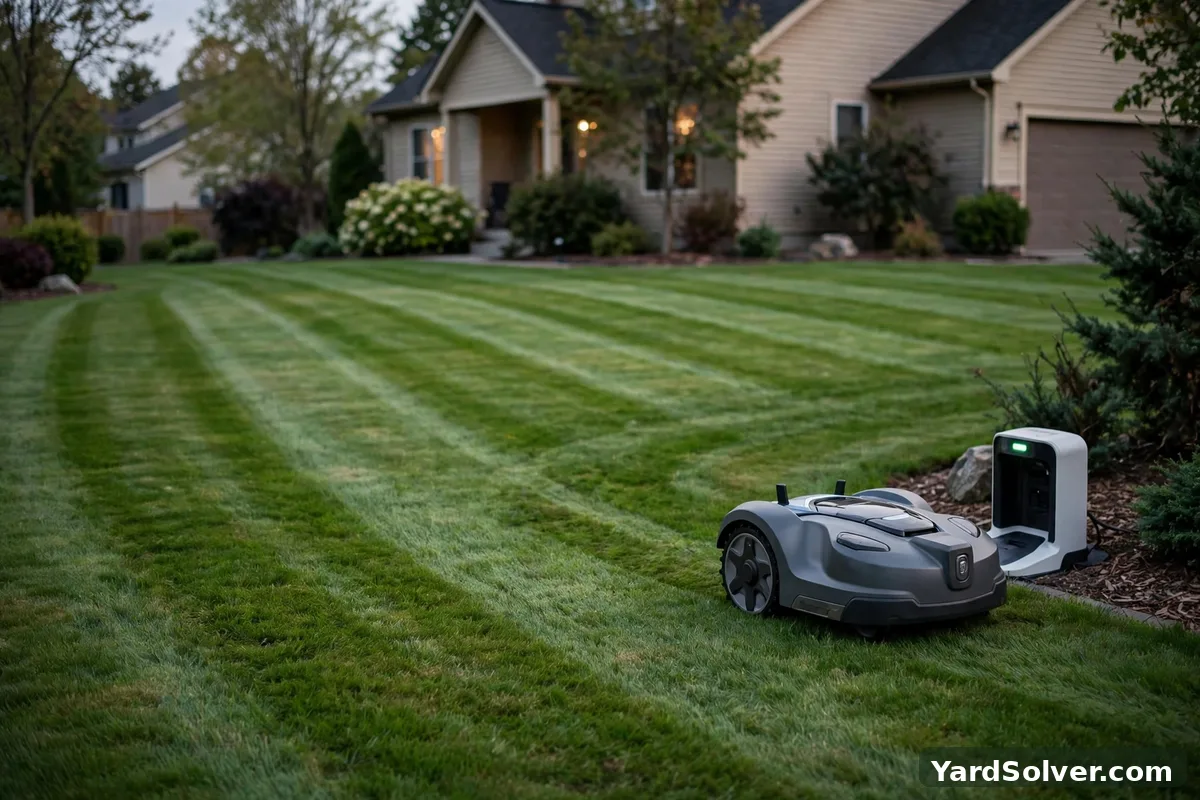
Worth it: lawns up to the model’s comfortable capacity with a mostly connected, mostly open shape; owners whose weekends are genuinely scarce; anyone whose lawn quality suffers from irregular mowing (the constant clip is visibly good for grass — it is the same principle as the clover lawn’s low, dense growth habit, applied to turf); people with mobility limits for whom mowing is a real burden; and second properties where the lawn must be kept up between visits. Skip it: lawns chopped into many disconnected pieces by fences and gates you will not modify; steep banks beyond the model’s slope rating; very rough, rutted ground; tiny lawns where a small mower finishes in ten minutes anyway; and anyone expecting stripes — a robot leaves a carpet, not a pattern, and gardeners who love the striped Saturday ritual are giving up a pleasure, not a chore.
One last piece of honesty: edges still exist. The robot cannot cut the last few centimetres against walls and fences, so a quick pass with a trimmer every week or two remains part of life — around bed edges planted with creeping thyme, that fringe is at least a deliberate look rather than a failure. Budget the trimmer into the dream and the dream holds up.
Keep going
Robots suit the low-and-dense school of lawn care. The other member of that school is the Clover Lawn — for some yards it removes most mowing altogether, no charging dock required.
New lawn projects, areas and schedules all belong on one plan — the Garden Planner builds yours from your frost dates, with quantities and a shopping list.
Questions people ask
Do robot lawn mowers really work, or are they a gimmick?
They work — with the caveat that they work by persistence, not power. A robot clips a few millimetres daily or every other day, so the lawn is permanently at its set height and the clippings are fine enough to disappear as mulch. On a suitable lawn (connected, mostly open, within the model’s rated capacity) the result after a month is a dense, even carpet. Where they fail is predictable: lawns chopped into fenced fragments, slopes beyond the rating, and areas bought too small for the machine’s capacity.
How much does a robot lawn mower cost to run?
The running costs are modest next to the purchase: replacement blade sets are a small consumable swapped every one to three months, electricity use is minor (the machine sips power compared with a petrol mower), and the significant mid-life item is a replacement battery after some years. There is no fuel and no annual engine service. The real economic question is the purchase itself versus the value of the weekly mowing time it returns — which is why the honest framing is that a robot mower buys time and consistency, not savings.
Can a robot mower handle slopes and uneven ground?
Up to a point, and the point is printed in the specs: every model carries a maximum slope rating, and exceeding it produces wheelspin, scalped crests and a stuck machine. Gentle, even slopes within the rating are fine, especially for models with driven rear wheels and good tread. Sharp banks, rutted or very bumpy ground, and narrow passages below the model’s minimum width are the real-world failures. Measure and read the slope rating before buying, not after the first rescue mission.
Comments & ratings
No comments yet.
Be the first to share your experience.