
Guides · Composting · Published November 13, 2026
Compost Greens to Browns Ratio: The Bucket Chart That Hits 30:1 Without Any Math
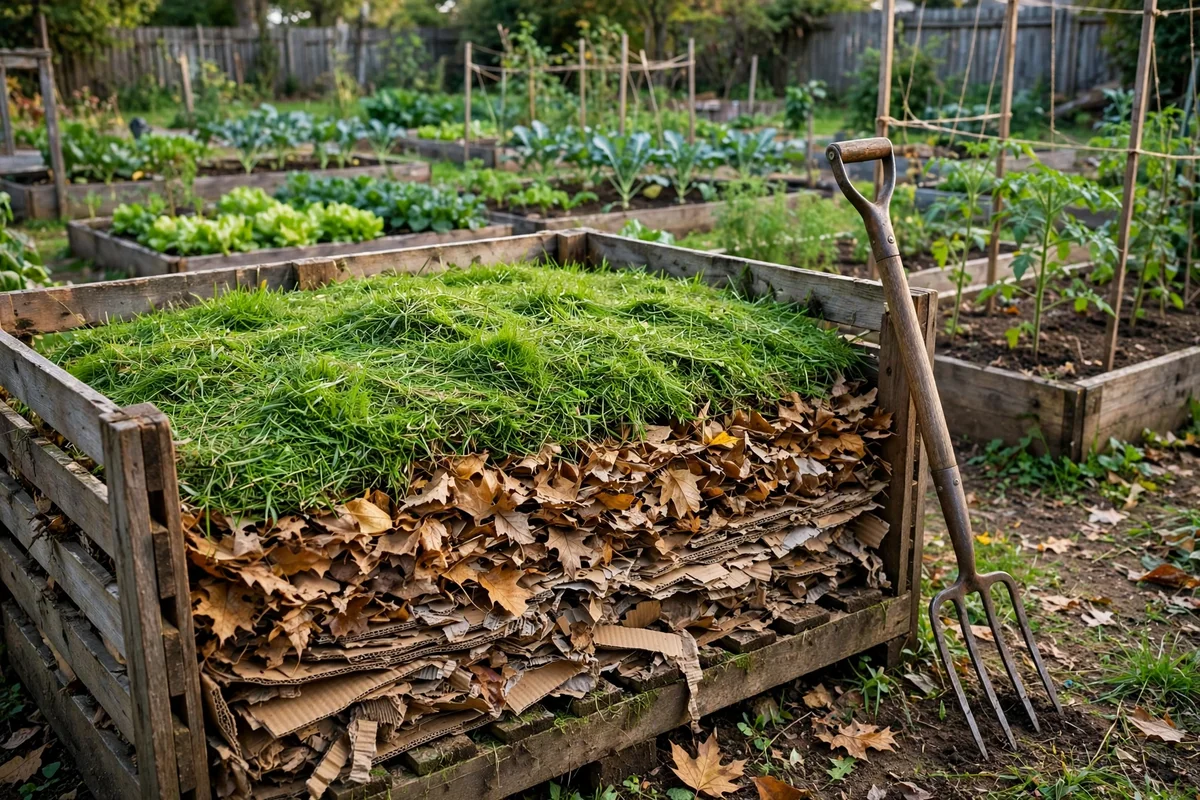
Every compost guide repeats the same two instructions: aim for a greens to browns ratio of about 30:1, and measure it in buckets. What none of them mention is that those two instructions fight each other. The 30:1 figure is a ratio of carbon to nitrogen by weight; a bucket is a measure of volume; and the materials in your buckets carry wildly different amounts of each. A bucket of food scraps needs nearly four buckets of dry leaves to balance it, while a bucket of grass clippings needs barely one — follow the standard "two or three buckets of browns per bucket of greens" for both, and one pile cooks beautifully while the other turns into a slimy, ammonia-smelling swamp. This page replaces the guesswork with a bucket chart worked out from the actual carbon and nitrogen in each material.
The short answers
- Target: about 30 parts carbon to 1 part nitrogen (25:1 to 30:1 heats fastest)
- Per bucket of grass clippings: add about 1 bucket of dry leaves, or ½ bucket of wood chips
- Per bucket of food scraps: add about 3½–4 buckets of dry leaves — scraps are far richer than grass
- Per bucket of coffee grounds: about 2 buckets of leaves, or 1 of cardboard
- Never average the ratios — 15:1 plus 54:1 does not make 35:1 (it makes about 21:1, and a smell)
The trap: why you cannot average two ratios
Here is the mistake, worth seeing once with real numbers. Food scraps sit at about 15:1 and dry leaves at about 54:1, so the averaged guess says an equal mix lands near 35:1 — close to perfect. It does not. A cubic foot of food scraps carries roughly 5.5 lb of carbon on 0.37 lb of nitrogen; a cubic foot of leaves carries about 3.4 lb of carbon on only 0.06 lb of nitrogen. Add them and the true mix is 8.9 lb of carbon over 0.43 lb of nitrogen — about 21:1, deep in the too-much-nitrogen zone where piles go slimy and bleed ammonia. Ratios are fractions, and fractions cannot be averaged by averaging their faces. The chart below does the honest arithmetic for you, once, so you never have to.
The bucket chart: greens to browns ratio in buckets, not grams
Read it as: for one bucket (any size — the proportions are what matter) of the green on the left, add this many buckets of the brown across the top to land on roughly 30:1. The figures are computed from each material's carbon and nitrogen content, moisture and loose density — the same extension data behind our Compost Calculator, which also works out how much finished compost a bed or lawn needs.
| 1 bucket of this green… | …needs dry leaves | …or straw | …or wood chips | …or shredded cardboard |
|---|---|---|---|---|
| Grass clippings (17:1) | 1.1 buckets | 0.9 | 0.4 | 0.5 |
| Food scraps (15:1) | 3.7 buckets | 2.9 | 1.2 | 1.8 |
| Coffee grounds (20:1) | 1.8 buckets | 1.4 | 0.6 | 0.9 |
| Horse manure (30:1) | Already balanced — add browns only for structure and dryness | |||
Three things this chart explains that the folk rule never could. Food scraps are the troublemakers — wet, dense and nitrogen-heavy, they need three to four times their volume in leaves, which is why the kitchen-scrap layer is where most piles turn. Chips and cardboard punch far above their volume — a little goes a long way, because their carbon dwarfs everything else on the list. And manure is nearly a finished mix by itself, which is why old farming piles of manure and bedding just work. Starting a pile from zero? How to Start Composting for Beginners covers bins and first layers; come back here whenever the pile smells wrong — the smell is this ratio, talking.
The reference chart: C:N ratios for common materials
| Material | Green or brown | C:N ratio (typical) |
|---|---|---|
| Food scraps | Green | 15:1 |
| Grass clippings, fresh | Green | 17:1 |
| Coffee grounds | Green | 20:1 |
| Fresh weeds and garden waste | Green | 20:1 |
| Horse manure | Green (nearly balanced) | 30:1 |
| Dry leaves | Brown | 54:1 |
| Peat moss | Brown | 58:1 |
| Corn stalks | Brown | 60:1 |
| Straw | Brown | 70:1 |
| Wood chips | Brown | 300:1 |
| Shredded cardboard | Brown | 560:1 |
Real materials wander around these figures — leaves run anywhere from 30:1 to 80:1 depending on the tree — so treat the chart as a steering wheel, not a laboratory result. The pile itself grades your work within days: heating to a steamy 130–160°F in the centre means the mix is close; the troubleshooting below translates the two failure smells.
Reading the pile: too green, too brown, and the two-bucket fix
Smells of ammonia, slimy, black and wet: too much nitrogen — the mix is down near 20:1 or lower. Fork in browns at the chart's rate for whatever green you last added (a scraps problem wants roughly 3–4 buckets of leaves per bucket of scraps already in), and the smell should fade within a day or two as the excess nitrogen gets eaten instead of evaporating. That ammonia is your fertilizer leaving — every smelly day is nitrogen the garden will never see.
Looks fine, does nothing, stone cold: too much carbon, or too dry — the microbes are starving at 50:1 and beyond. Add greens (a bucket of grass clippings is the fastest defibrillator a cold pile can get), water to the dampness of a wrung-out sponge, and turn it. The winter version of this problem has its own playbook in Composting in Winter.
Finished compost is a soil ingredient, not a garnish: when a batch is done, the Raised Bed Soil Calculator gives the volumes for refreshing beds with it, and heavy feeders like Tomato are where the best of it should go. Planning next season's beds around a compost corner? Sketch it in the Garden Planner — bins near beds, out of the midday scorch, is a layout decision worth making on paper.
Keep going
The companion guides: How to Start Composting for Beginners for bins and first layers, Composting in Winter for keeping a pile alive through the cold, and Wood Ash in the Garden for the other free soil amendment with a ratio problem of its own.
Using the finished product: raised beds drink the most compost on the site — Raised Bed Soil Top-Up Amounts gives the inches-to-bags maths for refreshing them each season.
Questions people ask
What is the ideal greens to browns ratio for compost?
About 30 parts carbon to 1 part nitrogen by weight — the 25:1 to 30:1 band where a pile heats fastest and loses the least nitrogen. In buckets, the answer depends completely on the materials: roughly 1 bucket of leaves per bucket of grass clippings, but 3½ to 4 buckets of leaves per bucket of food scraps. Use the bucket chart on this page for your actual materials.
Can I just use 3 parts browns to 1 part greens?
As a rough starting point for grass-and-leaves piles it works, because grass is a mild green. It fails for food scraps, which are much richer — three buckets of leaves per bucket of scraps still leaves the mix near the slimy end — and it over-browns coffee grounds and manure, which need far less. The 3:1 rule is a decent guess for one specific pile and a poor one for all the others.
Why does my compost smell like ammonia?
Too much nitrogen for the carbon available — the mix is too green. The ammonia smell is literally your fertilizer evaporating. Fork in browns at the chart rate for the greens you have been adding, turn the pile, and the smell should clear in a day or two. A pile that smells right — earthy, faintly sweet — is a pile holding onto its nitrogen.
Are coffee grounds a green or a brown?
A green, despite being brown in colour — the names describe nitrogen, not appearance. At about 20:1 they are a mild green, closer to balanced than grass clippings, and a bucket of grounds needs roughly 2 buckets of leaves or 1 of shredded cardboard to hit 30:1.
My pile is not heating up. Is the ratio wrong?
Probably, in the other direction: too much carbon (or too little moisture, or too small a pile — under about 3 feet cubed, piles struggle to hold heat regardless of mix). Add a bucket or two of grass clippings, water to wrung-sponge dampness and turn it. If it heats within a couple of days, the ratio was the problem; if it does not, size and dryness are.
Comments & ratings
No comments yet.
Be the first to share your experience.