
Guides · Lawn & Watering · Published November 13, 2026
How Long to Run Sprinklers for 1 Inch of Water: Exact Minutes by Sprinkler and Soil
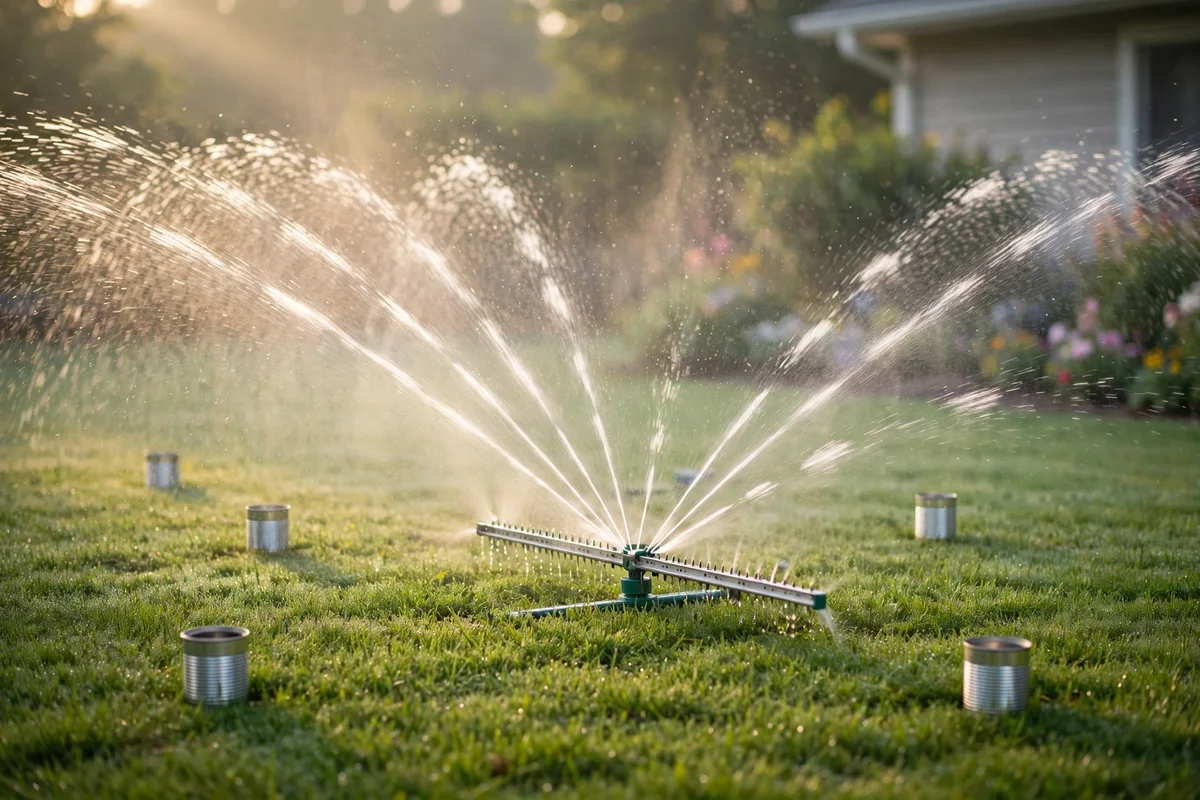
Ask how long to run sprinklers for 1 inch of water and most advice gives one number — "about an hour" — as if every sprinkler on Earth poured at the same speed. They do not. A fixed spray head throws water at roughly 1.75 inches per hour; a gear-drive rotor manages about 0.5 inches per hour. The same inch of water therefore takes 34 minutes from one sprinkler and 2 hours from the other, and a controller set from a magazine chart is set for somebody else's lawn. This page gives the minutes per sprinkler type, the two-minute test that measures your sprinkler instead, and the split-cycle schedules that stop clay soil from shedding half the water down the driveway.
The short answers
- Fixed spray heads: 34 minutes for 1 inch · 17 minutes for ½ inch
- Oscillating hose sprinkler: about 86 minutes for 1 inch · 43 for ½ inch
- Rotors and rotary nozzles: 2 hours to 2½ hours for 1 inch
- The rule: minutes = 60 ÷ your sprinkler's inches-per-hour rate
- On clay, never run it all at once — a spray head starts running off after about 7 minutes, so split the run into cycles with soak breaks
Why one lawn needs 34 minutes and the next needs 2 hours
Run time is just depth divided by application rate, and the rate is a property of the nozzle, not the lawn. That is also why vegetable beds play by different rules: a drip emitter delivers gallons to one plant at a time, which is why drip run times are set per plant instead of per inch. For sprinklers, find your head type in the chart, read across, and that is your starting schedule — then confirm it with the can test below, because pressure, nozzle wear and spacing move real rates well away from catalogue ones. Planning the whole garden's water while you are here? The garden water use guide totals up what beds and lawn together actually drink.
How long to run sprinklers for 1 inch of water, by sprinkler type
Rates below are the typical mid-range figures for each head family at normal home pressure (manufacturers and extension services quote the same bands: sprays 1–2 in/hr, rotors 0.25–0.75 in/hr). Minutes are rate maths, rounded to the nearest minute: 60 ÷ rate for a full inch.
| Sprinkler type | Typical rate | Minutes for ½ inch | Minutes for 1 inch |
|---|---|---|---|
| Fixed spray head (pop-up spray zones) | 1.75 in/hr | 17 | 34 |
| Oscillating hose sprinkler | 0.7 in/hr | 43 | 86 |
| Impact sprinkler | 0.45 in/hr | 67 | 133 |
| Gear-drive rotor | 0.5 in/hr | 60 | 120 |
| Rotary (multi-stream) nozzle | 0.4 in/hr | 75 | 150 |
Two honest warnings about this chart. First, the ½-inch column is the one most lawns should actually use: an inch a week is the standard target, and two half-inch waterings soak deeper with less runoff than one full-inch flood on most soils. Second, an inch is a lot of water — 623 gallons on every 1,000 square feet. A 5,000 sq ft lawn drinks about 3,100 gallons per full-inch watering, which is why shaving a wrong guess off the timer matters. For scale, that single watering is roughly what a 1,000 sq ft roof hands you in about 6 inches of rain — the Rain Barrel Calculator shows what your own roof could cover.
Step 1 — Measure your real rate with the can test (15 minutes)
Catalogue rates assume catalogue pressure. The can test — extension services call it a catch-can or tuna-can test — measures the sprinkler you actually own:
1. Set 4 to 6 straight-sided cans (empty tuna cans are perfect) at intervals across one zone, some near the heads, some between them.
2. Run that zone for exactly 15 minutes.
3. Measure the depth in each can, average them, and multiply by 4 — that is your inches-per-hour rate.
4. Minutes for 1 inch = 60 ÷ rate. Caught an average of ¼ inch in 15 minutes? Your rate is 1 in/hr and a full inch takes 60 minutes; ½ inch takes 30.
The spread between cans is information too. If one can holds twice another, the zone waters unevenly and the dry spots set your run time no matter what the average says — fix tilted or clogged heads before you fix the schedule. Repeat the test per zone; front and back yards on different head types are different schedules.
Step 2 — Split the run on soil that cannot keep up (cycle and soak)
Soil drinks at its own speed: roughly 1 inch per hour for sand, ½ inch per hour for loam, and only about 0.2 inches per hour for clay. When the sprinkler applies faster than the soil accepts, the excess does not wait — it runs off. A spray head on clay is applying nearly nine times faster than the ground can absorb, so most of a straight 34-minute run leaves. The fix is cycle-and-soak: run up to the soil's limit, rest 30 minutes, repeat.
| Sprinkler type | Longest single run on sand | On loam | On clay |
|---|---|---|---|
| Fixed spray head | 34 min (full run OK) | 17 min | 7 min |
| Oscillating hose sprinkler | Full run OK | 43 min | 17 min |
| Impact sprinkler | Full run OK | Full run OK | 27 min |
| Gear-drive rotor | Full run OK | Full run OK | 24 min |
| Rotary nozzle | Full run OK | Full run OK | 30 min |
Worked example, the hardest common case — spray heads on clay: you need 34 minutes total, the soil takes 7 minutes at a stretch, so program 5 cycles of about 7 minutes with at least 30 minutes between them. Most controllers call this "cycle and soak" or let you repeat a start time; hose-end users can simply move the sprinkler to another patch and come back. Slopes behave like clay even when the soil is loam — halve the cycle length on any ground water visibly slides off.
Step 3 — Set the weekly pattern, then let the lawn grade it
For most lawns in most summers: ½ inch twice a week, watered early in the morning so it soaks before the day heats up, skipping any session that real rain already delivered (a cheap rain gauge in the lawn settles arguments the forecast starts). In a heatwave, add a third session rather than lengthening the two — depth per session is capped by your soil, not by your intentions. Then read the lawn, not the calendar: footprints that stay flattened in the grass and blades folding in half lengthwise are thirst signals; mushrooms and a squelchy surface are over-watering ones. Laying out beds or a new lawn shape while you rethink watering? Sketch it first in the Garden Planner — zone maps are cheaper on paper than in pipe.
Keep going
Watering the beds instead: Drip Irrigation Run Time by Plant sets minutes per vegetable, and How Much Water Does a Vegetable Garden Use? totals the weekly gallons. Storing roof water for dry weeks starts with What Size Rain Barrel Do I Need?
And if the lawn itself is the problem child — thirsty, patchy, expensive — the lowest-water planting on the site is in the plant library: Lavender and the other drought-tolerant plantings want a fraction of what turf drinks once established.
Questions people ask
How long should I run my sprinklers to get 1 inch of water?
It depends on the head, not the lawn: about 34 minutes for fixed spray heads, 86 minutes for an oscillating hose sprinkler, 2 hours for rotors and 2½ hours for rotary nozzles. The only number that is truly yours comes from the can test: run the zone 15 minutes, average the depth caught, multiply by 4 for your inches-per-hour rate, then divide 60 by it.
Is it better to run sprinklers for 1 inch once a week or ½ inch twice?
Twice, for most lawns. Two half-inch sessions soak to root depth with far less runoff, especially on clay and slopes where a full inch cannot enter the ground in one sitting. Sandy soil is the partial exception — it drains so fast that the two patterns end up similar, and in extreme heat a third short session helps more than a longer one.
How long should I run sprinklers in clay soil?
Never the full chart time in one go. Clay accepts only about 0.2 inches per hour, so a spray head starts shedding water after roughly 7 minutes. Split the total into cycles at or under the clay column in the chart above — about 7 minutes per cycle for spray heads, 24 for rotors — with at least 30 minutes of soak time between cycles.
How many gallons is 1 inch of water on a lawn?
About 623 gallons per 1,000 square feet. A typical 5,000 sq ft lawn therefore uses roughly 3,100 gallons for one full-inch watering, which is why correcting a doubled run time is one of the largest easy savings on a water bill.
What is the tuna can test for sprinklers?
It is the home version of an irrigation audit: straight-sided cans placed across a zone, one 15-minute run, then measure and average the depths caught. Multiply the average by 4 and you have your system's real inches-per-hour; divide 60 by that number for the minutes needed to apply 1 inch. Big differences between cans mean uneven coverage that longer run times cannot fix.
Comments & ratings
No comments yet.
Be the first to share your experience.