
Guides · Watering · Published November 12, 2026
Drip Irrigation Run Time by Plant: Emitters and Minutes for 12 Vegetables
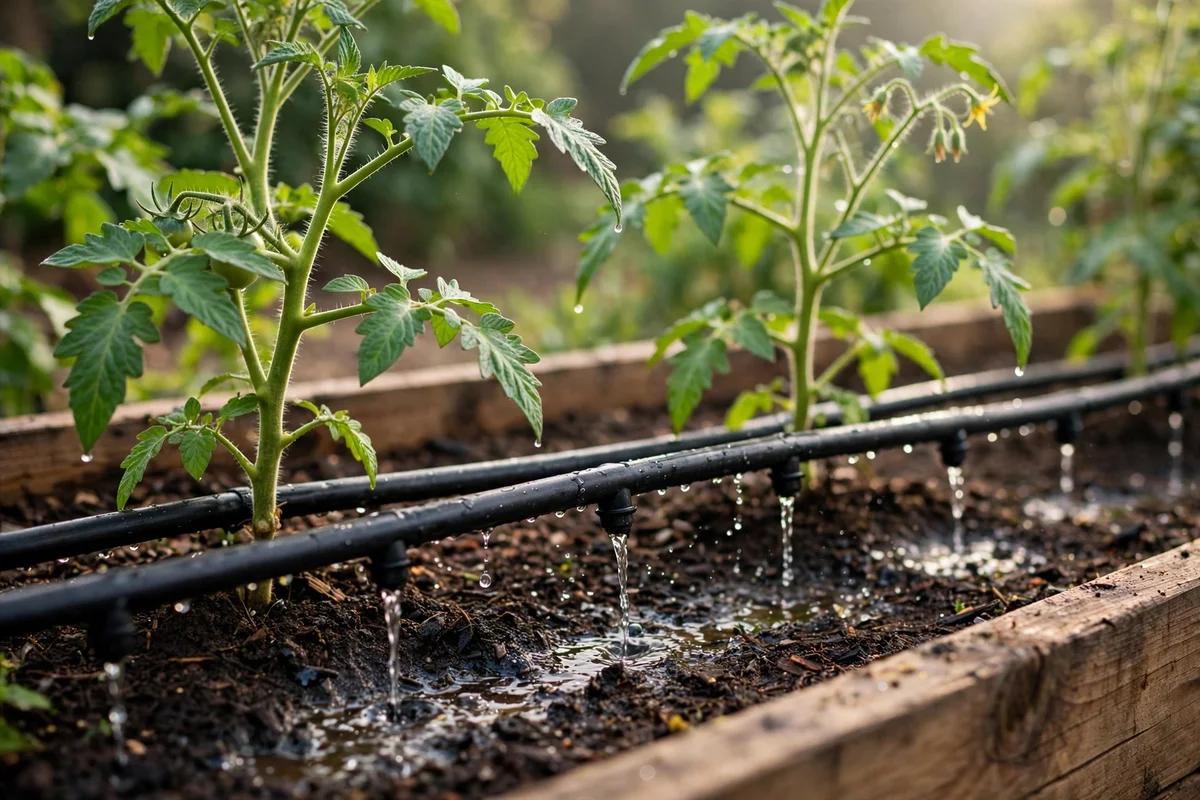
Ask the internet how long to run drip irrigation and you get one answer for every garden on Earth: "30 to 60 minutes." Thirty minutes of what, though — through a 0.5 GPH emitter on a lettuce, or two 1 GPH emitters on a tomato that drinks ten times as much? Run time is not a property of the timer; it is a property of the plant, the emitter and the session. This page gives the number per plant: how many gallons a mature plant needs in a peak summer week, how many emitters to clip onto it, and the exact minutes per session that deliver those gallons. The headline case: a tomato needs about 5 gallons a week, and with two 1 GPH emitters, run twice a week, that is 75 minutes per session.
The short answers
- The formula: minutes per session = (gallons per session ÷ total emitter GPH on that plant) × 60
- Tomato: 5 gal/week · 2 emitters at 1 GPH · 75 minutes, twice a week
- Pepper: 2 gal/week · 1 emitter at 1 GPH · 60 minutes, twice a week
- Lettuce and onions: 0.5 gal/week · 1 emitter at 0.5 GPH · 30 minutes, twice a week
- Two deep sessions beat daily sips — then verify by digging: moist 6–8 inches down an hour later means you got it right
Plan the line before you set the timer
Emitter spacing is plant spacing — an emitter belongs at each plant's root zone. Lay your beds out with the Plant Spacing Calculator and the emitter count per bed falls straight out of the plant count. Feeding the line from a barrel instead of a tap? The Rain Barrel Calculator works out how many gallons your roof delivers; Step 4 below shows how long that stored water actually runs a line. Setting the system up from scratch first? How to Set Up Drip Irrigation covers the hardware, then come back here for the numbers.
Step 1 — Start from the plant's weekly gallons, not the timer
Every run-time answer begins with a target: how much water this plant should receive in a hot, dry week once it is full size. The figures below are peak-summer targets for mature plants in beds or in-ground rows, built from the standard one-to-one-and-a-half-inches-a-week rule applied to each plant's root-zone area. In spring, with small plants and cool weather, run about half. After real rain, skip a session — the target is rain plus irrigation combined.
| Plant | Gallons per week (peak) | Emitters per plant | Minutes per session · 2 sessions a week |
|---|---|---|---|
| Tomato | 5 | 2 × 1 GPH | 75 |
| Zucchini | 6 | 2 × 1 GPH | 90 |
| Cucumber | 4 | 2 × 1 GPH | 60 |
| Potato | 3 | 1 × 1 GPH | 90 |
| Pepper | 2 | 1 × 1 GPH | 60 |
| Kale | 1.5 | 1 × 1 GPH | 45 |
| Bush beans | 1 | 1 × 0.5 GPH | 60 |
| Strawberry | 1 | 1 × 0.5 GPH | 60 |
| Basil | 0.75 | 1 × 0.5 GPH | 45 |
| Carrots (per foot of row) | 0.75 | 1 × 0.5 GPH per foot | 45 |
| Lettuce | 0.5 | 1 × 0.5 GPH | 30 |
| Onion | 0.5 | 1 × 0.5 GPH | 30 |
Read one row end to end and the whole system makes sense. A tomato's 5 gallons a week, split across two sessions, is 2.5 gallons per session. Two 1 GPH emitters deliver 2 gallons an hour, so 2.5 gallons takes an hour and a quarter — 75 minutes. Change the emitters and the minutes change, but the gallons never do: on a single 1 GPH emitter the same tomato needs 150 minutes a session, and on two 2 GPH emitters (a good choice in sandy soil) just 38.
Step 2 — Fit the emitters to the plant
Big plants get two emitters, one either side of the stem about 6 inches out, because a single wet spot leaves half the root zone dry — and a half-dry tomato is the classic setup for blossom end rot, which is a watering-consistency problem far more often than a calcium problem. As the plant grows, nudge the emitters outward toward the drip line of the leaves. Small, dense crops — lettuce, onions, carrots, beans — are easier on dripline with built-in emitters every 12 inches, which works out to roughly one 0.5 GPH emitter per plant or per foot of row, exactly how the table treats them. Three hardware points decide whether the printed flow rate is the real one: fit a 25 PSI pressure regulator (house pressure of 40–80 PSI makes emitters mist and lie), use 0.5 GPH emitters on clay so water soaks in instead of pooling, and keep line runs under about 200 feet of half-inch tubing or the far end starves.
Step 3 — Adjust for your soil, then check with a trowel
The table assumes loam. Soil changes the schedule, never the weekly gallons. In sandy soil, water drains through before it spreads sideways, so split the same weekly total into three shorter sessions. In clay, water spreads well but enters slowly: run each session in two halves with an hour's break between them (cycle-and-soak) so it soaks instead of running off. Mulched beds hold moisture noticeably longer than bare ones — if your beds are mulched and the dig test still shows moisture at 6 inches on watering day, stretch the gap between sessions rather than shortening the sessions themselves.
Whatever the chart says, the trowel is the referee. An hour after a session ends, dig one careful hole beside a plant: the soil should be moist 6 to 8 inches down for vegetables, and the wet zone should reach most of the way across the plant's root area. Too shallow — lengthen the session. Wet only in a narrow spike under the emitter — add the second emitter before you add minutes.
Step 4 — One worked zone: what the timer setting really delivers
Say one drip zone waters a bed of 8 tomatoes and 8 peppers, fitted exactly as the table says. The zone's total flow is (8 × 2 × 1 GPH) + (8 × 1 × 1 GPH) = 24 GPH. Run the timer 75 minutes and the zone delivers 30 gallons: each tomato receives its full 2.5-gallon session, and each pepper receives 1.25 gallons — a little over its 1-gallon session target, which in peak heat is harmless, and in mild weather is your cue to move the peppers to 0.5 GPH emitters or onto their own shorter zone. That small mismatch is the honest limit of shared zones: group plants with similar thirst on the same timer wherever you can.
Feeding that zone from a 55-gallon rain barrel? At 24 GPH, a full barrel lasts about 2 hours 20 minutes — roughly three normal sessions, or a week and a half of the bed's water. Size the storage to your beds with the Rain Barrel Calculator, and remember gravity pressure is low: choose emitters rated for it, keep lines short, and expect delivery a touch slower than the label rate. Laying out a new bed for all this? Put the plants, paths and water points on paper first in the Garden Planner — emitter maths is much cheaper before the plants are in.
Keep going
Installing the system itself: How to Set Up Drip Irrigation walks the hardware end to end, and How to Water Plants While on Vacation covers timers and backups for when you are away.
Dial in individual crops in the plant library — Tomato, Cucumber, Pepper, Zucchini — or check the whole garden's weekly water bill in How Much Water Does a Vegetable Garden Use?
Questions people ask
How long should I run drip irrigation for tomatoes?
A mature tomato plant needs about 5 gallons a week in peak summer. With two 1 GPH emitters on the plant, split into two sessions a week, run the timer about 75 minutes per session. In sandy soil split the same water into three shorter sessions; in clay, run it in two halves with an hour's soak break in between.
How many emitters does a tomato plant need?
Two emitters for a full-size tomato — one either side of the stem, about 6 inches out — so the whole root zone gets wet. Small plants under a foot tall manage on one emitter until they size up. Peppers and kale need one emitter each; cucumbers and zucchini need two.
Is 30 minutes of drip irrigation enough?
For small, shallow-rooted crops on gentle emitters, yes — lettuce and onions do well on about 30 minutes twice a week with a 0.5 GPH emitter each. For fruiting plants it is not: a tomato on two 1 GPH emitters only receives 1 gallon in 30 minutes, about a fifth of its peak-week need. The right check is to dig 6 to 8 inches down an hour after watering; the soil should be moist at that depth.
How long will a 55-gallon rain barrel run a drip line?
Divide 55 by your line's total flow. A bed line of 24 emitters at 1 GPH flows 24 gallons per hour, so a full barrel lasts about 2 hours 20 minutes — roughly three normal watering sessions. Gravity-fed barrels run at low pressure, so use emitters rated for low pressure or a small pump, and expect slightly slower flow than the rating printed on the emitter.
Should I run drip irrigation every day or twice a week?
Twice a week, deeply, for almost everything in the ground or in a raised bed. Deep sessions push roots downward and wet the full root zone; short daily runs keep only the top inch damp and train shallow roots. The exceptions are containers, very sandy soil and newly sown seedbeds, which can need shorter, more frequent sessions.
Comments & ratings
No comments yet.
Be the first to share your experience.