
Guides · Watering · Published November 12, 2026
How Much Water Does a Vegetable Garden Use? Gallons a Week, a Season — and the Bill
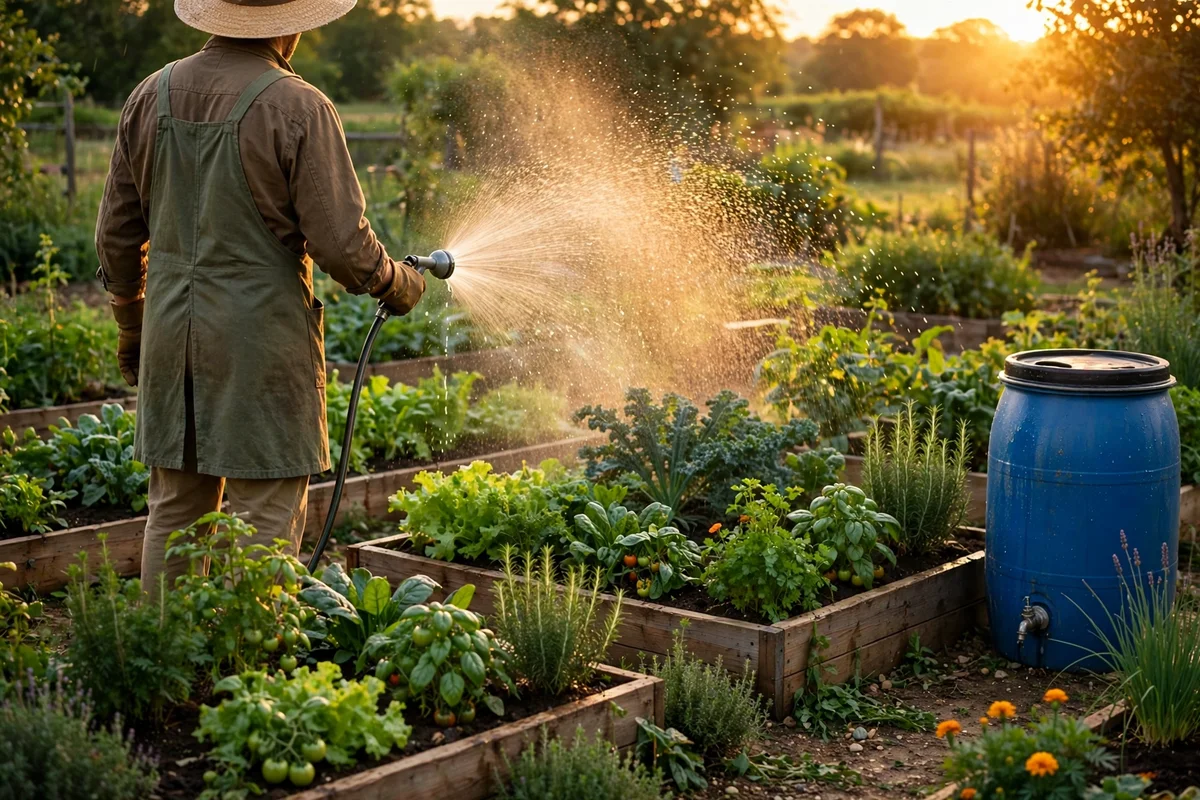
Vegetable gardens are watered by the inch — "an inch a week" — but water arrives by the gallon, is stored by the gallon and is billed by the gallon, and nobody's hose has an inch gauge on it. So here is the conversion nobody bothers to finish: one inch of water over one square foot is 0.623 gallons, which means one standard 4×8 bed drinks about 20 gallons a week, a four-bed garden about 80, and a whole 20-week season for that garden comes to roughly 1,600 gallons — about $10 to $19 at typical water rates. The full picture follows: weekly gallons by garden size, the season total, the bill, and the number gardeners actually feel — how many minutes a week you stand there holding the hose.
The short answers
- The conversion: gallons = square feet × inches of water × 0.623
- One 4×8 bed: about 20 gal/week at 1 inch · about 30 in peak heat (1.5 in)
- Four beds (128 sq ft): 80 gal/week · about 1,600 gallons a 20-week season · roughly $10–19 a season
- Hose time: at a typical 5 gallons a minute, one bed's weekly inch is about 4 minutes of flow
- Context: a 5,000 sq ft lawn at the same inch drinks about 3,115 gallons a week — the vegetable beds are not your water bill's problem
Turn roof rain into garden water
The cheapest gallons are the ones that fall on the roof. The Rain Barrel Calculator takes your roof area and rainfall and returns gallons collected and barrels needed — and Step 4 below puts a number on what that stored water is worth against the totals on this page. New to harvesting? Rainwater Harvesting for Beginners covers the setup before you size anything.
Step 1 — The weekly gallons, by garden size
The one-inch rule is good advice with a useless unit. Converting it is a single multiplication — area × depth × 0.623 — and here it is done for the garden sizes people actually have, at the standard inch and at the inch-and-a-half that hot, dry, windy weeks in mid-summer call for:
| Garden | Area | At 1 inch a week | At 1.5 inches (peak heat) |
|---|---|---|---|
| One 4×8 raised bed | 32 sq ft | About 20 gal | About 30 gal |
| Two 4×8 beds | 64 sq ft | About 40 gal | About 60 gal |
| Four 4×8 beds | 128 sq ft | About 80 gal | About 120 gal |
| Six 4×8 beds | 192 sq ft | About 120 gal | About 180 gal |
| In-ground plot, 10×20 ft | 200 sq ft | About 125 gal | About 187 gal |
| Large plot, 20×20 ft | 400 sq ft | About 249 gal | About 374 gal |
Two qualifications keep these numbers honest. First, the target is always rain plus watering: a week with half an inch of rain halves what you add, which is why a five-dollar rain gauge in the middle of the garden pays for itself in the first month. Second, raised beds and containers run thirstier than the table — they drain freely and warm from the sides — so in a heatwave treat the 1.5-inch column as their normal and check the soil with a finger before assuming the schedule is keeping up. What each individual plant does with its share, emitter by emitter, is worked out in Drip Irrigation Run Time by Plant.
Step 2 — The season total, and what it costs
Multiply the weekly figure by your watering season — 20 weeks is a fair average for a temperate garden, counting the weeks rain does not cover — and the season's water budget appears:
| Garden | Gallons per season (20 weeks at 1 in) | Cost at $6 per 1,000 gal | Cost at $12 per 1,000 gal (water + sewer) |
|---|---|---|---|
| One 4×8 bed | About 400 | About $2.40 | About $4.80 |
| Two 4×8 beds | About 800 | About $4.80 | About $9.60 |
| Four 4×8 beds | About 1,600 | About $9.60 | About $19 |
| Six 4×8 beds | About 2,400 | About $14 | About $29 |
| Large plot, 400 sq ft | About 5,000 | About $30 | About $60 |
Rates vary by town and many utilities price in tiers, so check your own bill for the real per-1,000-gallon figure — but the order of magnitude surprises almost everyone: a productive four-bed vegetable garden costs less to water for a whole season than a single month of keeping a mid-size lawn green (that lawn, at 5,000 sq ft, uses about 3,115 gallons a week). Water is not the expensive input to a vegetable garden. Your time is — which is the next number.
Step 3 — Your minutes at the hose
Gallons become minutes through your hose's flow rate. Find yours with a bucket and a phone timer: time the open hose filling a 5-gallon bucket and divide 300 by the seconds — 30 seconds means 10 gallons a minute, 60 seconds means 5 GPM, and 5 GPM through a wand or nozzle is the common case. At 5 GPM the flow-time for a weekly inch is about 4 minutes per 4×8 bed — 16 minutes for four beds. Hand-watering takes longer than the pure flow time, of course, because you move, aim and wait for soak-in; but the comparison that matters is with a sprinkler left running "for a while," which happily pours 500-plus gallons an hour over beds that asked for 80 a week. The real fix for hose time is delivery that runs itself: a drip line on a timer delivers the exact gallons from Step 1 at the root zone, and its minutes per plant are charted in the drip run-time guide. Time the whole layout once in the Garden Planner — beds, water points and planting dates in one place.
Step 4 — Three honest ways to use less
Mulch first. A 2-to-3-inch mulch layer shades the soil and slows evaporation, and it is the only saving that also feeds the bed — depths by material are in How Deep Should Mulch Be? Drip second. Water delivered at the root zone instead of sprayed over the whole bed typically cuts what a bed needs by a fifth to a third, because almost none of it lands on paths or evaporates mid-air. Rain barrels third — with honest expectations. One 55-gallon barrel holds about 2.8 weeks of one bed's water but only about 70% of one week for a four-bed garden; its real value is how fast a roof refills it. An inch of rain on just 500 square feet of roof yields roughly 265 usable gallons after losses — over three weeks of a four-bed garden's summer water, from a single ordinary storm. Size the system to your roof and beds with the Rain Barrel Calculator, and give thirsty crops like tomatoes and cucumbers first claim on the stored water.
Keep going
Per-plant delivery: Drip Irrigation Run Time by Plant turns these gallons into emitters and timer minutes for 12 vegetables, and How Much Water Does a New Tree Need? does the same job for the tree in the corner.
Setting up storage and delivery: Rainwater Harvesting for Beginners and How to Set Up Drip Irrigation.
Questions people ask
How many gallons of water does a 4×8 raised bed need per week?
About 20 gallons for the standard one inch of water a week, and about 30 gallons in peak summer heat when the target rises to an inch and a half. The maths is the same for every bed: square feet × inches × 0.623. A 4×8 bed is 32 square feet, so 32 × 1 × 0.623 is about 20 gallons. Count any rain that week toward the total — a simple rain gauge in the bed tells you what is left to add.
How much does it cost to water a vegetable garden?
Less than most people fear. A four-bed garden (128 sq ft) uses about 80 gallons a week at one inch, roughly 1,600 gallons over a 20-week season. At typical US rates of $6 per 1,000 gallons for water alone, or about $12 with sewer charges included, that is roughly $10 to $19 for the entire season. Even in peak summer at an inch and a half a week, the same garden runs about $3 to $6 a month.
How do I find my hose's flow rate?
Time how long the open hose takes to fill a 5-gallon bucket, then divide 300 by the seconds. Thirty seconds to fill means 10 gallons a minute; 60 seconds means 5 GPM, which is typical through a nozzle or wand. That number turns every gallons figure on this page into your personal watering time.
Does rain count toward the weekly inch?
Yes — the target is always rain plus watering combined. An inch of rain on your beds is the full week's requirement delivered free; half an inch leaves half to add. A cheap rain gauge in the garden beats guessing, because a heavy-looking shower often delivers less than it feels like, and a long soft rain delivers more.
How much of my garden's water can a rain barrel cover?
A full 55-gallon barrel holds about 2.8 weeks of water for one 4×8 bed at an inch a week, or about 70% of one week for a four-bed garden. The bigger prize is refills: an inch of rain on just 500 square feet of roof yields roughly 265 usable gallons — more than three weeks of a four-bed garden's summer water — so a barrel under a working downspout refills far more often than it empties.
Comments & ratings
No comments yet.
Be the first to share your experience.