
Plant Library · Houseplants
🪴 How to Grow Monstera
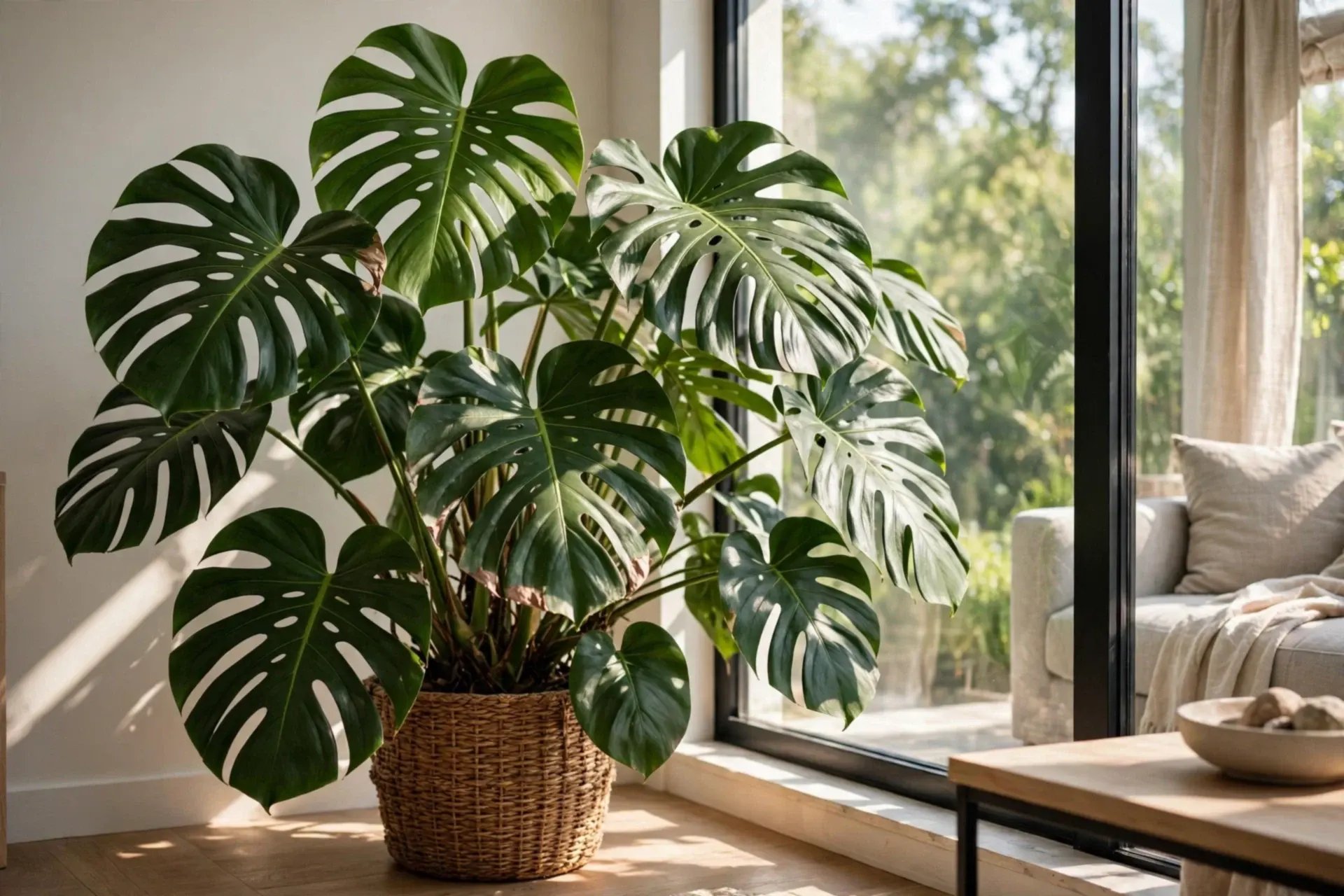
The Swiss cheese plant, and the most wanted houseplant of the last decade — a rainforest climber whose leaves split and hole as it matures, if (and only if) it gets enough light. Monstera is a houseplant for indoors year-round: give it bright indirect light, a chunky free-draining mix, and something to climb, and it repays you with leaves the size of dinner plates.
🎬 Watch: Why Your Leaves Aren't Splitting
Prefer to watch it happen? In this short animated story, Dan shows Lily the five rules that get a monstera's leaves to split.
Grow Monstera with us — step by step
Everything for this plant is written step by step below — what to do, and exactly when. Read it through first if you like: you can grow it entirely on your own with that guide. Or start with us here — tell us your planting day and we lay out your personal schedule on this page, every next step on its own day, counted from your planting date. No guessing, no forgetting.
Step 1 — today: Settle your Monstera into its spot today: a pot with drainage, the light it loves (bright indirect light), and one good watering to settle the mix around the roots.
Monstera at a glance
Spacing: — (pot) · Propagation: Stem cuttings with a node, not seed
Sun: Bright indirect light; no harsh midday sun
Water: When the top 1–2 inches of mix are dry
Harvest: Grown for foliage — no harvest
Timing counts from your average last spring frost — get your own dates in the Planting Calendar. Guidance follows standard extension-service practice for Canada and the US.
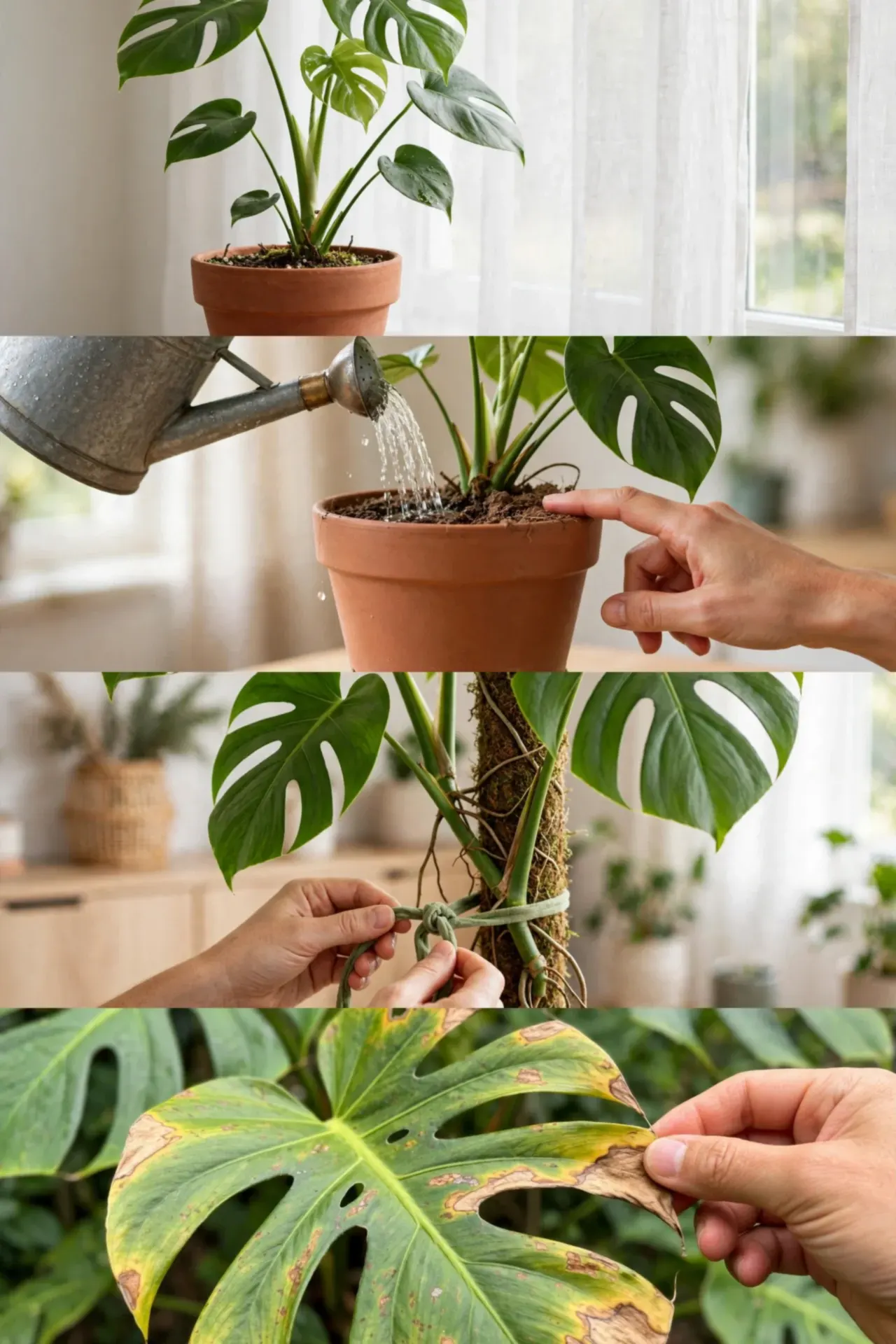
How to plant and grow monstera, step by step
Step 1 — Choose its spot
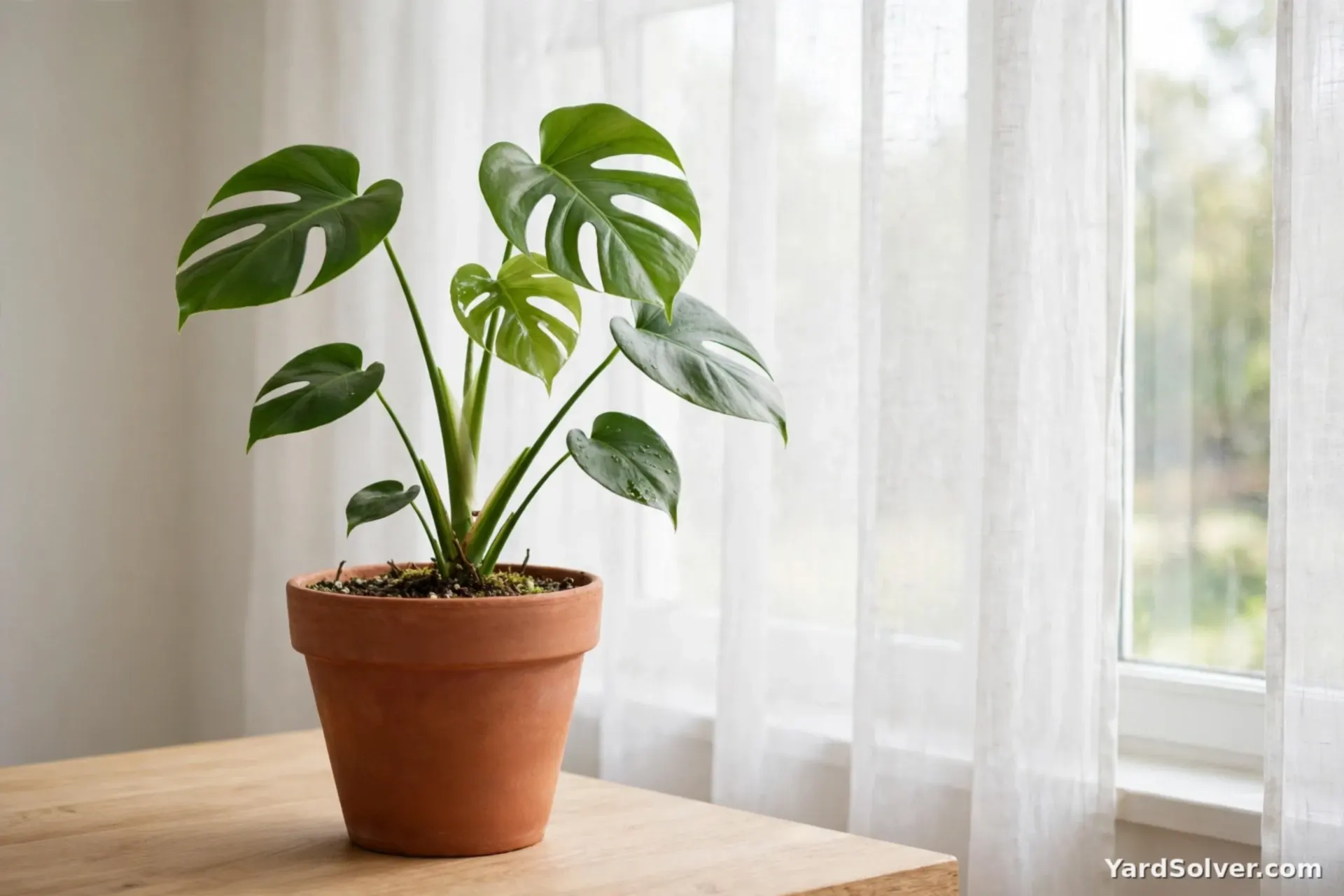
Bright indirect light suits monstera best — close to a bright window, with direct sun softened by a sheer curtain or a step back from the glass. This one decision decides whether you get the famous split leaves or a plant that stays stubbornly plain: in dim corners monstera survives, but every new leaf comes out small, whole and widely spaced on a leggy stem. Harsh midday sun through glass scorches pale patches into the leaves, so the target is bright shade, and a quarter turn of the pot every week or two keeps growth even.
Step 2 — Pot it in a chunky mix
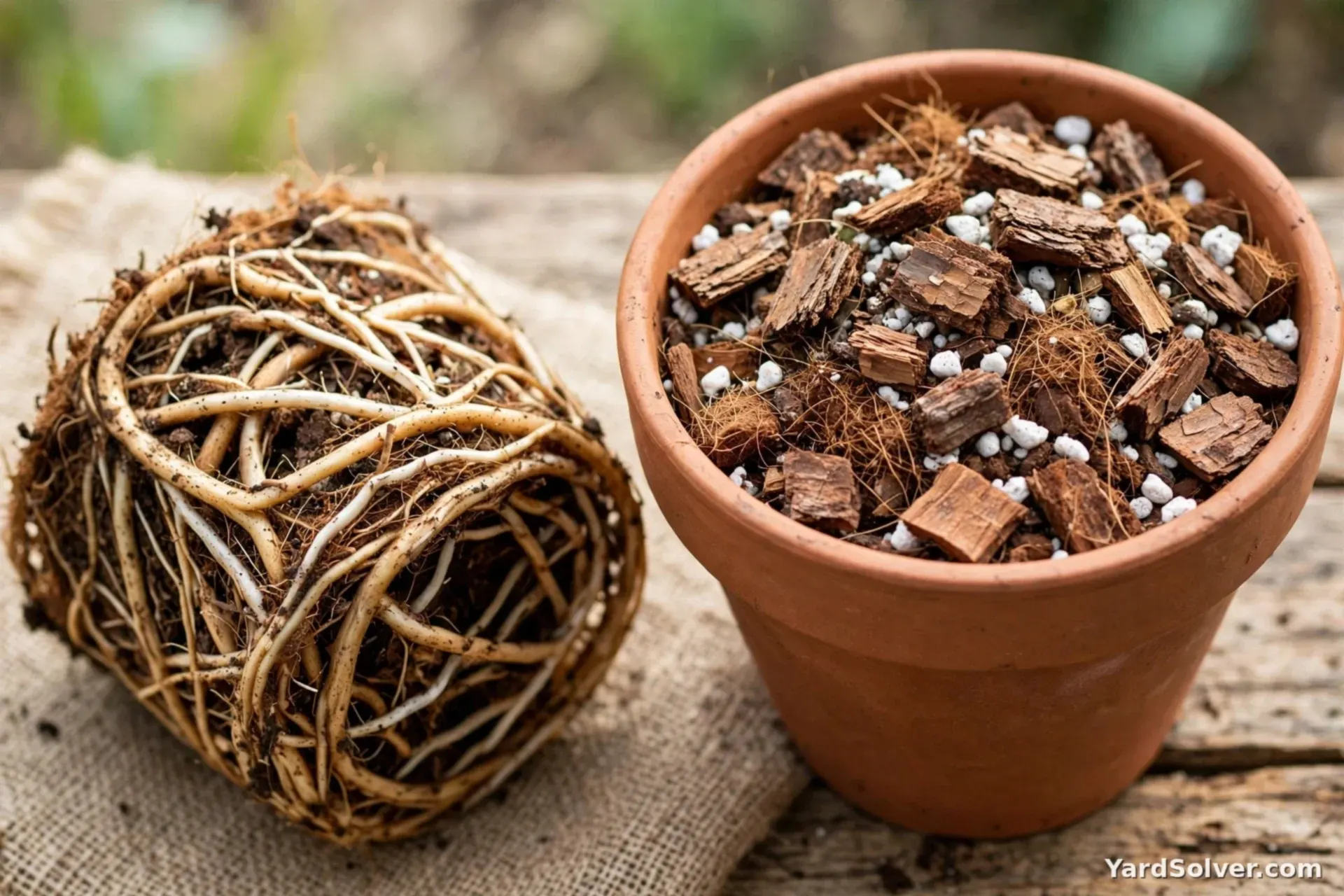
In the rainforest, monstera roots grip tree bark and leaf litter, not dense soil — so the pot mix should be chunky and open: ordinary potting mix with roughly a third bark chunks and a good handful of perlite or coco coir stirred through. A pot with drainage holes, only 1–2 inches wider than the root ball, is the other half of the equation: dense, soggy mix in an oversized pot is the root-rot recipe this plant is famous for suffering. Repot in spring when roots circle the bottom or climb out of the drainage holes, and add the support (Step 5) at the same time, while the roots are undisturbed afterwards.
Step 3 — Water when the top 1–2 inches are dry
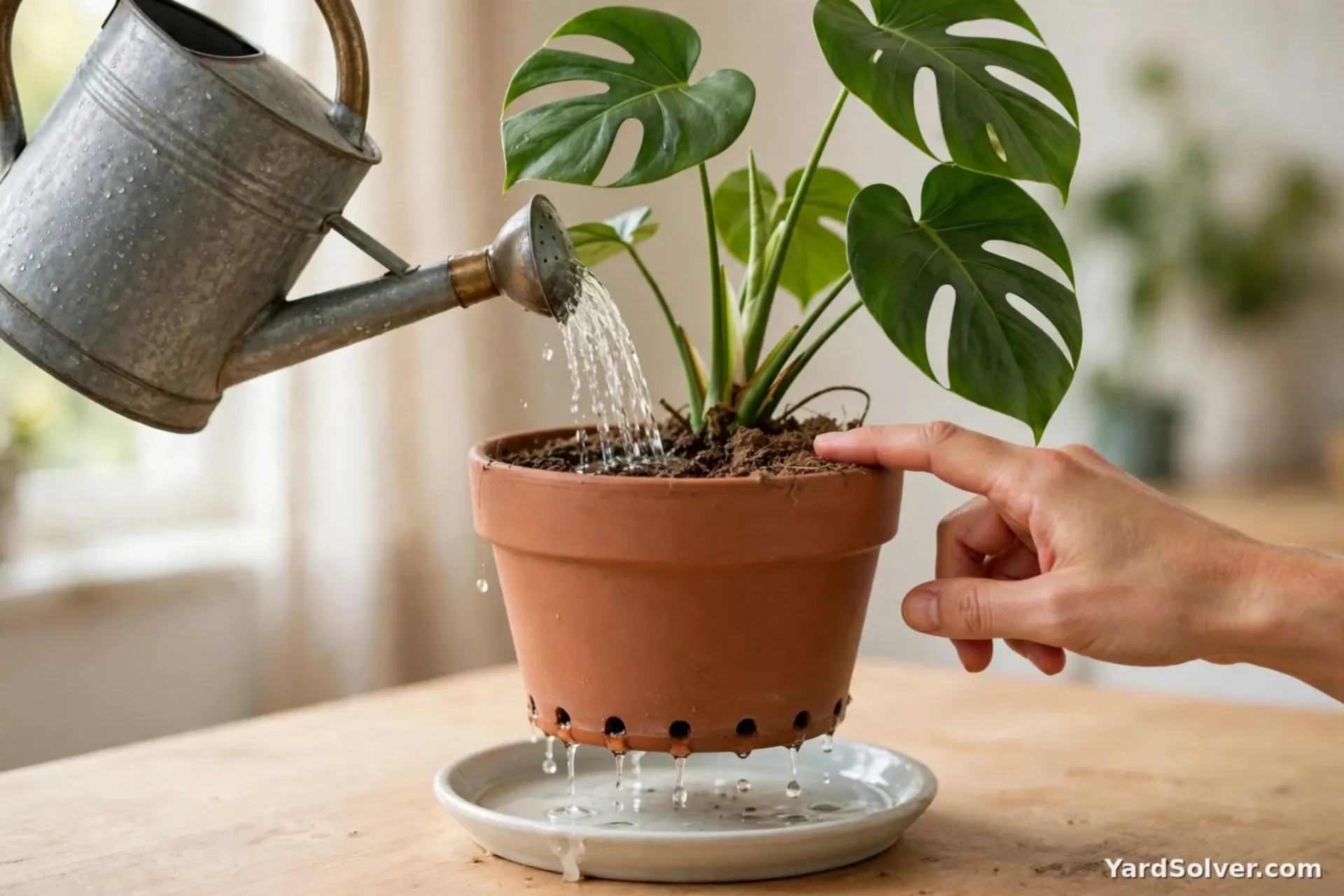
Push a finger into the mix: if the top 1–2 inches are dry, water thoroughly until it runs from the drainage holes, then empty the saucer. In practice that is every 1–2 weeks for most rooms — faster in bright summer light, slower in winter. Monstera wants more water than a snake plant and far less than a fern; the failure mode in both directions looks similar (yellowing leaves), which is why the finger test, not a calendar, is the rule. The problem-sorting in the diagnosis section below separates the two.
Step 4 — Feed monthly in the growing season
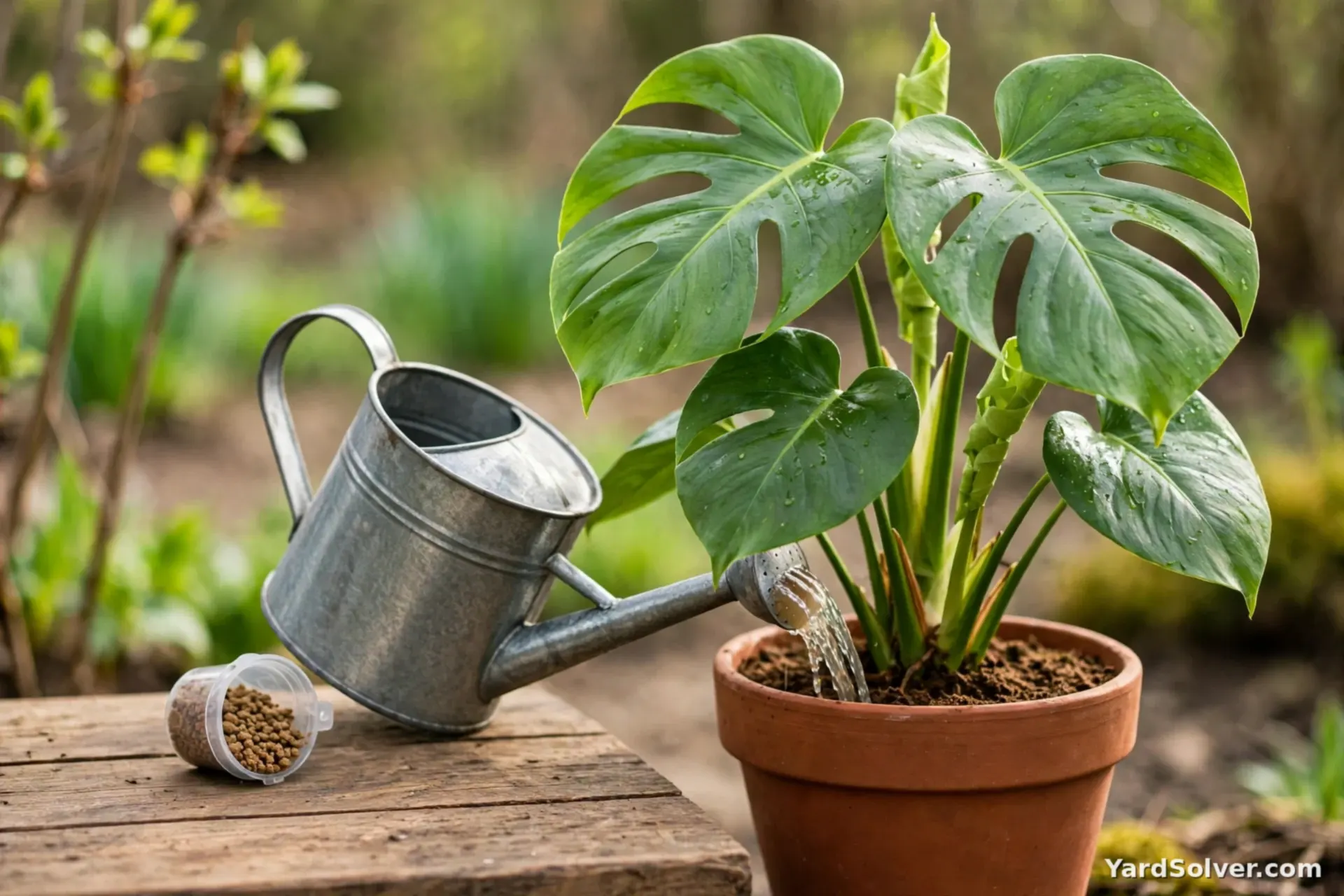
A big-leaved plant growing fast is a hungry plant: give a balanced houseplant feed once a month through spring and summer, at the diluted strength the label gives for houseplants, and stop over winter when growth rests. Guessing the dose is how leaves get fertiliser burn — the Fertilizer Calculator works out amounts by the NPK method, so the feed matches the plant instead of the mood of the person pouring. Pale new leaves with slow growth in the growing season usually mean feed (or light); brown crispy leaf edges after feeding usually mean too much of it — flush the pot with plain water and resume at half strength.
Step 5 — Train it up a moss pole — and why leaves split
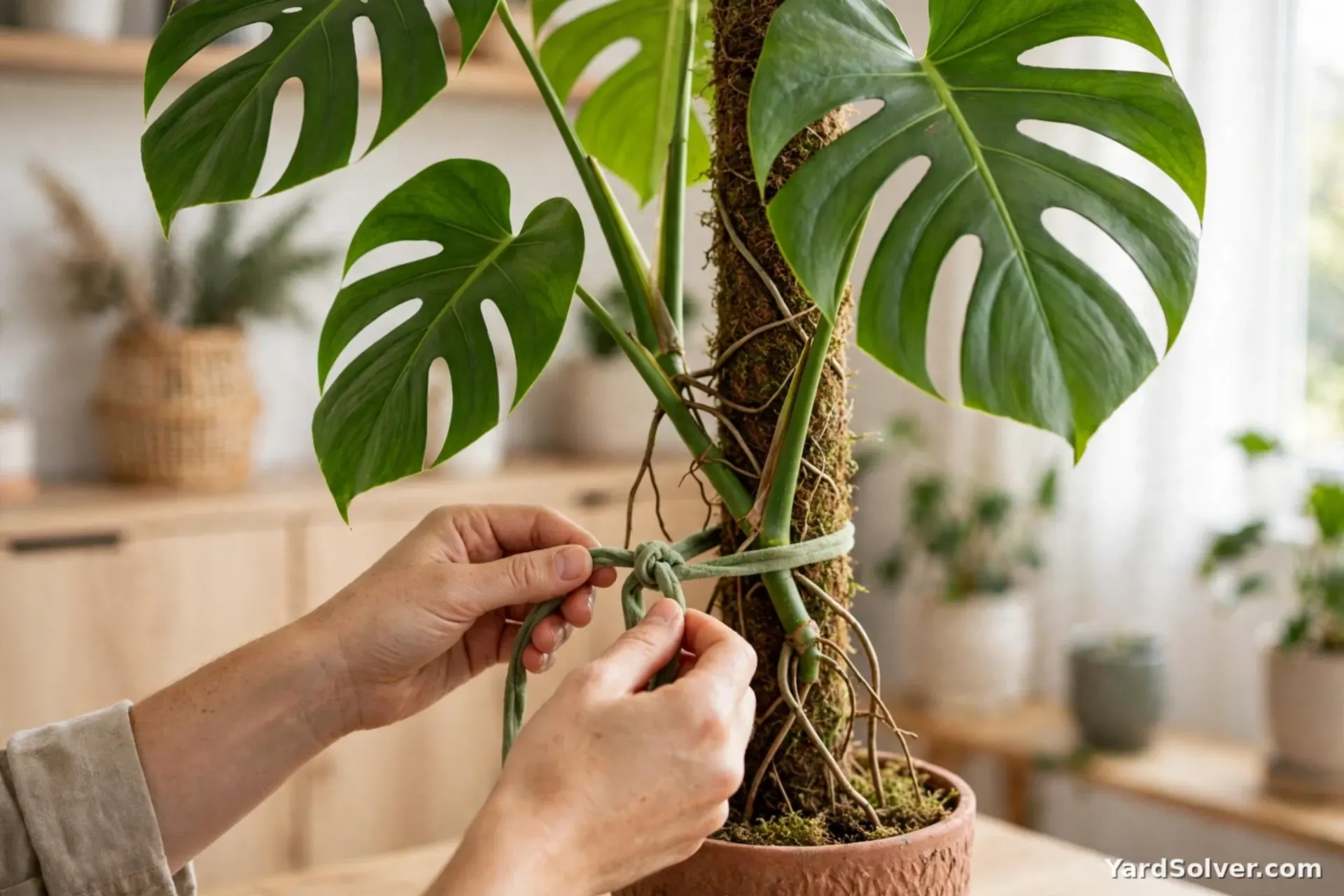
Left alone on the floor, monstera sprawls sideways and its leaves stay modest. Given a moss pole or coir pole to climb — stems tied in loosely as they grow, aerial roots pointed toward the pole — the plant does what it does up a rainforest tree: each new leaf comes out bigger than the last, and the mature leaves develop their fenestrations, the splits and holes that let light reach the leaves below and let storm winds pass through. Two honest conditions: splits are a maturity feature, so a young plant's first leaves are plain no matter what you do; and they are a light feature — a plant that is not splitting is almost always asking for more light first, and a pole second.
Step 6 — Watch for the usual problems
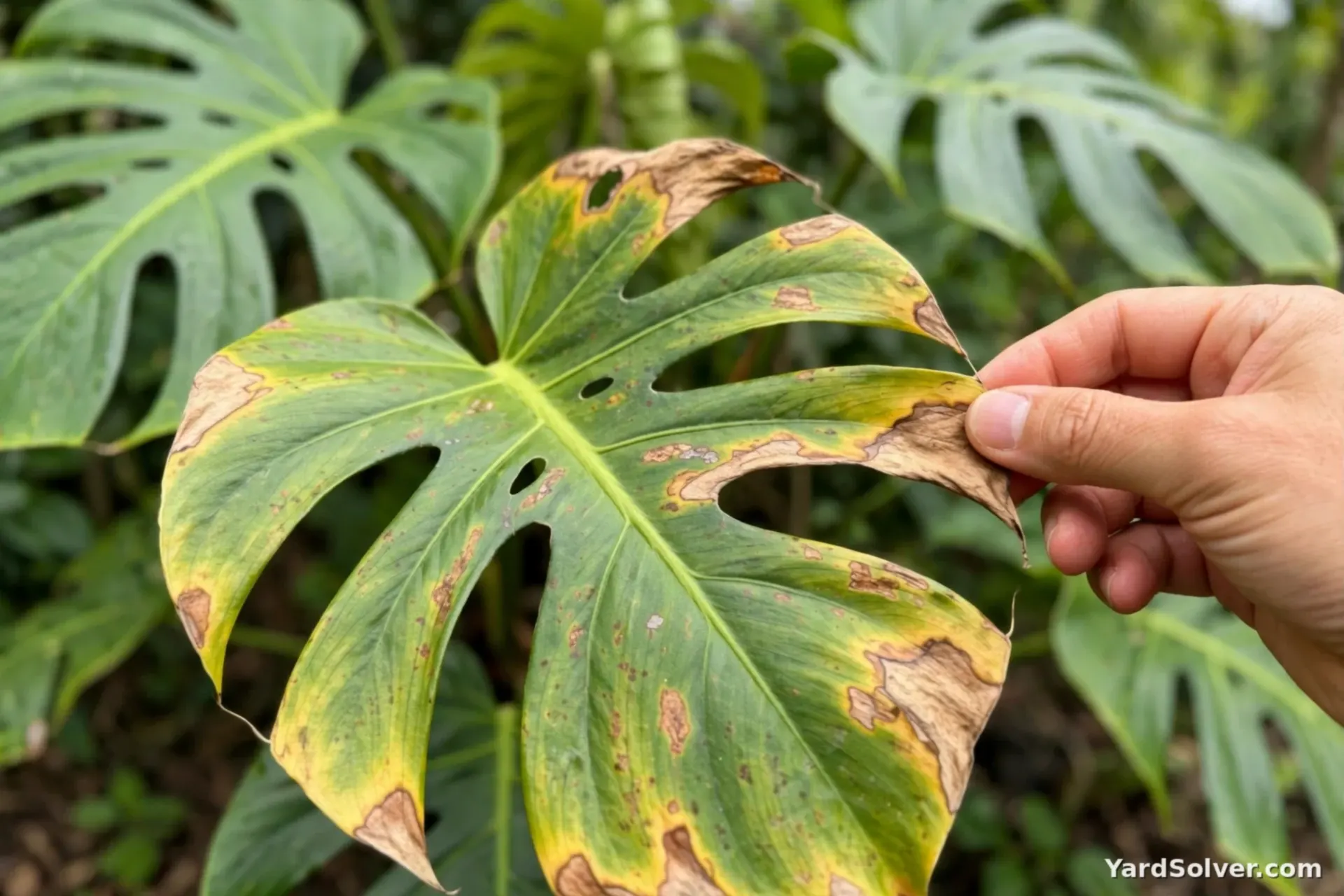
- Yellow leaves — too much water is the first suspect; check the mix before anything else.
- No splits — light and maturity, in that order.
- Thrips and scale — check leaf undersides and stems as you water; the full diagnosis list follows.
Problems, pests & diseases — diagnosis and fixes
- Silvery, speckled patches on leaves, tiny black dots, leaves looking dull and stippled: thrips — monstera's most damaging common pest, rasping the leaf surface. Fix: shower the plant thoroughly, wipe every leaf top and underside, and treat with insecticidal soap weekly for at least a month; badly shredded leaves do not recover and can be cut off.
- Hard brown bumps along stems and leaf midribs, sticky residue: scale insects. Fix: scrape bumps off and wipe the spots with rubbing alcohol; repeat weekly — scale hides where stems meet the pole.
- White cottony clusters in leaf joints: mealybugs. Fix: alcohol-dab each cluster, wipe clean, isolate the plant from other houseplants until clear.
- Lower leaves yellowing one by one, stems soft at the base, mix smelling sour: root rot from chronically wet mix. Fix: unpot, cut roots back to firm white tissue, repot into fresh chunky mix in a pot with drainage, and water once lightly — the general protocol is in the Overwatered Plant Rescue guide.
- Yellow leaves with dry, crispy brown edges, plant otherwise firm: underwatering or fertiliser burn — the opposite problem with a similar face. Fix: check the mix honestly (dry several inches down = water deeply; recently fed = flush with plain water), then return to the Step 3 rhythm.
- Distorted new leaves with a mosaic of light and dark green, growth stunted: possible mosaic virus — uncommon, incurable, and spread by sap and tools. Fix: there is no treatment; isolate the plant, do not propagate from it, and clean tools after touching it. Because other problems mimic it, confirm with clear photos at a local extension clinic before discarding a plant.
- New leaves plain, small and far apart; plant leaning hard toward the window: not a disease — light starvation. Fix: move gradually into brighter indirect light and add the pole (Step 5).
📅 Your personal Monstera schedule
Stay with us — we'll remind you. The procedure is the button above: press "🌱 Start Monstera with me", set your start date and, if you like, add your email. Your plant and its start date are saved on this device straight away, the schedule below is yours to keep in front of you, and email reminders switch on with the new YardSolver accounts — the email you save today is first in line, and from your start date the reminders follow your plant's own schedule. Free, no account needed today; your email is for your plant reminders only, with an easy stop in every message.
This plant runs on rhythm and season rather than a day count — here is the honest version of its schedule.
Varieties worth growing
| Variety | Colour | Why gardeners like it |
|---|---|---|
| Deliciosa (classic) | Deep green | The true Swiss cheese plant — the biggest leaves and the deepest splits as it matures |
| Borsigiana | Green | A faster, more compact-growing form that suits smaller rooms and climbs eagerly |
| Albo Variegata | Green splashed with white | The collector's form — dramatic white marbling; slower, pricier, and wants the brightest light of all |
| Thai Constellation | Green with cream speckles | Stable, starry cream variegation that does not revert the way Albo can |
| Adansonii (close cousin) | Green, heavily holed | A different Monstera species sold alongside it — a trailing vine whose smaller leaves are all holes, for shelves and baskets |
Good for you — and take care
Benefits
- The fastest route to a genuine indoor-jungle statement — big architectural leaves from a young plant within a season or two
- Forgiving of ordinary rooms: normal humidity and temperatures suit it, unlike many rainforest plants
- Climbs a pole, so it grows up instead of out — drama without the floor space
- Easy to propagate from stem cuttings with a node, once it is climbing well
Take care
- Poisonous if eaten by pets — the leaves contain calcium oxalate crystals that irritate the mouth and stomach; keep it out of chewing reach
- Overwatering in dense mix is its one real killer: chunky mix, drainage holes, emptied saucer
- A mature, climbing monstera is heavy — the pole and pot must be sturdy enough not to topple
A little history — and one good fact
Monstera deliciosa climbs the trees of rainforests from southern Mexico to Panama, starting life on the shaded forest floor and growing toward the light, its leaves changing from plain hearts to split giants as it rises. Victorian and then mid-century growers carried it indoors, and its leaves became one of the most copied shapes in design — but the plant itself never got fussier for the fame.
Fun fact: The name "Swiss cheese plant" is purely about the holes — botanists believe the fenestrations let light filter down to the plant's own lower leaves and let storm winds pass through without shredding the leaf.
Keep going
Guides: How to Propagate Pothos · Overwatered Plant Rescue · How Often to Water a Snake Plant
Calculators: Fertilizer Calculator · All calculators
More houseplants: Pothos · Snake Plant · Spider Plant
← Back to the Plant Library · Get your personal planting dates
Questions people ask
How often do I water monstera?
When the top 1–2 inches of mix have dried — typically every 1–2 weeks indoors. Water thoroughly until it drains, then empty the saucer.
Why are my monstera leaves not splitting?
Light first, maturity second. Fenestrations come on mature leaves of plants in bright indirect light, ideally climbing a pole; dim corners keep leaves plain and whole.
Is monstera poisonous to pets?
Yes — the leaves contain calcium oxalate crystals that irritate the mouth and stomach if chewed. Keep it where cats and dogs cannot reach the leaves.