
Plant Library · Houseplants
🪴 How to Grow String of Pearls
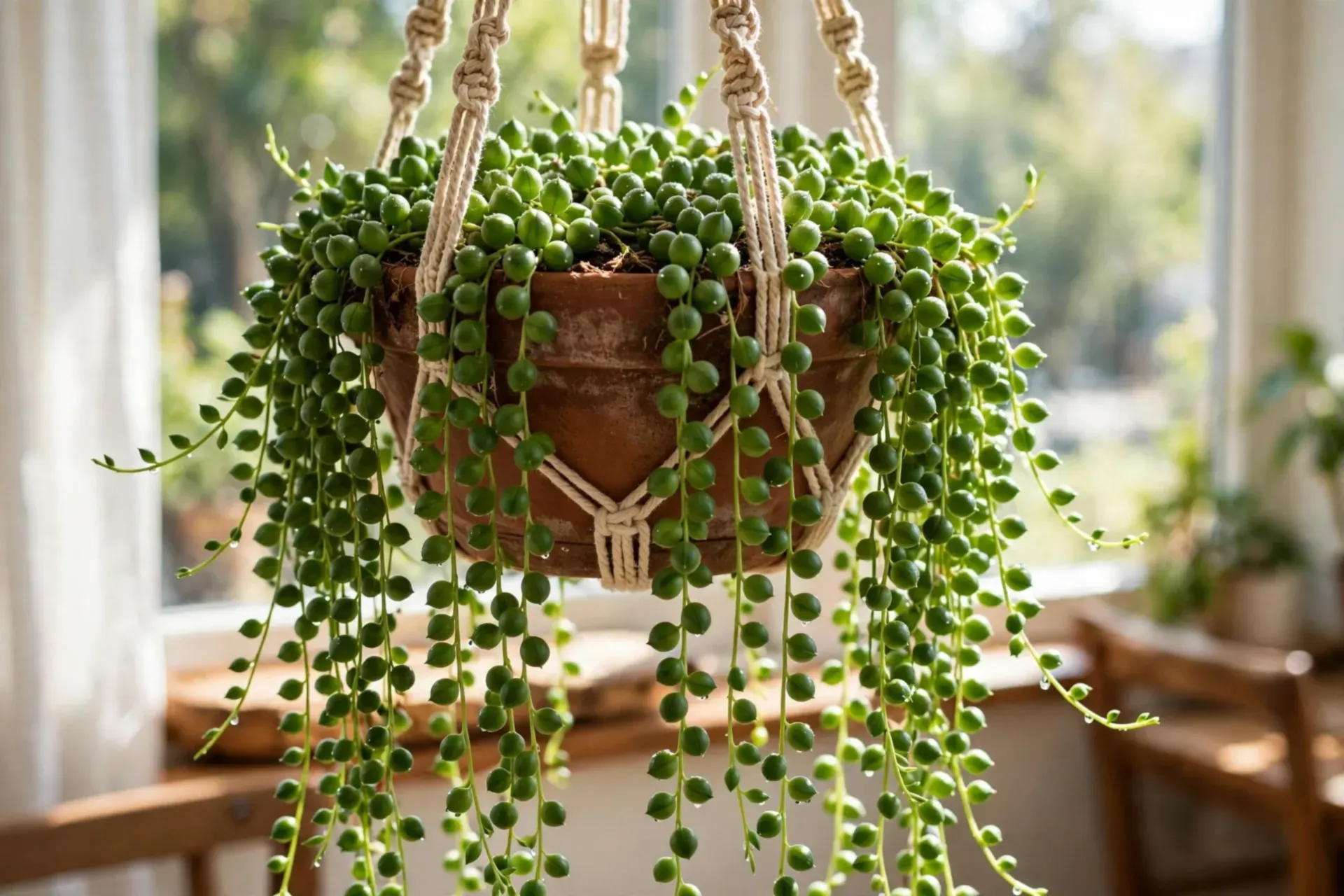
A succulent vine of green beads on strings — and the houseplant most often killed by kindness, because the pearls store their own water and rot under a normal watering schedule. Give it bright light that reaches the top of the pot, a shallow pot of gritty mix, and water only every 2–3 weeks, and the strands lengthen, branch and fill out instead of melting away.
Grow String of Pearls with us — step by step
Everything for this plant is written step by step below — what to do, and exactly when. Read it through first if you like: you can grow it entirely on your own with that guide. Or start with us here — tell us your planting day and we lay out your personal schedule on this page, every next step on its own day, counted from your planting date. No guessing, no forgetting.
Step 1 — today: Settle your String of Pearls into its spot today: the brightest light you have, with the top of the plant lit as well as the strands, a shallow pot with drainage, and one light watering to settle the mix.
String of Pearls at a glance
Spacing: — (pot) · Propagation: Stem cuttings, not seed
Sun: Bright light with a few hours of gentle direct sun
Water: Sparingly — every 2–3 weeks; the pearls store water
Harvest: Grown for foliage — no harvest
Timing counts from your average last spring frost — get your own dates in the Planting Calendar. Guidance follows standard extension-service practice for Canada and the US.
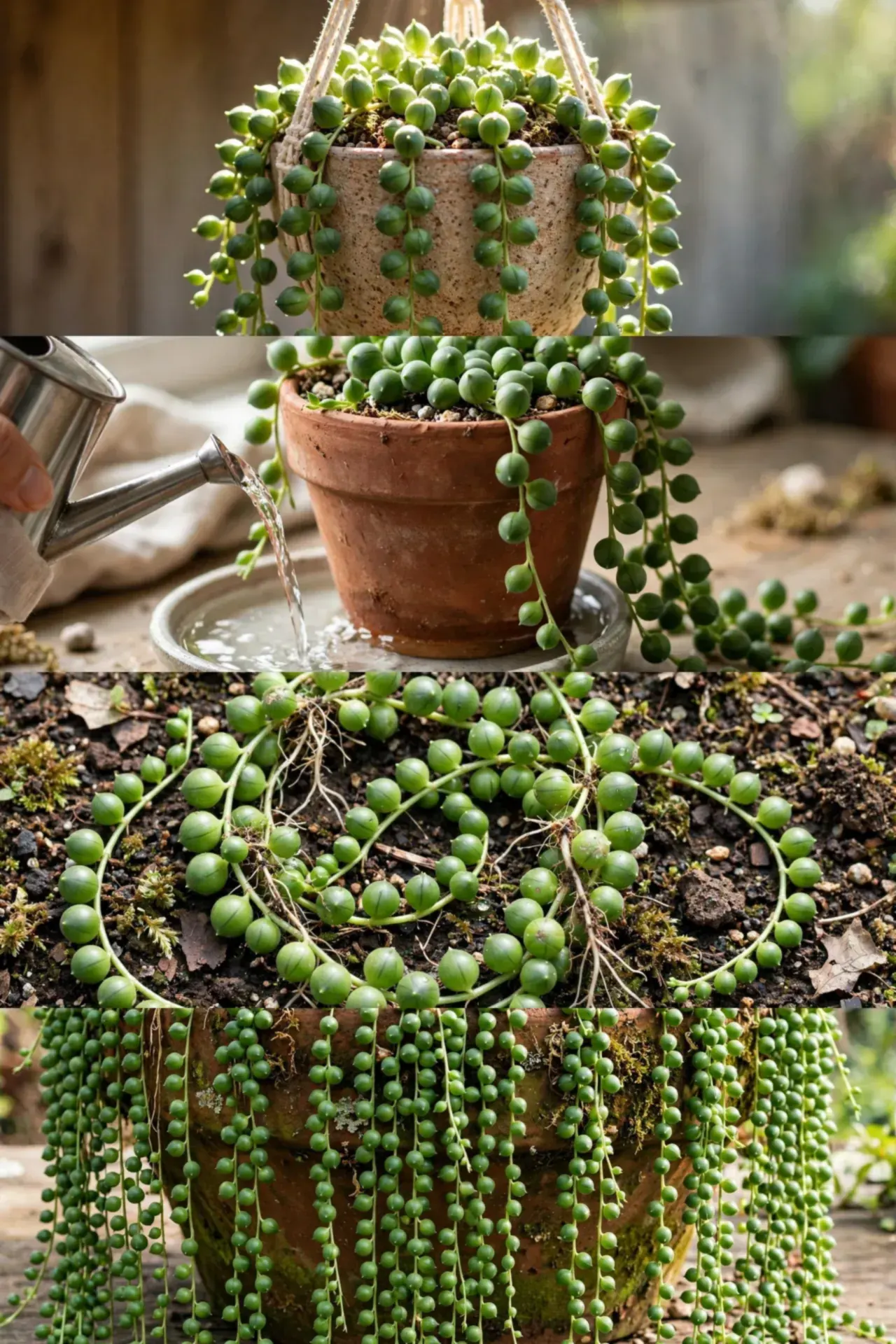
How to plant and grow string of pearls, step by step
Step 1 — Choose its spot — light the crown, not just the strands
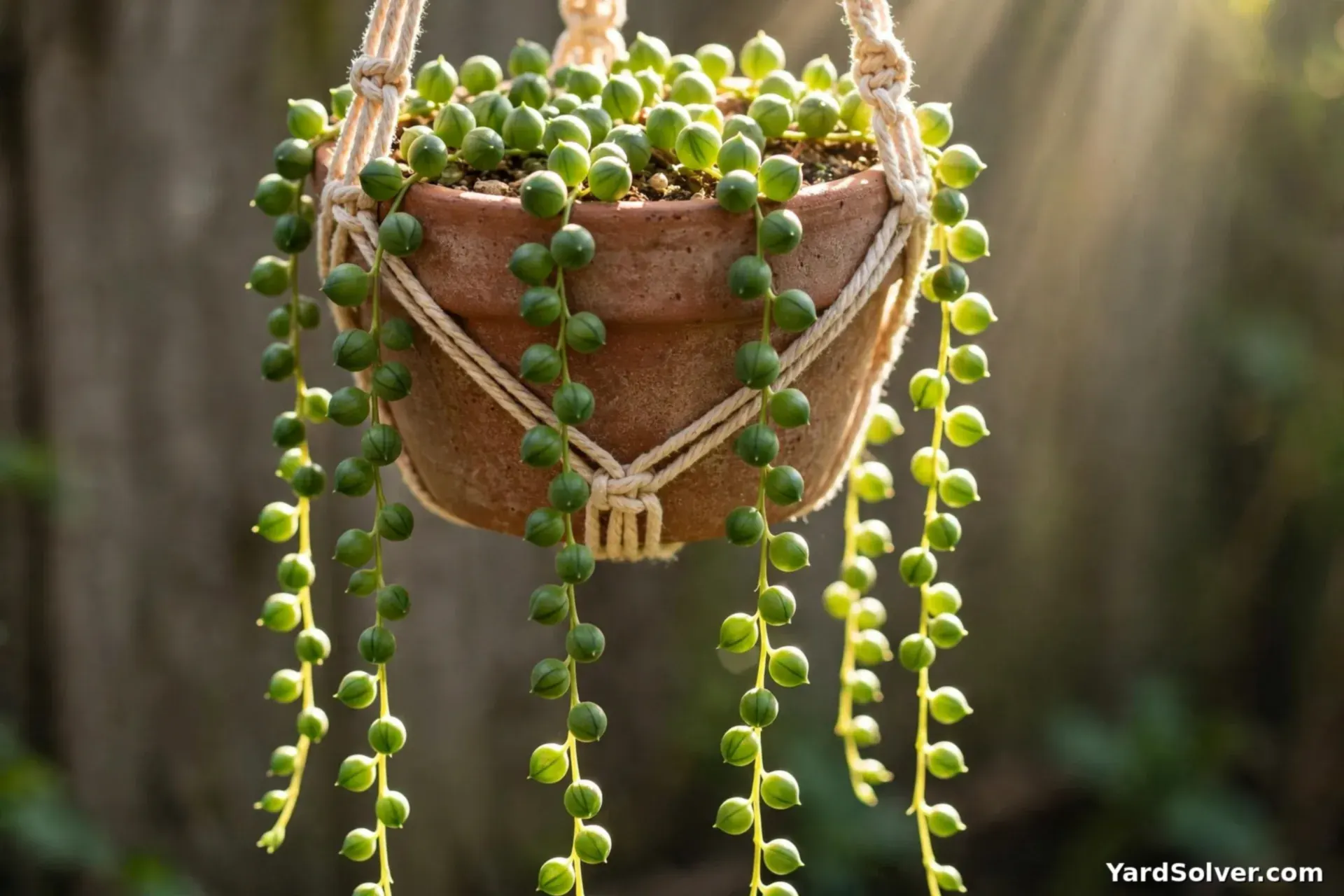
This is the number-one mistake with string of pearls: the plant hangs in a window, the strands glow in the light — and the crown, the surface where every strand begins, sits in shade above the light line. Within months the top goes bald while the ends still look fine. Hang or stand the pot so light falls on the top of the plant as well as the strands: a bright sill, or a hanging pot lowered until its surface catches the light. It wants the brightest spot you have, with a few hours of gentle direct sun (morning sun is ideal); harsh midday sun through glass can scorch the pearls, so watch a newly moved plant for a week.
Step 2 — Pot it shallow in gritty succulent mix
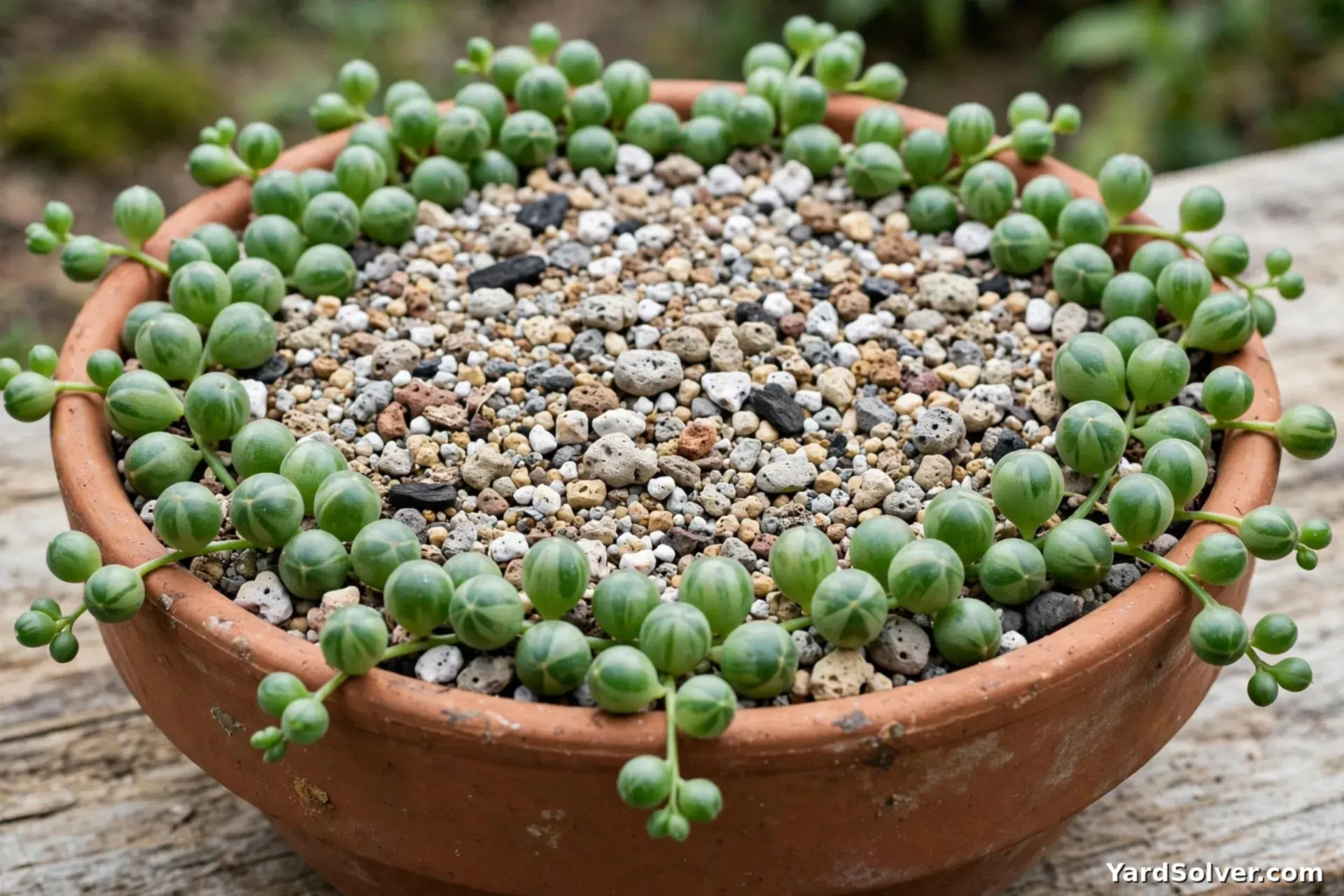
String of pearls has shallow roots and no use for a deep pot: choose a shallow pot with drainage holes and fill it with gritty succulent mix — cactus mix, or potting mix with roughly a third perlite or coarse sand stirred through so water runs straight through. Set the crown level with the rim of the pot, not sunk below it: a crown sitting in a damp hollow below the rim rots where the stems touch wet mix, which is exactly where this plant usually dies. Terracotta suits it well — the porous clay dries the mix evenly between waterings.
Step 3 — Water rarely — the pearls are the reservoir
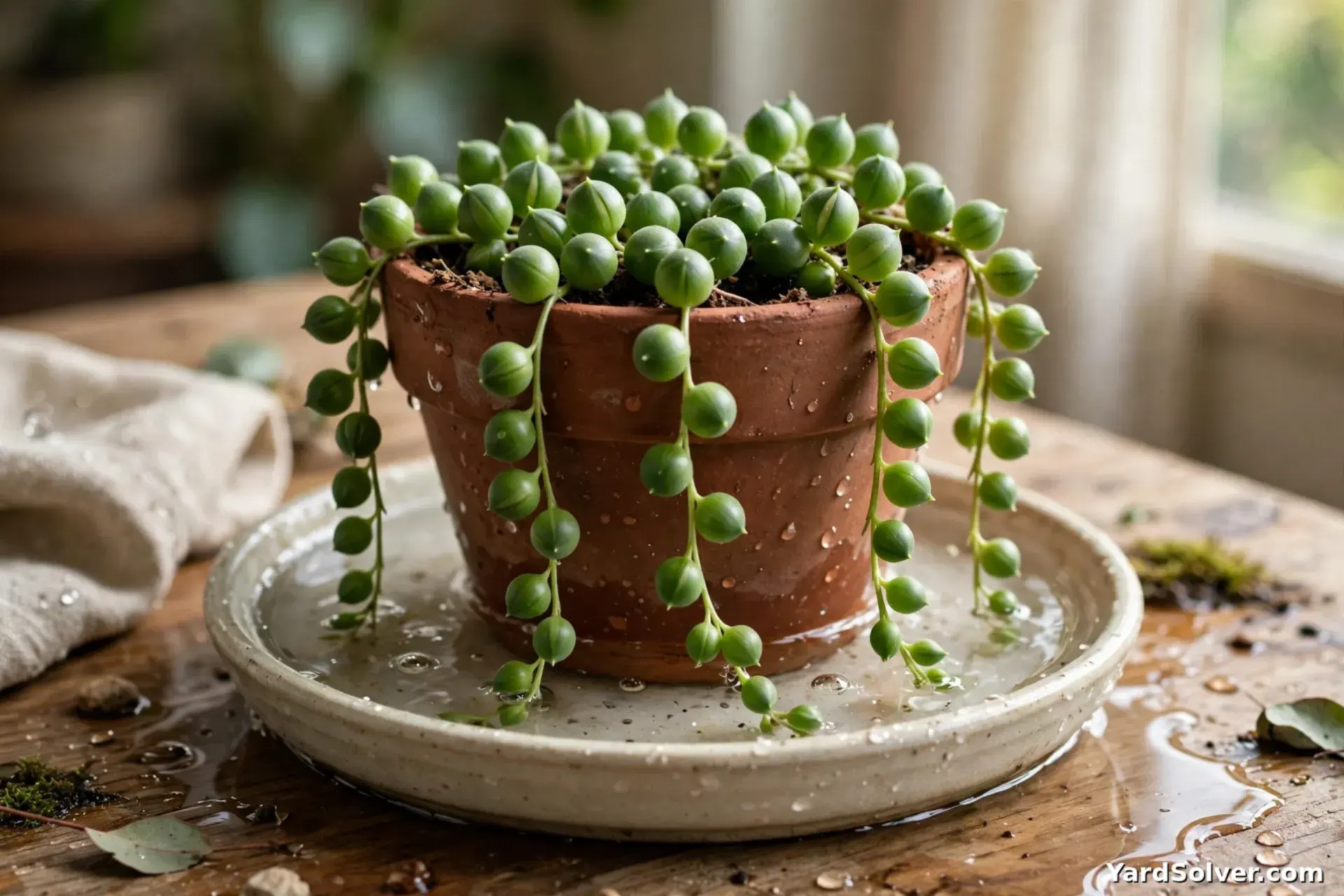
Each pearl is a water tank with a leaf's job, so this plant waters like a succulent, not a fern: let the mix dry out completely, then water thoroughly — about every 2–3 weeks in the growing season, less in winter. Watering from the bottom (stand the pot in a saucer of water for 15–20 minutes, then drain) keeps the crown and the surface stems dry, which is where rot starts. Never leave the pot standing in water afterwards. The diagnostic skill with this plant is telling thirst from rot — shrivelled pearls on dry mix mean water; shrivelled pearls on wet mix mean the roots have gone, and Step 6 explains the difference.
Step 4 — Feed very lightly in spring
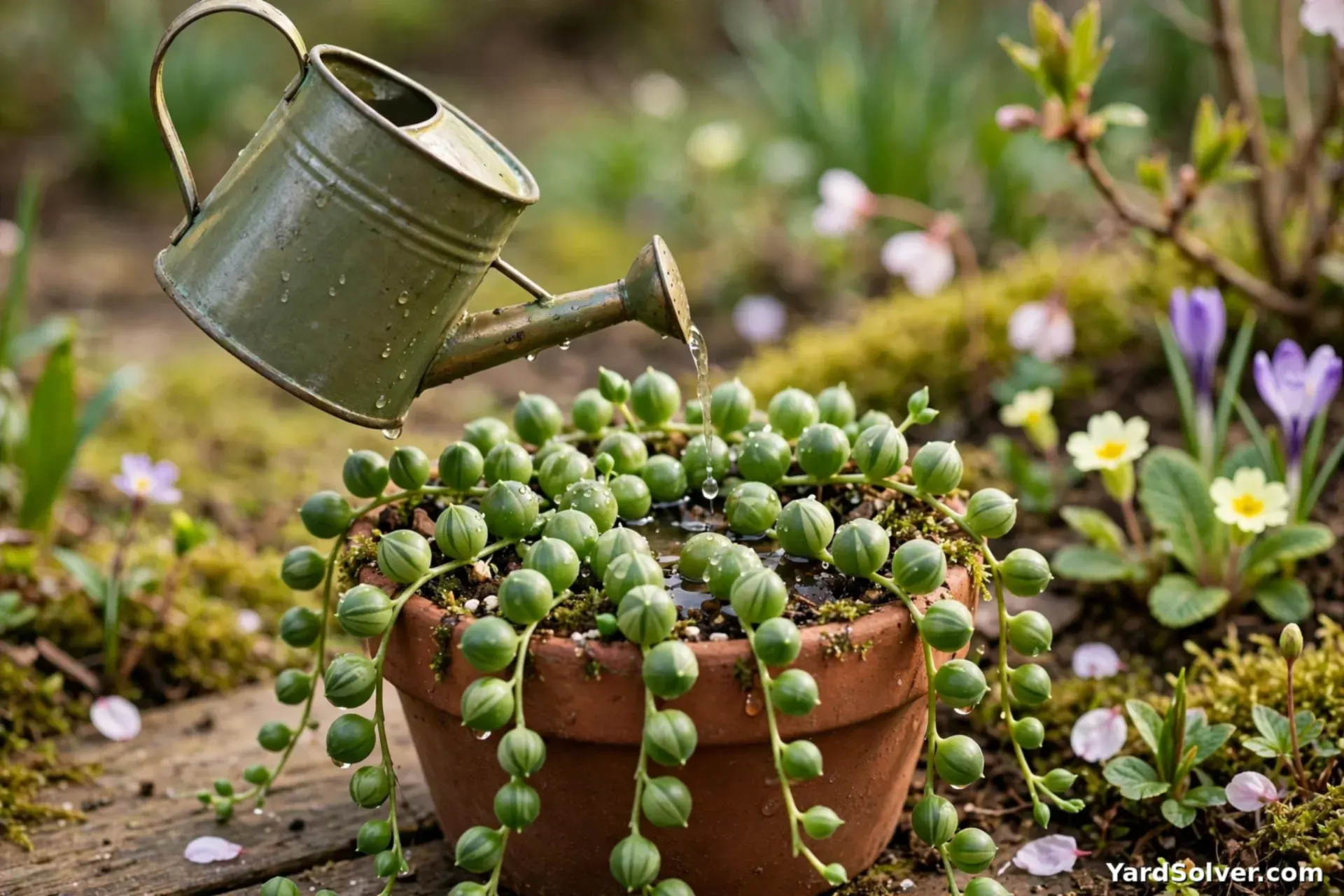
A plant built for poor, arid ground needs almost no feeding: a very dilute liquid feed once or twice in spring, at a quarter of the label strength, is plenty for a season of new strands. More feed does not mean more pearls — it builds salts in a pot that is rarely flushed by watering, and salts scorch the fine roots. If you are mixing your own, the Fertilizer Calculator works out amounts by the NPK method; for this plant, always err on the weak side, and skip feeding entirely in autumn and winter.
Step 5 — Coil strands on the surface to fill out
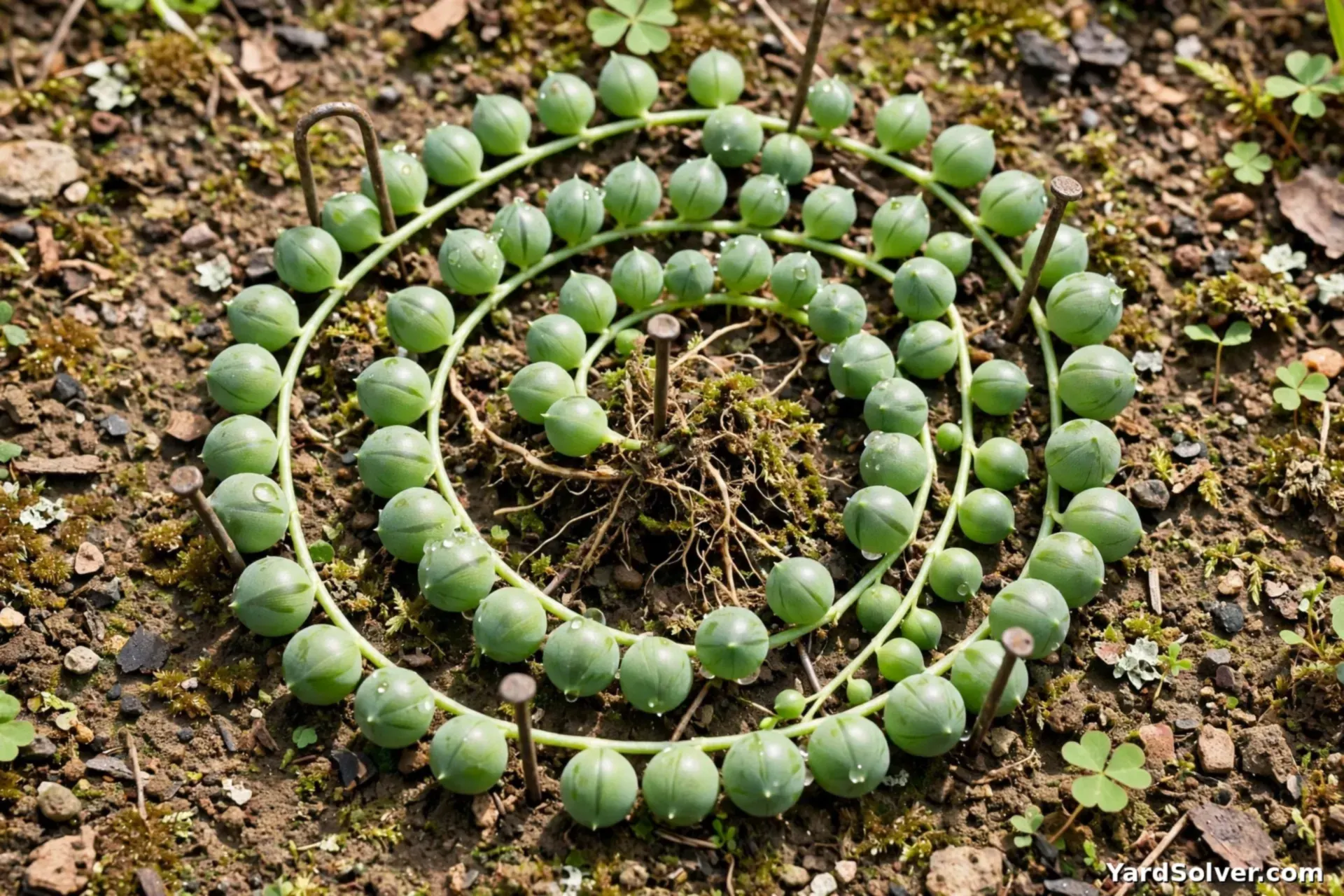
A fuller pot comes from the surface, not the ends. Take a long strand, coil it in a spiral on the mix and pin it down lightly (a bent paperclip or hairpin per loop) so the nodes touch the soil: the strand roots at the nodes and sends out new branching strands, filling the bald crown from within. The same trick propagates it — a cutting laid on gritty mix and kept just barely moist roots in a few weeks. Only coil onto a pot that is already getting light on its surface (Step 1), or the new growth thins out exactly like the old.
Step 6 — Watch for the usual problems
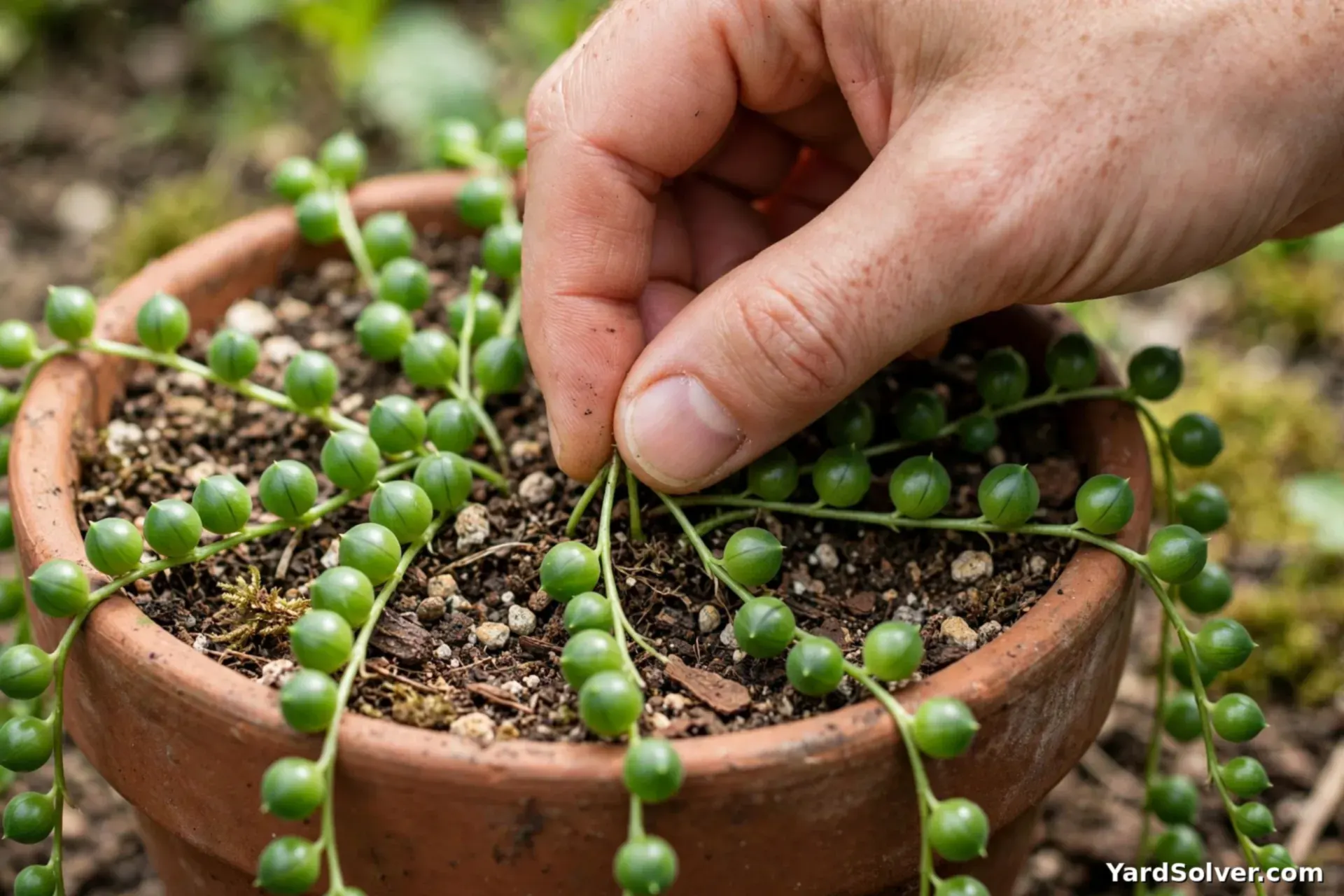
- Shrivelling pearls — thirst OR rot; check the stems at the soil line: firm stems on dry mix = water it, soft dark stems on wet mix = rot (see below).
- Bald crown with healthy ends — light is hitting the strands but not the top of the pot.
- White fluff where pearls meet stems — mealybugs; the full diagnosis list follows.
Problems, pests & diseases — diagnosis and fixes
- Mushy, translucent pearls and soft dark stems at the soil line: stem rot from overwatering — the plant's classic killer. Fix: cut firm, healthy strand tips well above the rot, lay them on dry gritty mix for a day to callus, then coil them on the surface to re-root (Step 5); the rotted crown does not recover.
- Pearls shrivelled and puckered, stems firm, mix bone dry: simple underwatering — the one this plant is famous for surviving. Fix: water thoroughly (from the bottom), drain fully, and the pearls plump back up within a few days; then settle into the every-2–3-weeks rhythm.
- Bald, bare crown while the hanging strands still look fine: light reaches the strands but not the top of the pot. Fix: lower or move the pot so light falls on its surface, then coil a strand on the crown to re-root and refill it (Step 5).
- White cottony tufts where pearls meet the stem: mealybugs, the main pest of this plant. Fix: dab each tuft with rubbing alcohol on a cotton bud and pick them off; repeat weekly — they wedge between the pearls where sprays miss.
- Strands snapping and dropping pearls at a touch: brittle, overwatered growth letting go. Fix: check the mix and the soil line for rot, cut back to firm growth, and water less — healthy strands bend before they break.
- Little or no growth through winter: normal rest, not a problem. Fix: none — water even less in winter and wait for spring light; growth resumes on its own.
📅 Your personal String of Pearls schedule
Stay with us — we'll remind you. The procedure is the button above: press "🌱 Start String of Pearls with me", set your start date and, if you like, add your email. Your plant and its start date are saved on this device straight away, the schedule below is yours to print or download as calendar reminders (.ics), and email reminders switch on with the new YardSolver accounts — the email you save today is first in line, and from your start date the reminders follow your plant's own schedule. Free, no account needed today; your email is for your plant reminders only, with an easy stop in every message.
String of Pearls is a houseplant that lives indoors year-round — a succulent vine whose bead-like leaves store their own water, so it is killed by kindness far more often than by neglect. Its care runs on rhythm and light, not on days since planting — water every 2–3 weeks, keep the crown lit — so it gets care tips instead of date reminders.
Varieties worth growing
| Variety | Colour | Why gardeners like it |
|---|---|---|
| Standard (Curio rowleyanus) | Green | The classic pea-on-a-string — round green pearls with a fine darker stripe, the toughest of the group |
| Variegated String of Pearls | Cream-striped green and white | Pearls marbled with cream and blushed pink in bright light; slower, and wants the brightest spot of all |
| 'String of Tears' (close relative) | Green | A near relative with teardrop-shaped leaves instead of spheres — same care, slightly faster growth |
| 'String of Dolphins' (close relative) | Green | A relative whose curved leaves genuinely look like tiny leaping dolphins; a hybrid grown the same way |
| 'String of Bananas' (close relative) | Green | A sturdier relative with banana-shaped leaves — the most forgiving of the string family for beginners |
Good for you — and take care
Benefits
- A living curtain for almost no floor space — long strands from a shelf or hanging pot
- Stores its own water in the pearls, so it forgives missed waterings and holidays better than almost any trailing plant
- Coil-and-root propagation means one plant fills its own bald spots and makes free new plants
- The bead strands are unlike anything else in the houseplant world — texture you cannot fake
Take care
- Poisonous if eaten — keep strands hanging out of reach of pets and small children
- Strands are fragile and drop pearls when knocked — hang it out of traffic, not over a busy doorway
- Overwatering kills it faster than any pest: if in doubt, do not water — check the mix and the soil line first
A little history — and one good fact
String of pearls (Curio rowleyanus, long sold as Senecio rowleyanus) comes from the arid Eastern Cape of South Africa, where it creeps along the ground in the shelter of rocks and shrubs, rooting as it goes — the trailing habit and the coiling trick in Step 5 are the plant doing exactly what it does at home. It is named for the British botanist Gordon Douglas Rowley, a specialist in succulent plants.
Fun fact: Each pearl is a leaf with a built-in window: a thin translucent stripe along its side lets light into the water-storing centre, so the leaf can photosynthesise while keeping almost its whole surface sealed against drought.
Keep going
Guides: How Often to Water a Snake Plant · Overwatered Plant Rescue · How to Propagate Pothos
Calculators: Fertilizer Calculator · All calculators
More houseplants: Jade Plant · Snake Plant · Spider Plant
← Back to the Plant Library · Get your personal planting dates
Questions people ask
Why is my string of pearls dying?
Overwatering, almost every time — the one this plant is famous for. The pearls themselves store water, so a plant watered on a houseplant schedule rots at the stems where they touch wet mix. Check the soil line: mushy, translucent pearls and soft stems mean rot (take firm cuttings from healthy strand tips and restart them), while shrivelled, puckered pearls on dry mix mean simple thirst. The cure going forward is light on the crown and water only every 2–3 weeks.
How often do I water string of pearls?
Sparingly — every 2–3 weeks in the growing season, and less in winter. The bead-like leaves store water, so the mix should dry out completely between waterings. Water thoroughly (from the bottom if you can), let it drain fully, and never leave the pot standing in water.
How do I make string of pearls fuller?
Light on the top of the pot, plus coiling. Most plants go bald at the crown because light hits the hanging strands but not the surface. Lay a long strand in a coil on the mix, pin it down lightly so the nodes touch, and it roots and branches into new strands. Cuttings laid on the surface the same way fill gaps within a season.