
Plant Library · Houseplants
🪴 How to Grow ZZ Plant
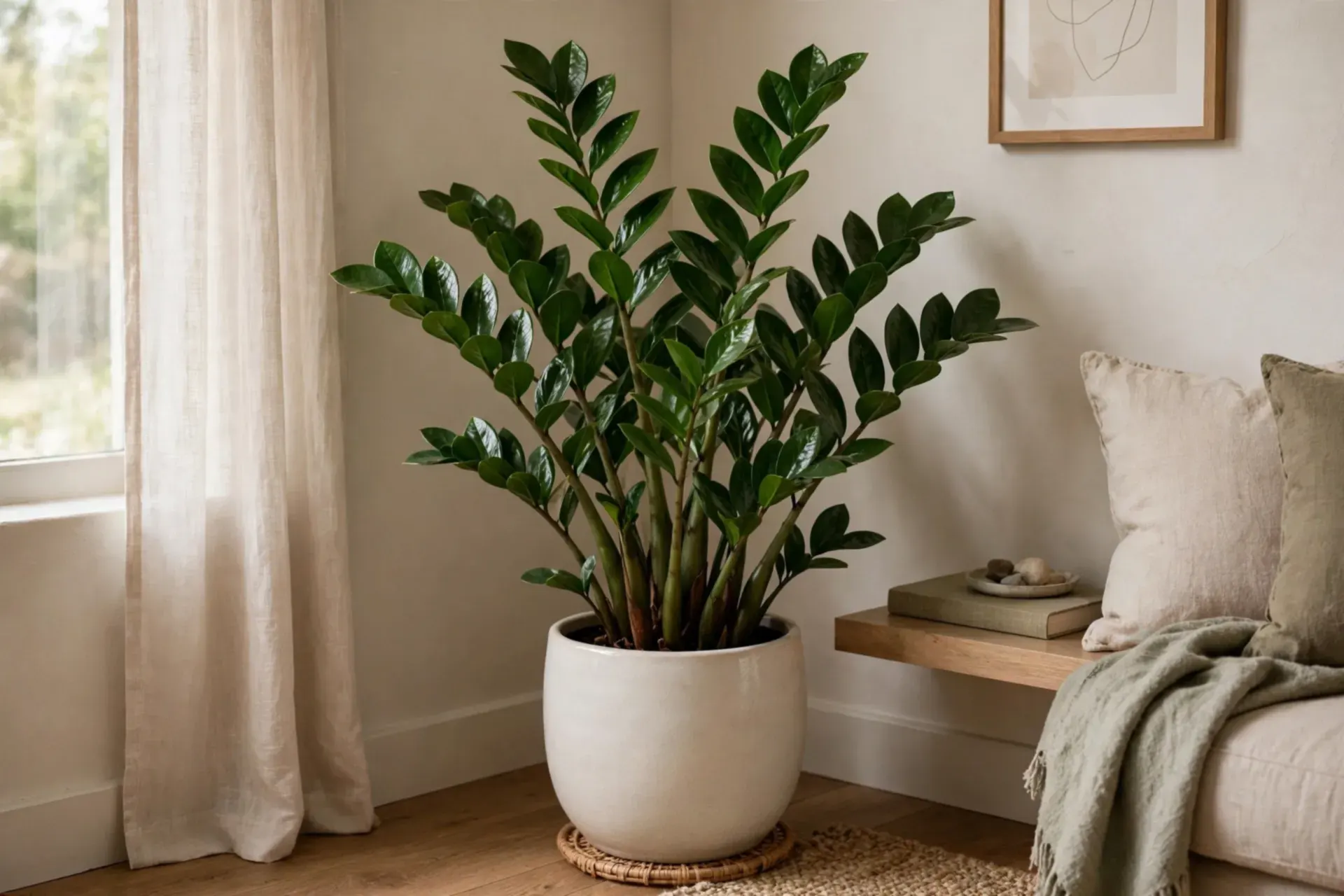
The toughest houseplant most people will ever own — a ZZ plant stores water in thick underground rhizomes, which is why it shrugs off dark corners, dry office air and owners who travel. It is a houseplant for indoors year-round, and its one real rule inverts most plant care: water it rarely, because kindness, on a schedule, is what kills it.
Grow ZZ Plant with us — step by step
Everything for this plant is written step by step below — what to do, and exactly when. Read it through first if you like: you can grow it entirely on your own with that guide. Or start with us here — tell us your planting day and we lay out your personal schedule on this page, every next step on its own day, counted from your planting date. No guessing, no forgetting.
Step 1 — today: Settle your ZZ Plant into its spot today: a pot with drainage, low to bright indirect light, and one good watering to settle the mix around the rhizomes — then leave it alone.
ZZ Plant at a glance
Spacing: — (pot) · Propagation: Leaf cuttings or division, not seed
Sun: Low to bright indirect light — tolerates shade few plants accept
Water: Every 3–4 weeks; its rhizomes store water
Harvest: Grown for foliage — no harvest
Timing counts from your average last spring frost — get your own dates in the Planting Calendar. Guidance follows standard extension-service practice for Canada and the US.
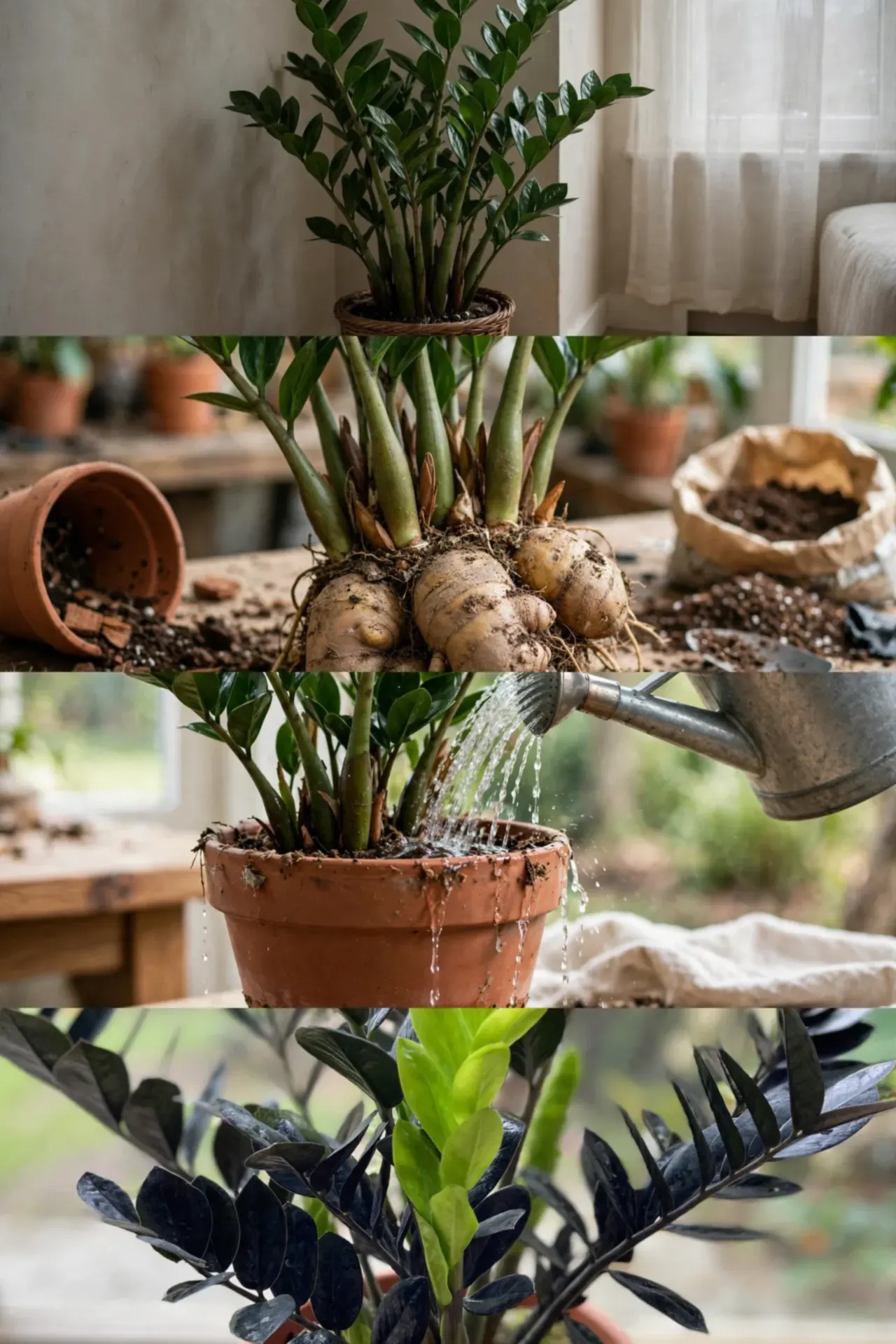
How to plant and grow zz plant, step by step
Step 1 — Choose its spot — the low-light champion
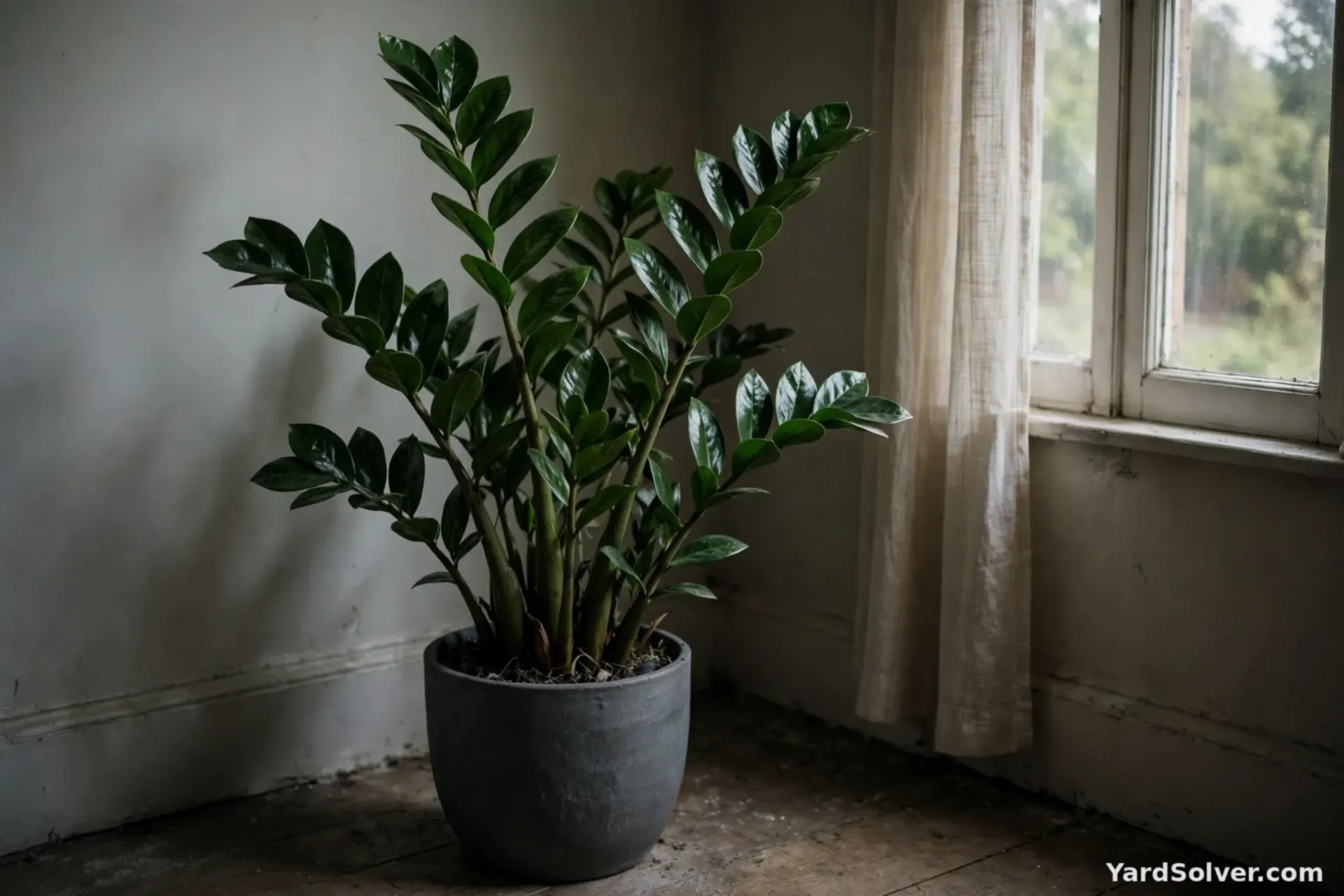
A ZZ plant accepts low to bright indirect light — it tolerates shade few plants accept — which is why it fills the corners, hallways and north-facing rooms that defeat everything else. Two honest limits: in deep shade it survives rather than grows, stretching slowly toward the light; and harsh direct sun through glass scorches the leaflets pale. For a full, upright plant, bright indirect light is the sweet spot — the dim corner is the talent, not the preference.
Step 2 — Pot it with drainage — meet the rhizomes
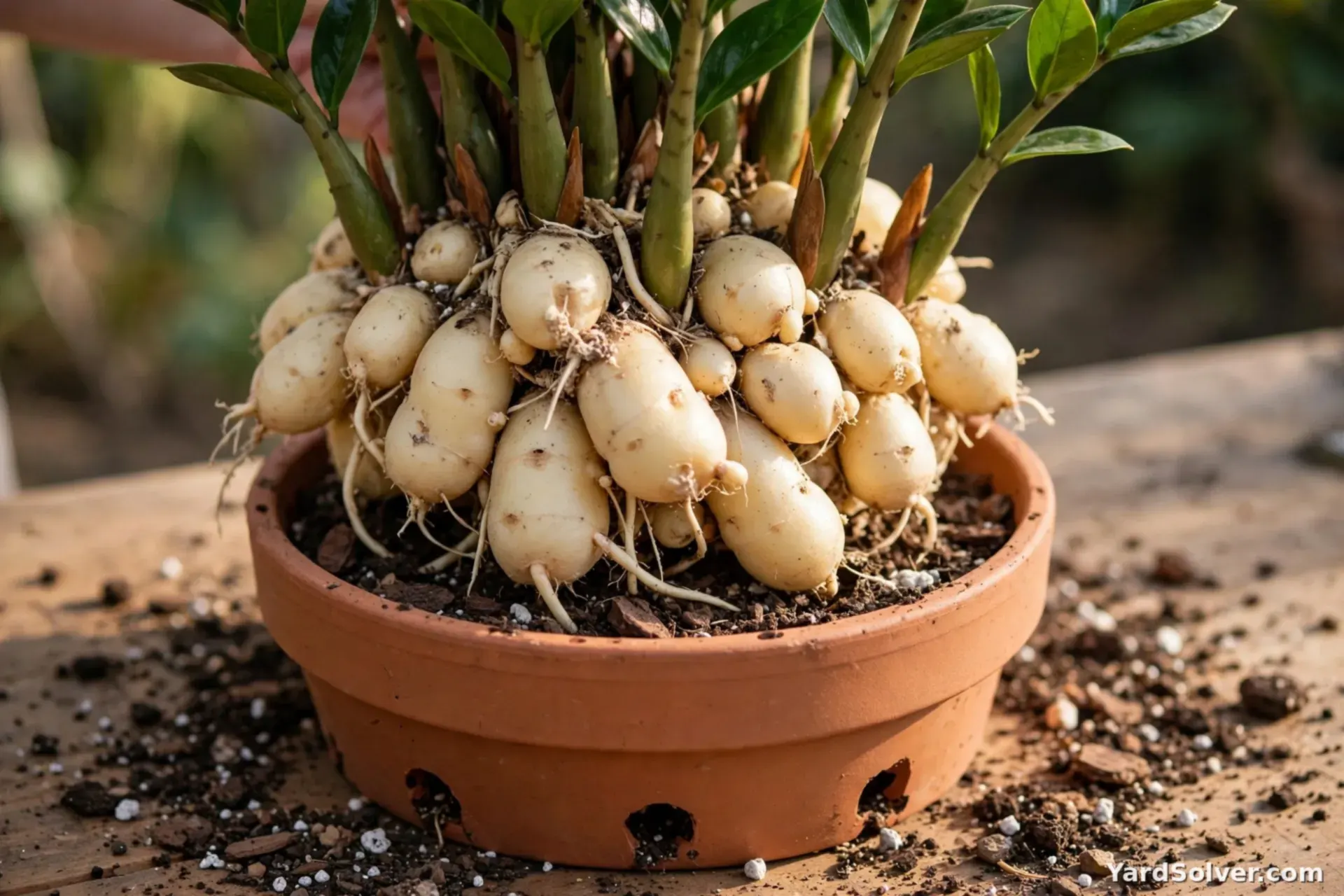
Under the soil a ZZ plant keeps its secret: thick, potato-like rhizomes that store water and food, feeding the stems through weeks of drought. Pot it in ordinary free-draining potting mix in a pot with drainage holes, only an inch or two wider than the root ball — a vast pot holds more wet mix than the rhizomes can forgive. When you repot (every couple of years, when rhizomes crowd or lift the plant), handle the rhizomes gently: a firm, pale rhizome is a healthy one, and a soft, dark one is rotting and should be cut away.
Step 3 — Water rarely — the 3–4 week rule
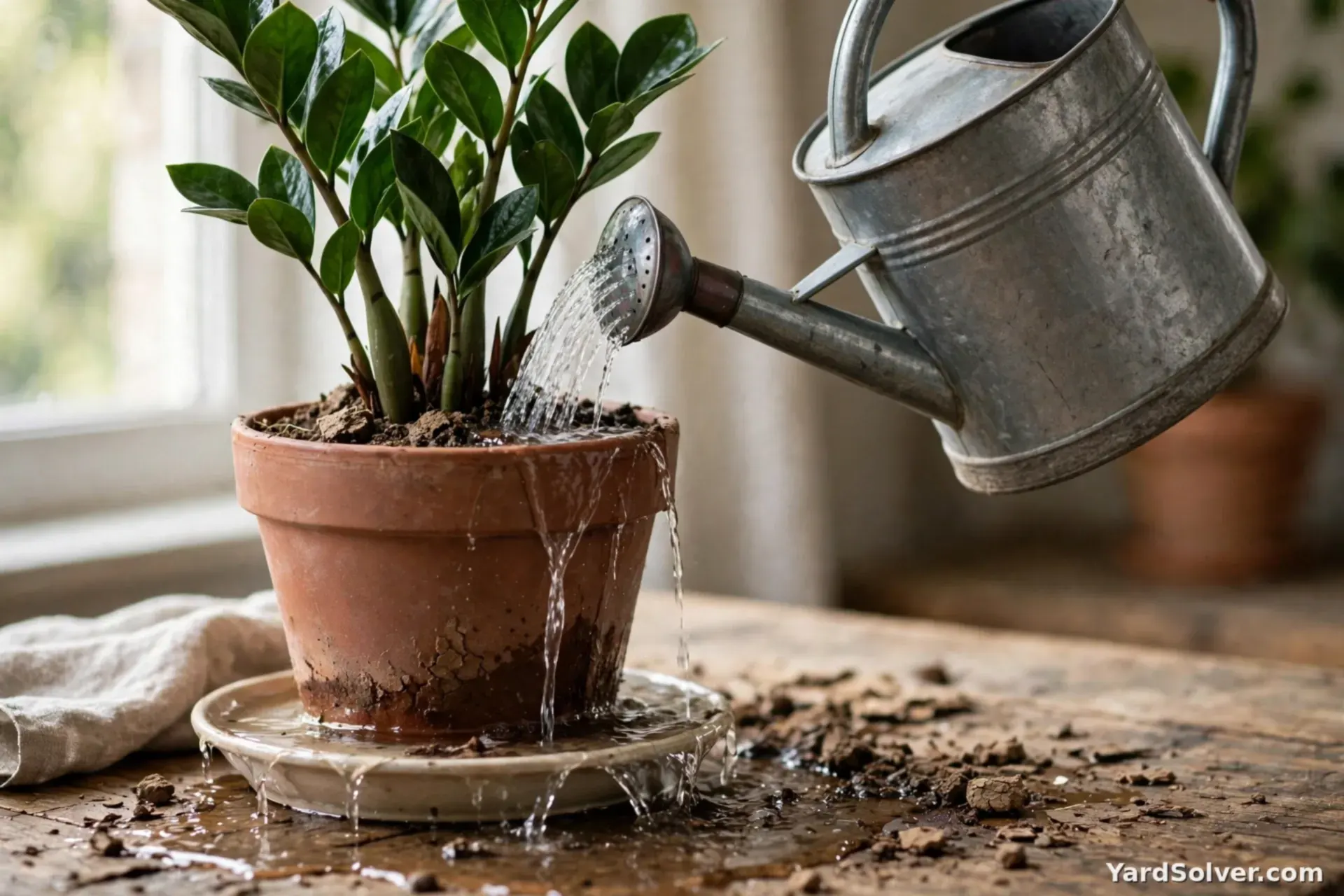
Water: every 3–4 weeks; its rhizomes store water. The routine is soak and dry: check the mix is dry all the way down (a finger or a wooden skewer comes out clean), water thoroughly until it drains, empty the saucer, and then do nothing for weeks. In winter or a dim room, monthly may be too often. More ZZ plants die of a weekly watering habit than of any drought — when in doubt, wait another week. The general rescue protocol for a plant that has been overwatered is in the Overwatered Plant Rescue guide.
Step 4 — Feed lightly, twice a year
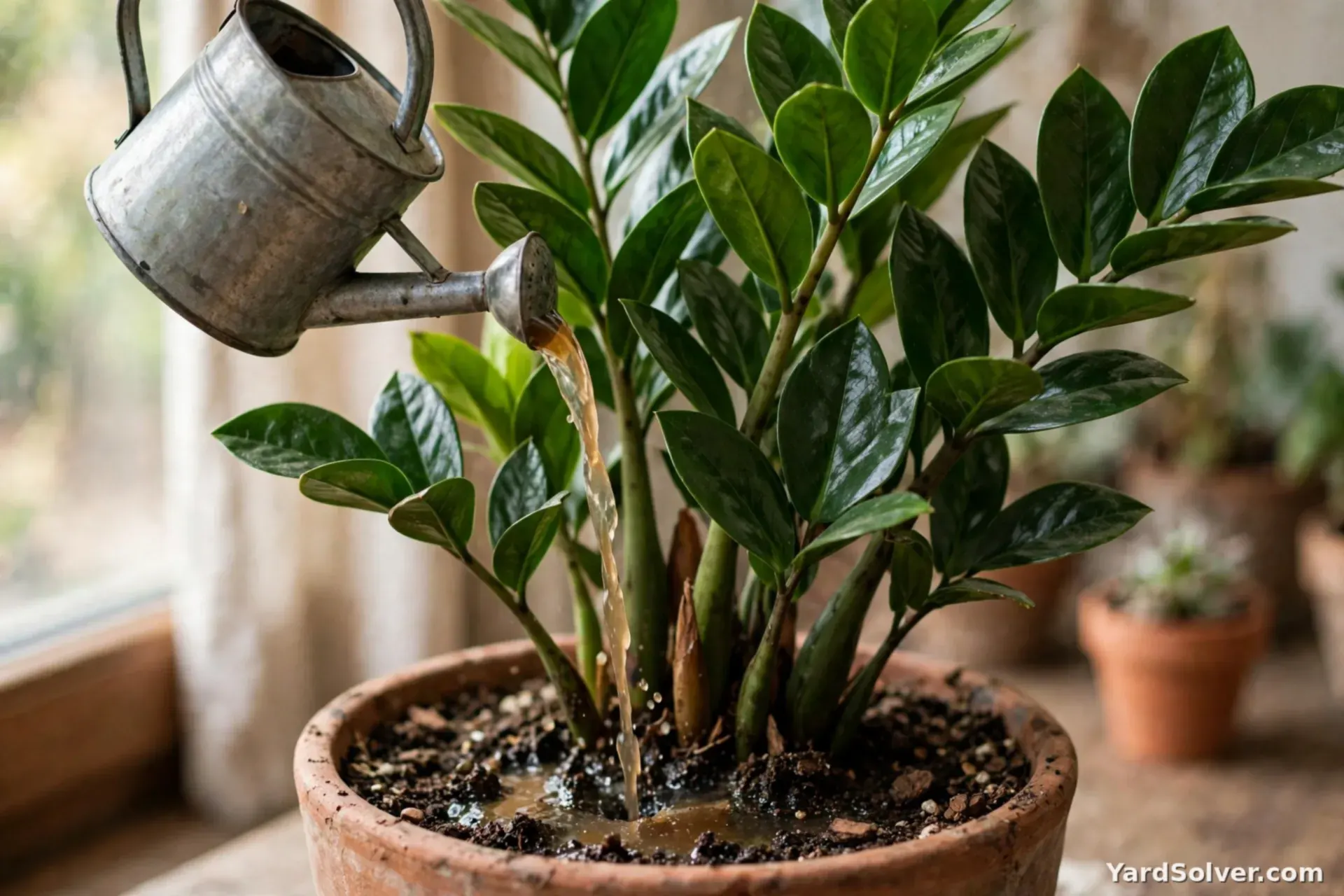
A ZZ plant grows slowly and feeds accordingly: a balanced houseplant feed at half strength, twice a year — once in spring, once in midsummer — is plenty. Guessing heavy is how leaves get fertilizer burn, so measure rather than splash; the Fertilizer Calculator works out amounts by the NPK method. Skip feeding entirely in winter, and never feed a plant whose mix is bone dry — water first, feed at the next watering.
Step 5 — Propagate by leaf or division — slowly
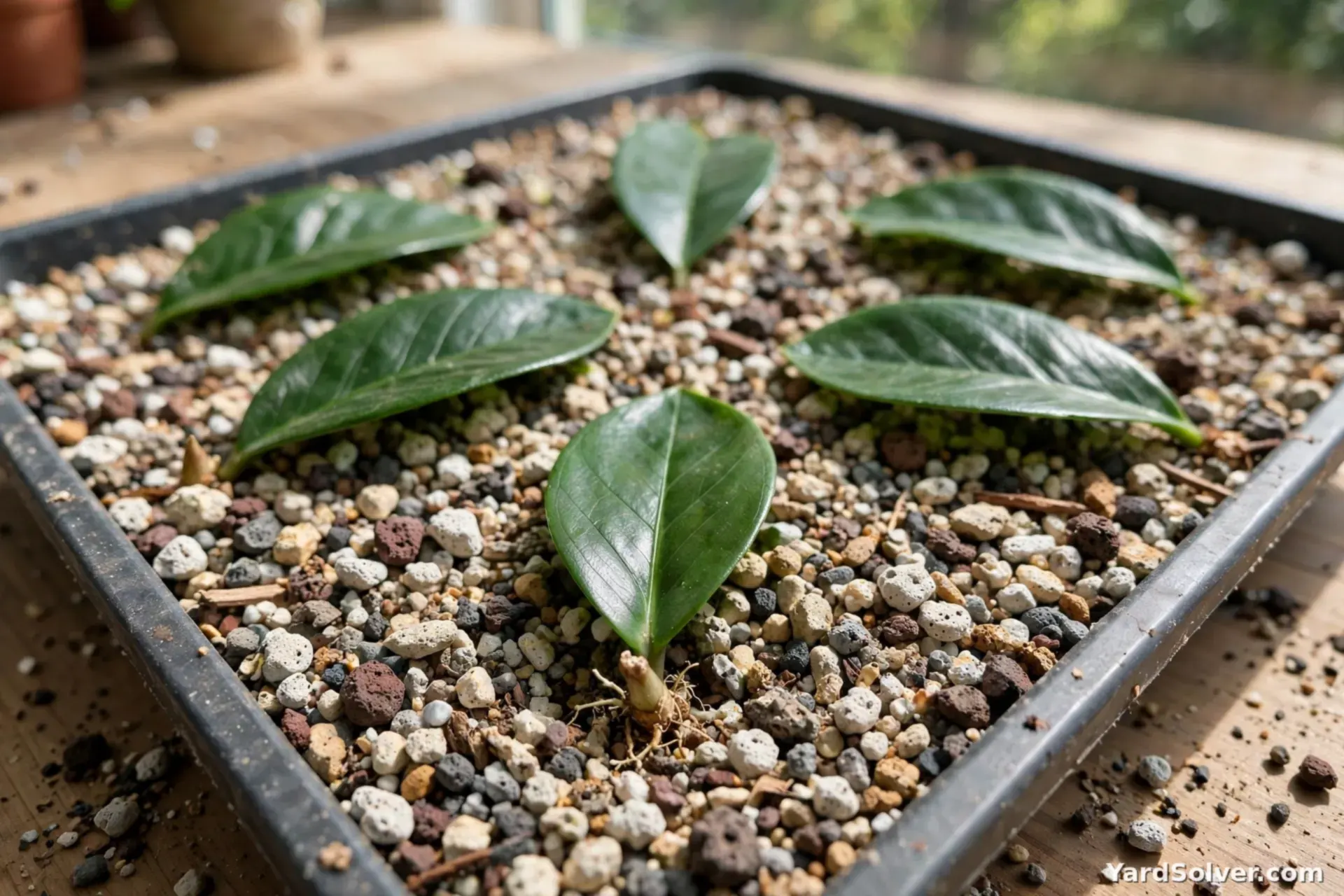
ZZ propagation is sure but gloriously slow. Division is fastest: at repotting, tease the rhizome clump apart into sections with stems attached and pot each up. Leaf cuttings are the patient magic trick — push the base of a leaflet into gritty mix (or stand it in water), and over months it builds a tiny new rhizome and eventually a stem; expect the better part of a year before it looks like a plant. Stem cuttings in water root the same slow way. Slow is normal here — the technique is the same patience pothos teaches faster, in How to Propagate Pothos.
Step 6 — Watch for problems
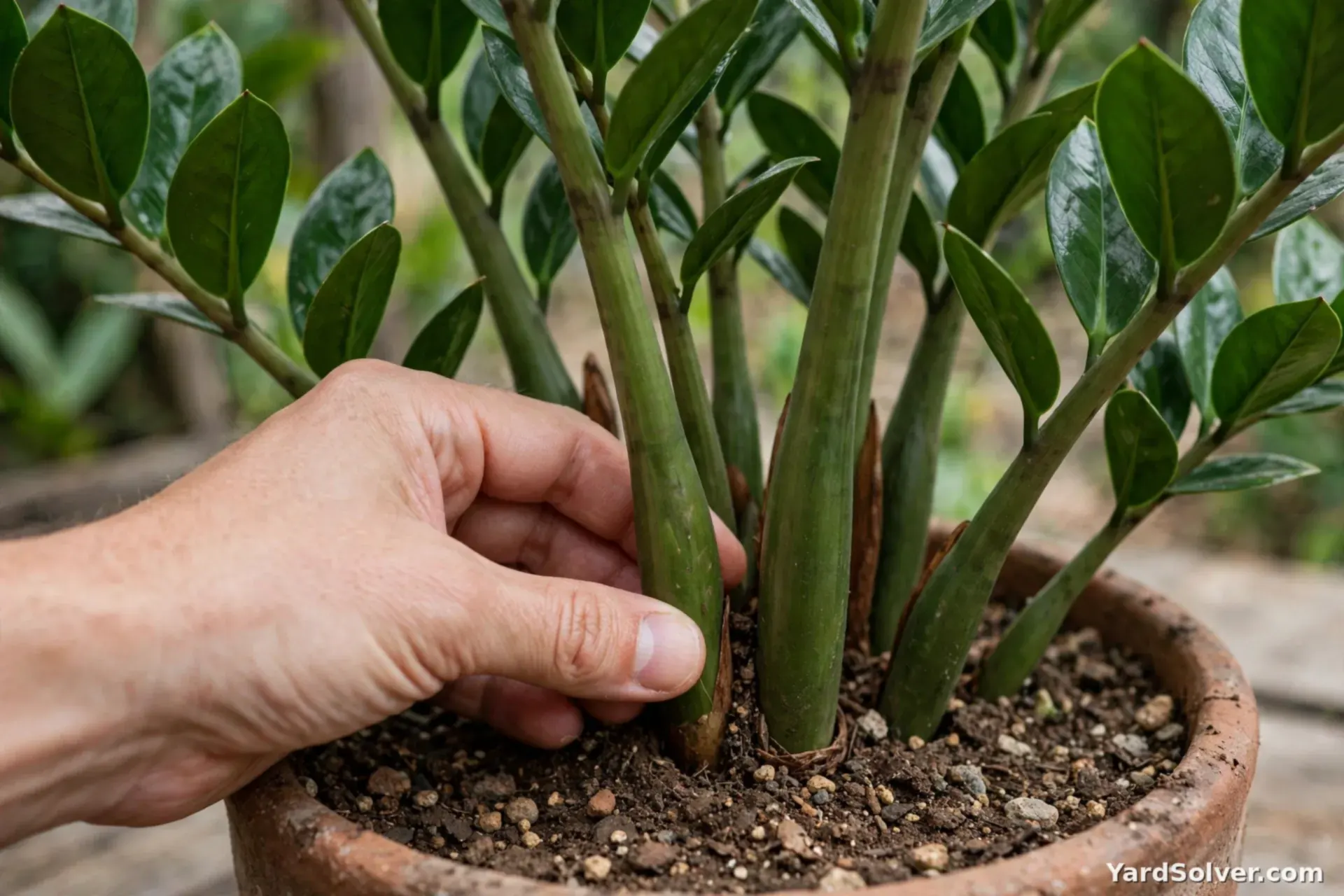
- Soft, yellowing stems — the rhizomes below are too wet; check the mix before anything else.
- Leggy, stretched stems — the plant is reaching for light it can tolerate lacking, but would rather have.
- Slow growth — usually just a ZZ plant being a ZZ plant; the full diagnosis list follows.
Problems, pests & diseases — diagnosis and fixes
- Stems soft and mushy at the base, rhizomes dark and soft, plant collapsing: root and rhizome rot from overwatering — this plant’s one real killer. Fix: unpot, cut rhizomes and roots back to firm pale tissue, let cuts dry a day, repot into fresh dry mix in a pot with drainage, and wait a week before watering lightly; the full protocol is in the Overwatered Plant Rescue guide.
- One stem yellowing while others stay green: usually that stem’s rhizome section stayed wet, or the stem is simply old. Fix: check the mix — if it is wet, let it dry fully and cut the yellow stem out at the base; a single lost stem on a dry-mix plant is housekeeping, not a crisis.
- Long, stretched stems with leaflets spaced far apart, leaning toward the window: light starvation — tolerated, but not enjoyed. Fix: move the plant gradually into brighter indirect light; stretched stems will not shorten, but new growth comes in compact.
- Hard brown bumps along stems and leaflet stalks, sticky residue: scale insects. Fix: scrape bumps off and wipe the spots with rubbing alcohol, repeating weekly until none return.
- White cottony clusters where leaflets meet stems: mealybugs. Fix: alcohol-dab each cluster, wipe clean, and isolate the plant from other houseplants until clear.
- Pale, bleached or scorched patches on leaflets in a sunny window: direct-sun scorch — glass magnifies midday sun beyond what this shade-tolerant plant handles. Fix: move it back from the glass or soften the light with a sheer curtain; scorched leaflets do not green up again, but new growth will be clean.
- No new growth for many months, plant otherwise healthy: normal — a ZZ plant grows in slow flushes, often one or two new stems a year in low light. Fix: none needed; more light and a spring feed encourage a flush, but patience is the actual requirement.
📅 Your personal ZZ Plant schedule
Stay with us — we'll remind you. The procedure is the button above: press "🌱 Start ZZ Plant with me", set your start date and, if you like, add your email. Your plant and its start date are saved on this device straight away, the schedule below is yours to print or download as calendar reminders (.ics), and email reminders switch on with the new YardSolver accounts — the email you save today is first in line, and from your start date the reminders follow your plant's own schedule. Free, no account needed today; your email is for your plant reminders only, with an easy stop in every message.
This plant runs on rhythm and season rather than a day count — here is the honest version of its schedule.
Varieties worth growing
| Variety | Colour | Why gardeners like it |
|---|---|---|
| Raven | Near-black | New leaves emerge lime green and darken over weeks to a dramatic near-black — the collector’s ZZ |
| Zenzi | Deep green | A compact dwarf form with tightly packed, curving leaves, made for desks and shelves |
| Variegated | Green and cream | Rare cream-splashed leaflets — slow, pricey, and wants the brightest light of the group |
| Chameleon | Golden-green | New growth opens golden-yellow and settles to green as it matures |
| Classic green form | Glossy green | The standard ZZ — upright stems of glossy oval leaflets, and the toughest of them all |
Good for you — and take care
Benefits
- Tolerates lower light than almost any other houseplant — the true dark-corner plant
- Stores its own water, so it thrives through holidays and busy months that kill thirstier plants
- Upright, architectural stems that suit modern rooms and small floor spaces
- Very long-lived and slow to outgrow its pot — a plant you repot every few years, not every spring
- Propagates from a single leaflet, given patience
Take care
- All parts are toxic if eaten — the plant contains calcium oxalate crystals; keep it away from chewing pets and children
- Overwatering is its one real killer: a pot with drainage, an emptied saucer, and a dry mix before every watering
- Strong rhizomes can distort or even crack a thin pot as they swell — a sturdy pot saves the surprise
A little history — and one good fact
The ZZ plant comes from the dry grasslands and forest edges of eastern Africa — Kenya down through Tanzania (including Zanzibar, which gave it the name ‘Zanzibar gem’) to South Africa. Botanists described it in 1829, but it stayed an obscure botanical-garden plant for over 150 years, until Dutch nurseries began mass-producing it in the 1990s and offices everywhere discovered a plant that survived their lighting and their watering habits.
Fun fact: A ‘Raven’ ZZ plant’s new stems emerge bright lime green like any other ZZ — the black arrives slowly, leaflet by leaflet, over the following weeks, so the plant is always wearing both colours at once.
Keep going
Guides: Overwatered Plant Rescue · How to Get Rid of Fungus Gnats · How Often to Water a Snake Plant
Calculators: Fertilizer Calculator · All calculators
More houseplants: Rubber Plant · Jade Plant · Monstera
← Back to the Plant Library · Get your personal planting dates
Questions people ask
How often to water a ZZ plant?
Every 3–4 weeks; its rhizomes store water. Water only when the mix is fully dry all the way down, then soak thoroughly and empty the saucer — a ZZ forgives a missed watering easily and forgives a soggy one rarely.
Can a ZZ plant live in low light?
Yes — a ZZ plant tolerates lower light than almost any other houseplant, because its rhizomes store water and food. Growth slows in deep shade and stems stretch, so bright indirect light keeps it fullest, but a dim corner will not kill it.
Is ZZ plant poisonous to pets?
Yes — all parts contain calcium oxalate crystals that irritate the mouth and stomach if eaten. Keep it where cats and dogs cannot chew the stems, or up on a shelf.